
Ford is set to bolster its European vehicle offerings through a new joint venture with Chinese automotive giant Geely Auto.
Announced on Thursday, the partnership will see the companies jointly manufacture low- and zero-emission vehicles at Ford’s factory in Valencia, Spain. This strategic move is designed to reignite Ford’s presence in the competitive European auto market, where the legacy carmaker faces increasing pressure from rapidly expanding Chinese companies that are dominating global sales.
The collaboration unfolds amid challenges in the American electric vehicle market and escalating global geopolitical tensions, partly fueled by US tariff policies that largely exclude Chinese firms from the domestic market. Despite this, American automakers continue to engage in production partnerships with companies in China, and Chinese vehicles are making broader inroads into North America.
Pending regulatory approval, the joint venture will be majority-owned by Ford, holding a two-thirds stake, with Geely — which also owns brands like Volvo and Polestar — retaining the remaining one-third. The companies have outlined plans to focus on five distinct vehicles.
Under the agreement, Ford will continue production of its Kuga plug-in hybrid vehicle and introduce a new Bronco SUV, with production slated to begin in 2028. Geely, meanwhile, plans to manufacture two electric SUVs at the plant, the first of which is also scheduled for 2028. Additionally, the automakers will jointly develop a new “multi-energy” crossover model, expected to arrive in 2028.
A joint statement from the companies emphasized that the venture “addresses the new realities of the European market — intense global competition, relentless cost pressure and tightening regulation — resetting Valencia to build at the industry’s emerging cost benchmark.”
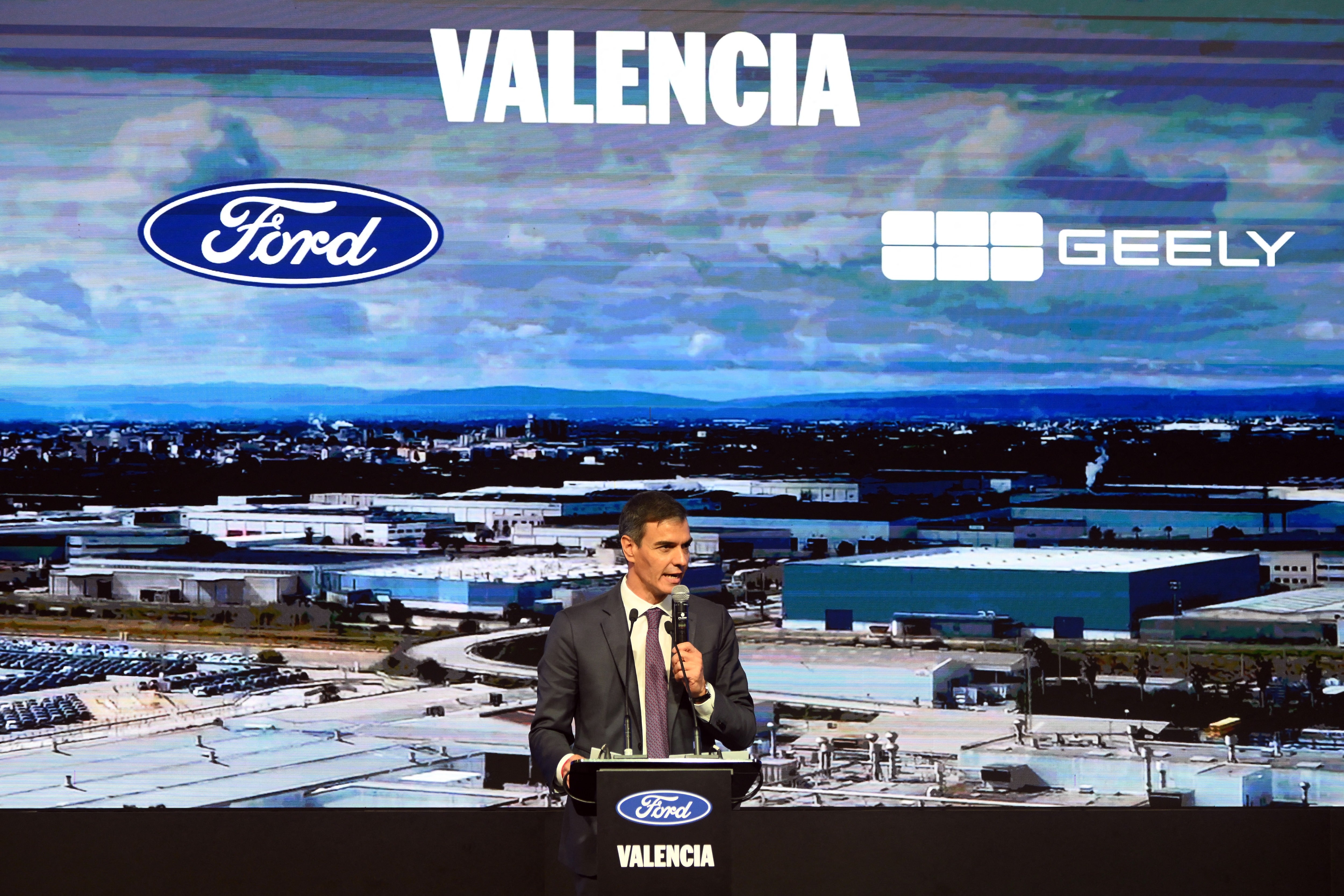
This global collaboration aligns with Ford leadership’s ambition to be competitive outside its domestic market, even as its executives have publicly voiced caution regarding Chinese EVs in the US.
Ford CEO Jim Farley elaborated on this dual strategy during the company’s first-quarter earnings call in April: “We leverage global partnerships and even IP (intellectual property) sharing, including with the Chinese (companies), to grow our business around the world. How I would think about it is Ford continues to be a global company. We want to have the rights to win around the globe. We need IP and partnerships outside the U.S. to do that. And when it comes to the U.S. industry itself, we are extremely protective, as we should be.”
Chinese firms are gaining ground and expanding
Chinese automakers have been gaining momentum in recent years as they produce high-quality and efficient hybrid and pure EVs — coined “new energy vehicles” — with advanced technology at a low price-point. These auto companies have been highly subsidized by the Chinese government with a vested interest in their success.
However, they are also starting to see a slowdown in China due to scaled-back consumer purchase incentives and increasing domestic competition.
So Chinese companies have found early success expanding throughout other nations in Asia, in Latin America and parts of Europe as the global EV transition forges ahead to varying degrees outside of the U.S. The war in Iran has also spurred global interest in Chinese EVs as conflict in the Strait of Hormuz impacts the world’s crude oil and liquefied natural gas supply.
The Ford venture will expand Geely’s European local production footprint — and helps keep Ford workers on the line, experts say.
Ford’s facing a critical moment
Ford has lost ground in Europe for years, from selling more than 1 million vehicles across the continent a decade ago, down to under half a million cars last year. While the Valencia factory has annual capacity of 500,000 vehicles, production fell below 100,000 in 2025.
The partnership is sure to reduce pressure on the American auto giant as the two share costs. Ford and Geely already share history; Ford sold Volvo Cars to the Chinese firm in 2010.
“This deal offers a road map for how traditional automakers can survive and thrive in Europe,” said Jessica Caldwell, head of insights at auto research firm Edmunds. “Ford gets the scale and cost efficiencies it needs for its Valencia plant, while Geely gets a direct shortcut around (European Union) tariffs. More broadly, it underscores a major industry shift we’re likely to continue seeing: automakers can no longer go it alone and must collaborate with rivals — Chinese or otherwise — to survive the capital-intensive transition to electrification.”
U.S. automakers, generally, have spent billions of dollars on electrification over the past several years. But the Trump administration has dramatically shifted away from clean vehicle policy, weakening fuel economy rules and auto tailpipe emissions rules.
The administration also eliminated former President Joe Biden’s target for half of all new vehicle sales in the U.S. to be electric by 2030, and signed off on Congress’ tax and spending bill that ended federal new and used EV purchase tax credits.
U.S. automakers likely see potential in the European EV market amid uncertain EV sales in the U.S., but may also have to explore more partnerships in order to remain competitive there.
“Like GM before it, Ford has been slowly reducing its reliance on Europe,” said Sam Fiorani, vice president at AutoForecast Solutions. “Now, with the help of Geely, Ford can have new products designed for the European market without bearing the full development costs of a new platform.
“While Chinese automakers like Geely continue their growth around the world, Ford should take this opportunity to learn how to cut costs and develop lower-priced vehicles,” Fiorani added. “If Ford cannot compete on price in Europe, the automaker may need to look at selling plants outright rather than sharing them. Losing Europe could hurt Ford’s standing as a global automaker, but continuing to have the region drain its finances could be more devastating.”

