
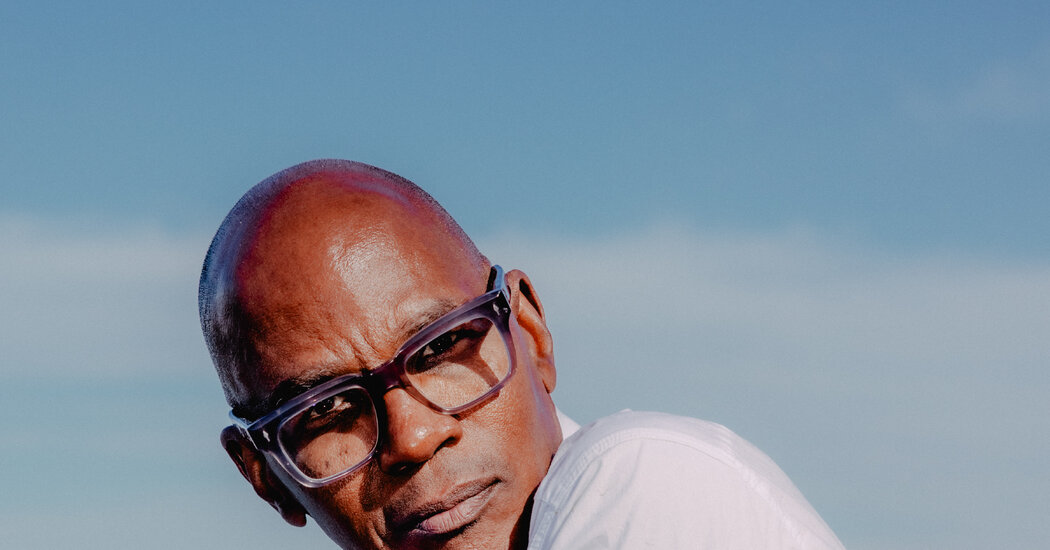
Inside the tower of the Obama Presidential Center on Chicago’s South Side, the artist Mark Bradford paused beneath broad, three-story-tall windows, rummaging through a capacious cardboard box. “I grew up in a beauty salon,” Bradford said as he pulled out tangles of rope, caulk and torn strips of billboard. “I like to travel with my stuff.”
Piercing light illuminates Bradford’s titanic new painting, “City of the Big Shoulders,” a 38-foot-tall patchwork of colors, commissioned for the Obama Foundation, conceived and scaled for the museum’s atrium — a surprisingly airy, cheerful space given the staunch, monumental mien of the tower’s exterior.
An object in the box caught Bradford’s eye: a translucent piece of orange paper marbled with shades of tangerine and marmalade. Bradford, who is warm and playful in person, held the rectangle up to the window light.
With a few swift, balletic gestures, all 6-feet-8 inches of him climbed onto a nearby scissor lift. He pasted the paper directly onto the giant canvas. His long, salon-trained fingers smoothed its edges. What was once a muted banana-yellow section of the mural was now a flare of light.
Bradford descended to ground level, stepped back and studied his work. “It’s like it was always meant to be there,” he said, delighted. “I always leave room for chaos.”
Bradford, who at 64 is one of the country’s most celebrated contemporary painters, brings some controlled chaos to every canvas. Tension between disorder and structure animates “City of the Big Shoulders.” The brief for the 2019 commission came with few parameters. The piece would need to suit the tower that anchors the 19-acre site.
The Museums Special Section
The center, on the edge of a sprawling park designed by Frederick Law Olmsted, neighbors a lagoon and is a short walk from Lake Michigan. Bradford knew instinctively that his piece would be a map of Chicago. “I wanted a border. A landmass and a water mass,” he said. “I liked the idea of the tension between the two, so I didn’t want to just have a screenshot of a neighborhood.”
Though Bradford is most often described as a painter, he doesn’t just stick to paint. He pulls in materials that he finds emblematic of everyday life. His canvases often bloom with hairdressers’ end papers, for example, the thin sheets used to wrap treated hair in beauty salons. He has also used local merchant posters advertising home loans and tax services, and incorporated pieces of city billboards.
“I make my own detritus,” Bradford said, “and then I use the detritus to make a painting.” The debris makes his canvases impressionistic and sculptural, and resistant to linear, literal storytelling.
“Mark traverses an urban landscape and finds ways in which the textures of that landscape create incredible aesthetic visions,” said Naomi Beckwith, the deputy director and chief curator of the Guggenheim Museum, and a Chicago native who has worked with Bradford on several occasions. He takes the ephemera of Black life, Beckwith added, and turns it into “big, muscular, semiabstract paintings that have been a hallmark of American culture.” They echo the symbols of American life found in the work of postwar artists like Robert Rauschenberg and Jasper Johns, as well as the large-scale abstractions of the painters Howardena Pindell and Jack Whitten.
Bradford also uses the materials to populate his own interpretive maps. In “Finding Barry,” a 2015 map painting addressing the AIDS crisis, for the lobby wall of the Hammer Museum in Los Angeles, he worked on dense, abraded canvases, superimposing infection rates over a map of the United States. In “Scorched Earth,” his 2006 painting reflecting on the destruction of the thriving Black community leveled in the 1921 Tulsa race massacre, Bradford layered city plans with torn paper and blood-red pigment. The works evoke how violence and memory settle into, and haunt, the ground.
Inspired by a Sandburg Poem
“City of the Big Shoulders” takes its title from a line in the 1914 Carl Sandburg poem “Chicago” — “Hog Butcher for the World/ Tool Maker, Stacker of Wheat” — a gritty and locally beloved anthem to the city. Constructed on 13 canvases — some weighing as much as 300 pounds — “City of the Big Shoulders” is both charred and radiant. The painting unfolds as a packed, patchwork cityscape in muted blacks and browns, punctuated by ocher, brick red and flamingo pink. Lake Michigan, a swirl of lapis, sky and sapphire blue takes up nearly a third of the piece. Bradford said his palette was inspired by the Works Progress Administration’s public art projects of the 1930s.
The colossal painting fills the view upon entering the museum. Bradford is one of 30 contemporary artists commissioned to create site-specific works that will be unveiled when the complex opens officially on June 19. The center will also include works by Kiki Smith, Jenny Holzer and Chicago’s Theaster Gates and Nick Cave. Julie Mehretu’s immense abstracted glass window installation, embedded in the building’s north side, has been visible for months.
The center, which cost $850 million, has not been without controversy. It spurred years of debate over building on public parkland. A group of neighbors protested that the center would lead to gentrification and displacement of longtime residents. Development percolating near the center suggests they may be right. Critics have also pointed to the removal of hundreds of mature trees and the impact on the many bird species that inhabit and migrate through the nearby wetlands. The grounds will include 950 new tree plantings.
The art program complements Chicago’s long tradition of ambitious public art, including by Alexander Calder, Marc Chagall and Pablo Picasso. All but two of the Obama commissions will be visible to passers-by in non-ticketed areas of the campus.
“President Obama and former first lady Michelle Obama believe that art really is a way to weave us all together and tell a significant part of the American story,” Valerie Jarrett, the chief executive of the Obama Foundation said in a video interview. “The art is not an afterthought. It is an essential ingredient in what makes the campus so special.”
Mapping Migration and Structural Racism
For “City of the Big Shoulders,” Bradford drew from Chicago’s history as a central railway hub. He was particularly interested in the Illinois Central Railroad, which carried millions of Black Americans north during the Great Migration and reshaped the city culturally and politically in the 20th century.
The artist has long been drawn to trains as a liminal space where “you are not at home and you’re not at your destination,” he said. In his 20s, he rode trains across Europe after fleeing Los Angeles at the height of the AIDS epidemic, watching unfamiliar landscapes pass by. Those journeys allowed Bradford to imagine expansively and freely at a time when that felt increasingly out of reach as a queer Black man in the United States.
On his canvas, those rail lines appear as strands of yellow veins across the surface. They cut through thick accumulations of material — sealant, twine and shredded paper — that Bradford piles, tears and reworks. In places they weave around fragments of old train timetables, with city names and travel distances etched into the surface.
Bradford also wanted to underscore how maps have been used as instruments of control. That includes the redlining maps created in the 1930s by the Home Owners’ Loan Corporation, a government policy that graded neighborhoods for mortgage lending. Black communities were shaded in red and labeled “hazardous.” The resulting painting outlines the contours of a Chicago where neighborhoods remain sharply divided by race and wealth, and where disparities in housing, health and economic opportunity still fall along lines drawn nearly a century ago.
“Maps. Land. Power,” Bradford said. “It’s all there.”
“City of the Big Shoulders” took Bradford five years to imagine and complete. The meticulous artist estimates he ripped apart at least a dozen earlier versions along the way. Remnants of those attempts remain in the work, a palimpsest of earlier drafts. “I wanted the labor to be visible,” Bradford said, “because cities are messy.”
Jarrett said the messiness is part of the magic. “Mark’s piece has this very visible sense of things being complicated,” she said. “But that’s what makes it real and authentic. It isn’t a sugarcoated description.” The painting, she said, shows “the strength of our city.”
Finding light within the dark is an endeavor Bradford tries to convey in all his work. “We are always looking for place, trying to find our place,” he said. “I want people to lay their stories on top of the map.” In that sense, he added, “it can be what you want it to be. The painting becomes yours.”

