
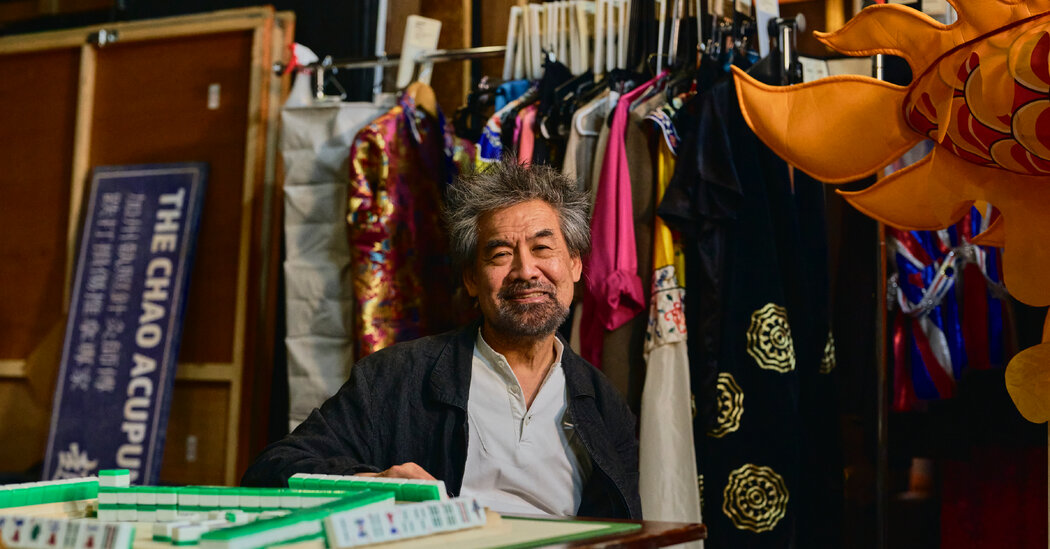
When East West Players in Los Angeles reached out to David Henry Hwang two years ago about staging one of his works for the theater troupe’s 60th anniversary season, Hwang had a lot of material to choose from.
Maybe “M. Butterfly,” the 1988 Tony-winning work inspired by the true story of a love affair between a French diplomat and a Chinese opera singer, with a nod to Puccini’s opera? Or “Yellow Face,” the Pulitzer-nominated play that skewered “Miss Saigon,” Hollywood racism and even the playwright himself?
Your pick, the theater company told him.
Hwang ultimately chose “Flower Drum Song,” the 1958 Rodgers and Hammerstein musical — or rather, the wholly reworked version he created more than two decades ago.
The original tells the story of Chinese American elders and youngsters in 1950s-era San Francisco Chinatown, quarreling about family obligations and falling in and out of love. The Rodgers and Hammerstein estate had let Hwang rewrite the book for his 2001 show, in part to remedy elements of the musical that had not aged well, like the otherwise peppy song “Chop Suey,” with its nods to Bobby Darin and Hula Hoops.
“The lyric is, ‘living here is very much like chop suey,’ and as an example of what we call either the melting pot or the salad bowl or the great mosaic, it’s not a bad metaphor,” Hwang said in a video interview from his home in New York. “But it was hard to figure out how to make that speak to an audience, even 20 years ago.”
Twenty-five years after his revival premiered at the Mark Taper Forum in Los Angeles, “Flower Drum Song” returned this month to the city for a seven-week run. Critics in Los Angeles hailed that earlier production, but the Broadway transfer a year later closed before recouping its investment, despite being nominated for three Tony Awards.
This most recent outing allowed Hwang, 68, to address some flaws in the original and even in his own remake: like, why would Mei-Li, the show’s heroine newly arrived from China, fall for a wishy-washy guy like Wang Ta, the son of a Chinese opera company manager? He also added a scene that drives home the fact that coming to America as a poor immigrant isn’t all flower drums and show tunes.
Hwang’s revival is the first time that the all-Asian musical has been staged at East West Players, the nation’s oldest and largest Asian American theater company. But the play didn’t open in East West’s main stage, which is named after Hwang. The production, with its splashy nightclub numbers and grand wedding scene, is simply too big for the 220-seat theater. Instead, the show is being performed two blocks away, at the Japanese American Cultural & Community Center’s 880-seat Aratani Theater.
“I’ve had other works done at the David Henry Hwang Theater, so I don’t have any problem with that,” Hwang said with a laugh. “And it’s nice that they want to do it in a bigger space.”
The playwright has always loved the musical, with its images of Chinese American teenagers dancing to rock tunes; its shout-outs to San Francisco’s Chinatown (“Grant Avenue”); and Nancy Kwan, who played the showgirl Linda Low in the 1961 film, extolling the joys of having a nice figure and lots of suitors (“I Enjoy Being a Girl”).
But the play’s story of young Chinese Americans butting heads with their tradition-bound elders needed a refresh, Hwang decided (see: “Chop Suey” and “I Enjoy Being a Girl”). He complicated a story of generational conflict by adding scenes about the Cultural Revolution in China and the migration of refugees to America, while strengthening the relationship between the would-be rivals Mei-Li and Linda Low.
“I have a lot of respect for what Rodgers and Hammerstein set out to do,” he said. “But at the same time, there was stuff that felt creaky and stereotypical. They were trying to understand the community, but they weren’t from the community.”
“I always use the example of the song ‘Grant Avenue,’ and the lyric, you travel there in a trolley, in a trolley up you climb,” he continued. “So who’s the ‘you’ there? The ‘you’ is someone who’s visiting Chinatown, not someone who lives there.”
A few years ago, however, Hwang had his own reckoning. “When I looked back at my own script,” he said, “there were things of mine that looked creaky too.”
Hwang went to work, cutting some jokes from that 2001 production. “I don’t even want to repeat them now,” he said when asked to name some.
There are other changes, too. A character named Harvard, whom Hwang created for his version, was “probably a gay character, although we were never specific about it,” he said. Harvard is definitely gay now. “Part of that is acknowledging the degree to which San Francisco’s Chinatown played an important role in the development of what we now call L.G.B.T.Q.+ culture,” he said.
The revival’s focus on intraracial discrimination between American-born Chinese and recent Chinese immigrants has also been heightened, said Lily Tung Crystal, the artistic director of East West Players and the show’s director.
“A lot of Asian American works have focused on white community racism on Asian American communities,” she said. “One reason I love this show is that David also discusses how we discriminate against each other in our own communities.”
Costumes have also been updated, with fewer Chinese robes and more cardigans and high-waisted trousers. “In the 2002 Broadway production, some of the costumes leaned into stereotypes or tropes of how Asians might dress or look,” she said. “Our show really leans into what people were wearing in 1965 in San Francisco.”
On a recent evening, Tung Crystal was running a rehearsal of the musical in a dance studio in the arts district of downtown Los Angeles. In one scene, Madame Liang, a no-nonsense talent agent played by Emily Kuroda (“Gilmore Girls”), is instructing Linda Low, played by Krista Marie Yu (“Reboot”), on the finer points of media interviews. Tamp down the talk of Hollywood. Play up a good-girl image.
The role is particularly meaningful to Yu, who first appeared in a production of “Flower Drum Song” in Oakland when she was 15. Her great-aunt was Dorothy Toy, half of the pioneering tap dance duo Toy & Wing, who performed in the “Chop Suey Circuit” immortalized in the play.
Even so, Yu appreciated Hwang’s revisions. In an updated monologue that precedes “I Enjoy Being a Girl,” she said, “Linda expresses how she came from a place where she was bullied, where she was not accepted, and this song empowers her to not be ashamed of who she is and what she likes to do.”
For Hwang, the play’s pro-immigrant message, baked into the play since the 1958 original, is even more relevant now.
“In 2001, there was still a broad consensus in this country that America is a nation of immigrants, and immigration is a good thing, whereas now immigrants have been brutally targeted by the highest levels of government,” he said. “So I’m very proud to be doing a show which asserts the importance of immigration to this country and portrays immigrants in a very human and three-dimensional and joyful way.”
The show will close East West’s 60th season, and Hwang has been there for much of its run. His first experience came when he was 10, when his mother was a pianist for one of the troupe’s early productions; since then, the company has hosted or collaborated on eight of his shows, including ‘Yellow Face” and “M. Butterfly.”
“I feel like I’m coming back to my theatrical roots,” he said.

