
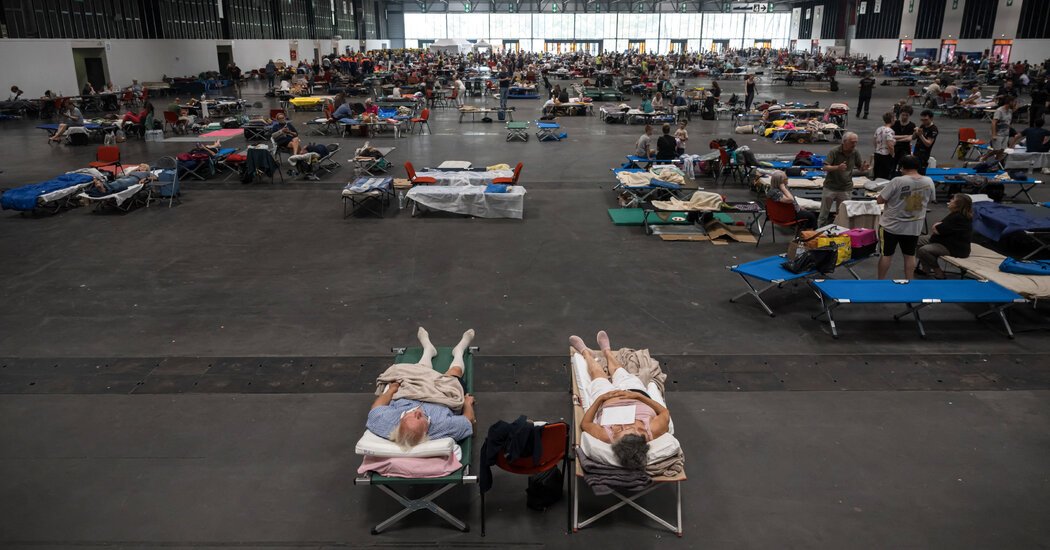
As a fierce, fast-moving, and capricious wildfire spread to within 10 miles of Bordeaux on Sunday, the city, France’s sixth largest, had become a refuge for thousands of people evacuated from their towns and villages.
Many of them took shelter in Bordeaux’s cavernous exhibition center, united by fear, confusion, and a determination to get back their homes, which they desperately hoped would be spared by the flames.
There are differing voices in this instant community, attesting to the divergent lives of the people across the Gironde region. Fear is leavened by hope, gratitude to the firefighters is tinged by anger toward the authorities, and optimism in a swift recovery is offset by uneasiness about the natural forces that led to this disaster.
“I don’t want to start again at zero to find a new apartment,” said Imane El Idrissi, 35, a single mother who fled at 4 a.m. on Saturday, after the police pounded on her door to warn her it was time to leave. “I don’t have the means.”
Ms. El Idrissi, who was born in Morocco, said she had carefully gathered all her immigration and residency documents, filling her suitcase with papers in place of clothing. Her two daughters were born in France, she said, but she couldn’t shake the fear that if she left the country, she might not be allowed back in.
Her friend, Atika Farhati, 77, a retired hospital worker, said she worried about losing her apartment and treasured possessions, including a Chinese vase. Her town, Eysines, northwest of Bordeaux, lies in the path of the fires, which were blown east by swirling winds from the Atlantic toward the city.
“The sky was red,” she said, recalling the flame-scarred view from her fifth-floor balcony. “Now that we’re here, we can only wonder how it’s going to end.”
For Roger Peuron, that outcome is not seriously in doubt. A retired engineer who worked at an armaments factory in Saint-Médard-en-Jalles, Mr. Peuron, 89, said he was confident the fire would be stopped short of his town, if only to prevent it from igniting a factory that makes fuel for strategic ballistic missiles.
“If that ever happened to the industry,” he said, “it would be a true catastrophe.”
Still, Mr. Peuron said France had never witnessed a fire like this, and it raised profound questions about how people should change their relationship to their environment. Sprawling pine forests that were planted across the region over centuries are now an accelerant for fire.
“We need to replace the trees because the sap in the pines is flammable, and the trees don’t have deep roots, so they are easily blown over by the wind,” Mr. Peuron said. “The pines were planted to drain the region’s swamps, but they’re no longer suited to the environment.”
“We need sequoias,” he added. “They’re sturdy!”
French officials backed up Mr. Peuron’s contention about the extraordinary nature of the fire, reflecting a warming climate. About 42,000 hectares, or 103,000 acres, have burned in Gironde since the fire started last week. It has forced the evacuation of about 220,000 people, one of the largest peacetime evacuations in French history.
At the same time, fires in central Spain have burned about 50,000 hectares and displaced 105,000 people.
So far this summer, forest fires have burned 115,000 hectares in France, according to the French interior minister, Laurent Nuñez. By comparison, the average yearly loss from 2014 to 2023 was 9,000 hectares. In the summer of 2022, which was considered devastating and led France to bolster its firefighting resources, about 70,000 hectares burned.
On Sunday, a heavy yellow-orange cloud of smoke hung over Bordeaux, an elegant city of 260,000 that is famous as the center of France’s wine industry. An acrid smell pervaded its streets, and tiny particles of soot flecked the air. Pedestrians wore face masks, and many shut themselves in their homes.
As the fire crept toward the city limits, Bordeaux’s mayor, Thomas Cazenave, said on Sunday that the authorities did not expect they would have to order an evacuation. But he and other officials warned that uncertainty was the watchword, as shifting winds and heat made it difficult for firefighters to gain control of the blaze.
The forecast for Bordeaux calls for high temperatures of 37 degrees Celsius on Tuesday and 41 on Wednesday — about 99 and 106 degrees Fahrenheit.
At the exhibition center, the talk was of how long people would have to wait before they would be allowed back home. People passed the time reading, playing cards, and, in the case of one young man, Julien Hochard, picking at his guitar.
“There’s a solidarity that we’ve seen emerge here, one that’s slowly growing,” said Mr. Hochard, sitting on a camp bed next to his friend, Céline Lartigue. She said she had been impressed by firefighters’ efforts to stem the blaze.
But from a nearby bed, Rabah Boukabous piped up to disagree.
“I think the authorities reacted late,” he said. “They should have recognized the gravity of the situation.”
“They could not have prevented it,” said Mr. Boukabous, 70, “but they could have limited it.”
Catherine Porter contributed reporting from Paris

