
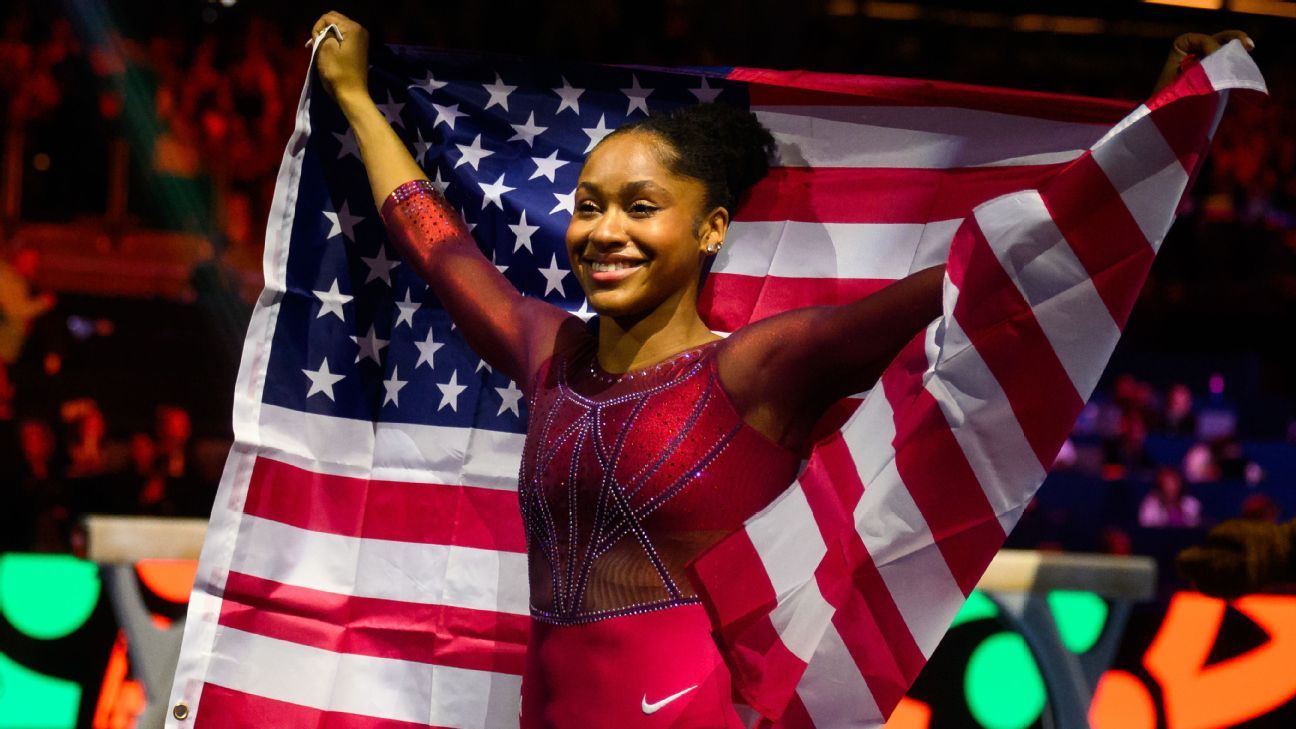
With less than two years until the 2028 Olympic Games in Los Angeles, there remain many questions about what to expect in artistic gymnastics — and who will ultimately walk away with the medals.
Many gymnasts were noticeably absent at the 2026 world gymnastics championships held in Rotterdam, Netherlands, this past week, including defending world all-around champion Angelina Melnikova, who was controversially denied a visa to enter the country, Simone Biles, who has yet to announce if she will come back to competition, and American Olympians Suni Lee, Jordan Chiles and Jade Carey, who have all started their returns to elite gymnastics.
But here’s everything we did learn after the nine-day competition, and what it means for the remainder of the Olympic quad.
The American women’s dominant streak ends
Entering the world championships, the United States had won every team gold at the competition since 2011 — and often by large margins. With the notable exception of the 2020 Olympic Games, in which the team took silver, the American women had won every major team title in that span.
But all reigns must come to an end and that’s exactly what happened in Rotterdam as the team finished in second place behind China. While the headline certainly and deservedly will be about the end of the streak, it’s worth noting there was just a razor-thin 0.233 deficit between the U.S. and China in the final results.
With a largely inexperienced team taking the floor — and with Hezly Rivera, the lone 2024 Olympic team member on the squad, having to withdraw ahead of qualifying due to a left ankle injury — a gold medal was hardly a guarantee. But the Americans actually earned the highest scores on three of the four events and the final podium standing truly came down to just a few pivotal moments late in the competition — a fall by Dulcy Caylor, Rivera’s replacement, during her dismount on beam, a disputed difficulty score by Skye Blakely on the same apparatus and some uncharacteristic errors by Reese Esponda on floor after being forced to alter a tumbling pass at the last minute. Meanwhile, China was nearly flawless on beam — gaining more than a four-point advantage over the U.S. on that event.
So it wasn’t exactly a rout by China, nor a complete collapse by the Americans, but it was a reminder that the gap among the world’s best is closing and there isn’t room for error when the stakes are highest. And, considering Russia was without two of its most experienced gymnasts from its 2020 Olympic gold-medal-winning team — Melnikova and Viktoria Listunova — it’s tough to say how that team might have fared. (The Russians finished in sixth place.)
Chellsie Memmel, the technical lead for the women’s team, told reporters after Wednesday’s team final that beam would be a point of emphasis for the team in the immediate future, as would improving execution scores. And she said the disappointing result — by the team’s standards, anyway — would only help them in the long run.
“It gives us a lot of motivation,” Memmel said. “We know where we want to be. We know there’s still work to do, but you know, it’s the middle of the quad, we have the time and I think it’s going to light a fire.”
And the rest of the competition proved the American women still were very much among the best of the best.
The official arrival of Skye Blakely and Claire Pease
Two days after competing in the team final, Blakely and Claire Pease placed first and seventh, respectively, in the all-around final — and it was just the start of a phenomenal showing by the American women in the individual events.
It was a near fairy tale result for the 21-year-old Blakely. A strong contender for the 2021 Olympic team, Blakely suffered a fluke elbow injury at Olympic trials. She was then a part of the world-championship-winning teams in 2022 and 2023, but ruptured her Achilles tendon at the Olympic trials in 2024, ending her hopes once again of making an Olympic team. She returned to competition last year, at both the elite and NCAA level, but didn’t compete in all four events until national championships over the summer.
On Friday, Blakely recorded the performance of her life. She took over the lead at the halfway point, following two stellar routines on vault and uneven bars, and all but sealed her fate with a strong beam outing. By the time she finished her floor routine, it was all but certain — Blakely would become the ninth American woman in history to win the coveted world all-around title.
Tears streamed down her face almost immediately after she finished on floor and only continued as she hugged her coach and later received her gold medal. “Throughout the meet, I was telling myself, ‘Do it for the girl in 2021 and the girl in 2024 who couldn’t do everything, just fight for her,'” Blakely told reporters after the meet. “That’s what I kept telling myself: ‘I am capable, I am ready’ and I made every version of myself extremely proud.”
Skye Blakely standing at the top of the world. And that’s something to be proud of. ❤️ #WorldGymnastics #Gymnastics #Rotterdam2026 https://t.co/rDHWX2tiPF
— World Gymnastics (@gymnastics) October 24, 2026
Russia’s Liudmila Roshchina earned the silver and China’s Ke Qinqin claimed the bronze. Pease, 17, finished in seventh place after a fall on beam. But neither Blakely, nor Pease, were done making an impression in Rotterdam.
By the end of the event finals, Blakely — who hit all 14 of her routines throughout worlds — had collected bronze medals on vault and the uneven bars as well. Pease took the silver medal on vault and closed out the competition — as the final competitor — by becoming the world champion on floor. Despite going out of bounds on one of her passes, Pease and her powerful tumbling still managed to score .300 points better than teammate Esponda, arguably the event favorite who won silver.
The Claire Pease show! 🤩 Welcome your Floor Exercise World Champion! 🇺🇸 #WorldGymnastics #Gymnastics #Rotterdam2026 https://t.co/wS9UqCR8NA
— World Gymnastics (@gymnastics) October 25, 2026
While there is still a long way to go before the team selection process for Los Angeles, Blakely and Pease made incredibly compelling cases for their inclusion and are currently sitting atop the contender list with some 20 months to go. And, the seven overall medals won by the American women were the most by any country — women or men — and more than double that of second-place China, which had three on the women’s side. It also helped quell much of the doubt around the United States’ vulnerability after the team final and proved it is still the world power in women’s gymnastics. For now, anyway.
Struggles — and a bright spot — for the American men
The American men’s team had arrived in Rotterdam brimming with confidence and expectations after winning the Olympic bronze medal in Paris two years ago. They were open about their collective desire to do even better and seemed to believe they could compete with the traditional powerhouses.
But in actuality, they finished more than four points off of the podium in sixth place — their worst result at the event in 20 years.
Japan, the Olympic gold medalists, were atop the podium yet again, and Russia and China claimed silver and bronze, respectively. More than six points separated Japan and the United States.
It was an error-riddled day for the Americans, from start to finish. There were falls and consequential errors on multiple events, during both days, and they simply had no way to overcome such deductions against such talented teams. With so much hype around a home Olympics in 2028, it was a stark reminder of how much work they will have to do to get back on the podium.
Like their counterparts on the women’s team, a number of stars — including 2024 Olympians Brody Malone and Asher Hong — have yet to return but are expected to in the next year. Their inclusion could certainly help the team’s chances in future global competitions but will it be enough? That remains uncertain.
Fred Richard, the 2023 all-around bronze medalist, and Danila Leykin, in his worlds debut, looked to redeem themselves in the all-around final on Thursday but were unable to find the podium. Richard was as high as sixth place through four of the six events, but fell to ninth place, and Leykin finished in 12th place. Japan’s Daiki Hashimoto won his fourth consecutive world all-around title in staggering fashion — with nearly two points between him and the rest of the field.
However, Richard did his part to ensure the U.S. men didn’t leave Rotterdam empty-handed. The 22-year-old won the first world title of his career with a dominant performance on floor to become the first American man to win the event since 2003 — eight months before he was born.
Frederick Richard puts up a HUGE 14.633 in the Men’s Floor Final! 📹⤵️ https://t.co/xLAPdIlQCu
— USA Gymnastics (@USAGym) October 24, 2026
Richard, who has become known for his high-flying tumbling, in addition to his bravado and social media prowess in recent years, was thrilled to have seen a longtime dream come to fruition.
“I hope this is a lesson to everybody that you don’t have to wait to get the win to say you will be a champion,” Richard said. “You don’t have to know when it’s going to happen or how it’s going to happen but believing it every second of every day does pay off. I’m proof of that now.”
Richard — who publicly predicted he would earn a gold medal at worlds earlier this year after winning his third NCAA all-around title — will now see his profile rise even further, and is a favorite to make his second Olympic team in 2028.
Global stars shine
While Blakely, Pease and Richard all became first-time individual world champions this week, others continued their reigns. Rebeca Andrade, the most decorated Brazilian gymnast of all time, won the 10th world medal of her storied career and her fourth world title with a gold medal performance on vault. Andrade did only vault and beam in Rotterdam — and showed she remains the woman to beat on vault, especially in Biles’ absence.
Gold for Brazil! Rebeca Andrade put together a vault for the highlight reel. 🇧🇷 📺 World Gymnastics Championships on Peacock & NBCSN https://t.co/fATIKoAkT8
— NBC Olympics & Paralympics (@NBCOlympics) October 24, 2026
After a disappointing all-around performance, in which she finished fourth after a substantial error on vault, Kaliya Nemour, the reigning Olympic champion on bars, rallied to secure her second consecutive world title on her signature apparatus — and then also added the world title on balance beam. The 19-year-old from Algeria continues to make history for herself and her country, and should continue to contend for multiple titles at every competition she enters throughout the quad.
It’s GOLD this time for Kaylia Nemour! 🥇🇩🇿 #WorldGymnastics #Gymnastics #Rotterdam2026 https://t.co/dP1Z6weWKZ
— World Gymnastics (@gymnastics) October 25, 2026
In addition to Hashimoto winning his fourth straight all-around title, China’s Zou Jingyuan claimed his fifth world gold medal on the parallel bars. The 28-year-old is the two-time defending Olympic champion on the event and seems nearly unbeatable as Los Angeles approaches.
Zou Jingyuan is just PERFECTION! 🇨🇳 There was only one place for the Parallel Bars World title to go: Zou Jingyuan’s hands – 15.733 #WorldGymnastics #Gymnastics #Rotterdam2026 https://t.co/IN79oqIaue
— World Gymnastics (@gymnastics) October 25, 2026
Okay, but what about Simone? (and everyone else hoping to return)
There were perhaps as many, if not more, conversations about who wasn’t competing at worlds over the past weeks as who was.
Biles has been noncommittal about a return to the sport but was in Rotterdam and even presented the medals for women’s floor on Sunday. Could that have been enough to spark her to make a comeback? Maybe!
Even with the strong performances of Blakely and Pease, it seems there would certainly be a place for Biles to lead the team — and it’s hard to think the lure of a home Games wouldn’t at least be tempting for her.
But, would there be a place for Lee, the 2020 all-around champion and 2024 all-around bronze medalist, and Chiles, a member of the 2024 gold-medal-winning team? That’s less certain. Same is true for Shilese Jones, a onetime lock for the 2024 team after earning six world medals in the last quad before tearing her ACL and meniscus during Olympic trials. None of the three have competed at the elite level since 2024.
Carey, another member of the gold-medal-winning team in 2024, as well as a two-time individual Olympic medalist, did make her return to elite earlier this year but was named the non-traveling alternate for the worlds team. Having said she’s pacing herself and not quite back to her full skills, Carey — known best for her vault and floor capabilities — also will need to prove herself among the new generation throughout the remainder of the quad.
Not to mention, Leanne Wong, the 2025 world all-around runner-up and two-time Olympic alternate, remains in the hunt. Wong injured her wrist over the summer and was unable to compete at nationals, and beyond, but has stated her intentions to return. And then there are other former world team members like Joscelyn Roberson, who earned bronze on vault in 2025, and Kayla DiCello, the 2021 all-around bronze medalist, who are both competing at the NCAA level and could certainly make elite returns next season.
And of course, there’s Rivera. The 18-year-old has won the past two national all-around titles but has been plagued by injuries. A previous ankle injury also kept her out of contention for a worlds spot in 2025. Will she be able to stay healthy, especially during the most crucial stretches, for the rest of the quad in order to make her second Olympic team? It remains yet another unknown.
But what we can say with certainty, with 628 days to go before gymnastics gets underway at the 2028 Olympic Games, is that there will be no lack of talent, storylines or intrigue in the months ahead.


