

Want to bookmark your favourite articles and stories to read or reference later? Start your Independent Membership today.
Already a member?
Log in
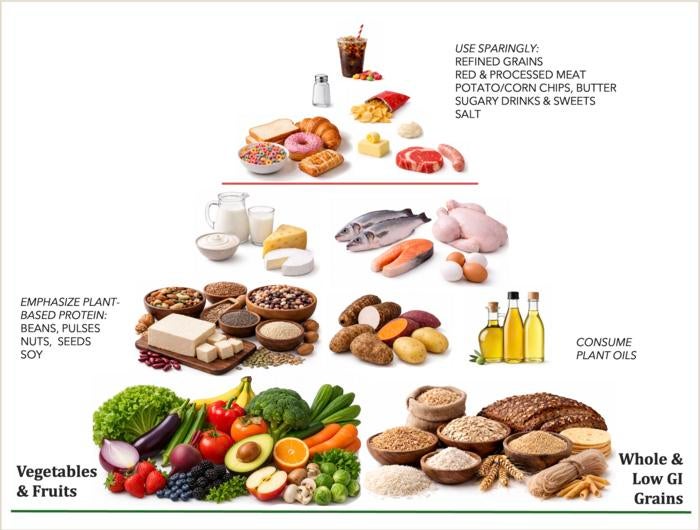
A first-of-its-kind food pyramid from a group of international nutritionists has been released – and counters the Trump administration’s recommendations for a healthy diet.
The new guidance, devised by 22 leading nutritionists from Europe, Canada, the U.S. and Australia, echoes the traditional food pyramid that has been used in the U.S. for decades by advising on daily food groups and portion sizes.
The new food pyramid, endorsed by global experts on carbohydrates, breaks from the Trump administration’s updated nutritional guidelines which follow Health Secretary Robert F. Kennedy, Jr.’s “MAHA” agenda and prioritize red meat above plants.
Instead, the new pyramid emphasizes plant-based protein sources, cooking with plant-based oils and healthier sugars and carbohydrates.
“When you’re designing a meal, start by thinking about the plant foods you want to emphasize,” Brigham Young University nutritional scientist Karen Della Corte explained. “What vegetables, whole or lower-GI grains, beans or lentils could you include?”
Decades of research has shown that regularly eating red meat – which is high in saturated fats that raises cholesterol levels – is tied to an increased risk of heart disease, cancer and premature death.
In another break with the Trump administration’s denial of climate change, the researchers acknowledge the heavy impact of the livestock industry in worsening the carbon and methane emissions that are driving up global temperatures.
“Our diet has to be not only for our own health but also for the health of our planet,” co-author David Jenkins, a professor at the University of Toronto and creator of the Glycemic Index, said. “Our science base has to be appropriately comprehensive to include that.”
The pyramid also recommends keeping sugar intake below 10 percent of a person’s total calories, in line with former U.S. guidance. The Trump administration changed the guidance this year to instruct people to have no more than 10 grams of added sugar per meal, in an effort to make it easier to understand.

Like carbohydrates, not all sugar sources are made equal. Sugary drinks are particularly of concern, the scientists noted. Substitute with sugar-free sparkling water or just plain water, the group advises.
The new pyramid also says canola or olive oil should be used instead of animal fats such as butter or tallow for cooking. Beans, peas, lentils, fish, poultry or yogurt should be eaten as sources of protein more often than red and processed meats.
But these changes won’t be easy for everyone to make, the scientists acknowledge, particularly with soaring food costs around the world.
“We need food environments that make it easy to put the pyramid’s recommendations into practice,” co-author Anette Buyken, professor at Germany’s Paderborn University, said. “Knowing what is healthy and being motivated to eat healthily is not enough when these choices are difficult or expensive.”


