
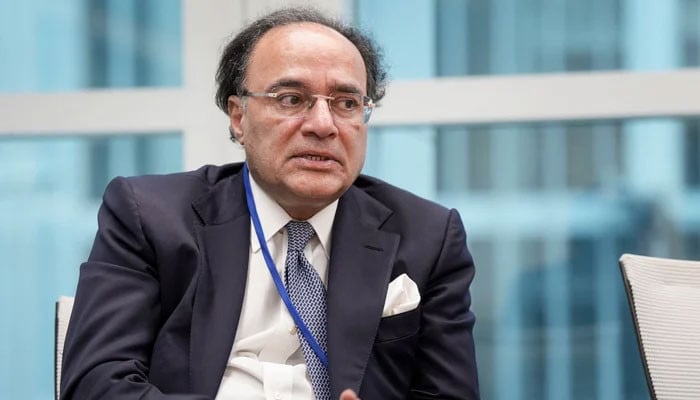
- FinMin says IMF programme set to conclude in October 2027.
- Adds Pakistan’s credit rating improved thrice since April 2025.
- Pakistan expects $44 billion in remittances this fiscal year.
Finance Minister Muhammad Aurangzeb has urged Pakistani businesses to reform their business and income models and improve productivity to strengthen their competitiveness in global markets, stressing the need for sustainable economic growth that also creates employment opportunities.
He was addressing a leadership panel discussion titled “From Stabilisation to Growth: Pakistan’s Long-Term Reform Agenda”, organised by the American Business Forum (ABF) in partnership with the Lahore University of Management Sciences (LUMS) at its campus in Lahore on Saturday.
The finance czar highlighted the need for structural reforms, export growth and greater private-sector participation in the economy.
He said businesses must adapt their operating and revenue models to changing global economic conditions, adding that improving productivity was essential for competing with regional and international markets.
Aurangzeb stressed that Pakistan needed an economic growth model that generated jobs rather than focusing solely on headline growth figures. Achieving growth of 7% to 8% would not be sufficient without corresponding employment opportunities, he said.
He also highlighted the need to increase women’s participation in the workforce, noting that their current participation rate stood at around 22.7%.
Economic outlook and reforms
Aurangzeb said the global economy is facing uncertainty, with international conflicts potentially affecting the prices of essential commodities.
Despite these challenges, he said Pakistan’s economic recovery is continuing, and the government is working to facilitate investors.
He noted that international investors are also looking at markets beyond Pakistan, while European and American investors have shown interest in the country’s bonds.
Pakistan issued €3 billion worth of bonds in the first week of September, he said, highlighting the country’s efforts to regain access to international financial markets.
The federal minister said Pakistan’s credit rating had improved three times since April last year, adding that the country had restored its rating to the ‘B’ category after four to five years of efforts.
He said Pakistan’s current International Monetary Fund (IMF) programme was scheduled to conclude in October next year.
Pakistan secured a $7 billion, 37-month Extended Fund Facility (EFF) from the IMF in September 2024 to support economic stabilisation and address its external financing needs.
The latest staff-level agreement covered the fourth review of the EFF and the third review of the Resilience and Sustainability Facility (RSF). Subject to approval by the IMF Executive Board, Pakistan will receive about $1 billion under the EFF and $210 million under the RSF.
Speaking at the event today, Aurangzeb said the government was continuing reforms to improve the tax system and broaden the tax base. It was also encouraging private-sector participation in economic development, he added.
Exports, remittances
The finance minister said Pakistan expected workers’ remittances to reach $44 billion in the current fiscal year. Although there had been concerns that the war would reduce inflows, remittances had increased, he added.
He said freelancers accounted for around $1.6 billion of Pakistan’s information technology (IT) exports, with young people exporting billions of dollars worth of IT services while working from home.
The government had taken steps to promote exports, including abolishing the super tax and reducing tax slabs, he said.
Aurangzeb added that exporters were being offered loans at an interest rate of 4.5%, with a low-interest financing facility for exporters included in the budget.
He stressed that reducing tariffs and energy costs was necessary to help Pakistani businesses compete in regional markets. The government had also discussed providing additional electricity to industries at Rs23 per unit, he said.
Pakistan’s goods exports had remained around $30 billion over the past five to ten years, while textile exports stood at approximately $17 billion, according to the finance minister.
He said increasing exports would require more than an appropriate exchange rate, stressing that businesses also needed to improve their productive capacity.
Exchange rate, economic competitiveness
The finance czar said Pakistan needed a market-based exchange rate, with the rupee’s value determined by supply and demand rather than being artificially maintained at a high level.
He said the State Bank of Pakistan (SBP) had purchased around $20 billion from the market over the past few years, including approximately $6 billion to $7 billion during the current year, to build foreign exchange reserves.
Aurangzeb noted that exchange rates, inflation and interest rates fell within the central bank’s domain.
He cautioned that artificially keeping the rupee strong could hurt exports, but said boosting overseas sales also depended on increasing productivity and strengthening the country’s production capacity.
Aurangzeb said Pakistan had significant opportunities to grow in the emerging economy and could progress faster than other countries by capitalising on these opportunities.
However, he stressed that businesses would need to adapt their models and become more productive to compete internationally.
Energy security, targeted subsidies
The finance minister said the government had worked to prevent fuel shortages and long queues at petrol stations in Pakistan, as seen in other parts of the world.
He said targeted subsidies had been provided because owners of larger vehicles did not need the same level of government support.
Aurangzeb said preparations were underway to meet the country’s energy requirements during winter, including securing adequate supplies of gas and liquefied natural gas (LNG).
He added that the supply situation for crude oil and other energy sources remained satisfactory and that Pakistan had avoided an energy shortage.


