
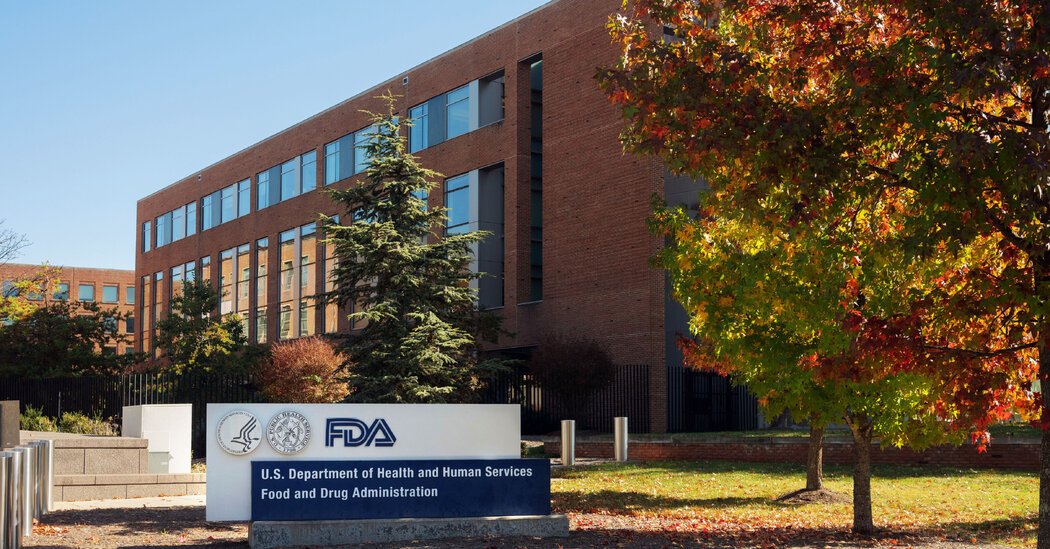
A Food and Drug Administration advisory panel recommended broader use of six unproven peptides, raising concerns that wellness and telehealth companies could adopt a once-obscure pathway to bring unapproved drugs to the commercial market.
The votes directed the F.D.A. to add some peptides to the list of substances that specialized, so-called compounding pharmacies can make for patients. That kind of prescribing, typically meant for exceptional cases, has grown into a booming business that has largely been limited to copycat GLP-1 drugs.
The panel’s decisions alarmed F.D.A. scientists who spoke extensively at sessions on Thursday and Friday. But they are likely to be well received by Health Secretary Robert F. Kennedy Jr., and signaled an increasing openness in the Trump administration to products popular with wellness influencers. These peptides in particular have prompted concerns, since they are mostly injected into the body, and have not gone through the F.D.A.’s thorough approval process.
The committee endorsed four peptides on Thursday and two more on Friday, though it also voted down the broader use of one rarely used peptide.
Some F.D.A. scientists during the panel meetings on Thursday and Friday pointed out that the peptides under review had not been proven to be safe or effective, and could present risks to patients.
Any hazards that emerge could be hard to track, the federal scientists said this week, since the advised action would push peptide use into a lightly regulated market largely overseen by state pharmacy boards.
Peptides have become a pet project for Mr. Kennedy, who has used the substances and has said publicly and privately that the agency should broaden access. His office took the unusual step of appointing eight new members to the committee that met this week, including six who market peptides in terms like “revolutionary” or able to “enhance disease resistance.”
The substances are chains of amino acids that prompt cells to perform actions like decreasing inflammation or increasing collagen production. Peptides that have been fully vetted by the F.D.A. include drugs like insulin or GLP-1s.
But unproven peptides with names like BPC-157 and MOTS-c have become popular items for social media influencers who unbox new peptides on camera and suggest that they improve skin tone and overall health. Some videos mock the F.D.A. and refer to peptides as “peppers,” to avoid content moderation.
Other users are people who feel failed by the medical system, and who distrust the pharmaceutical industry. Consumers buy peptides from longevity clinics, alternative health providers and even TikTok. The drugs are sometimes produced in unregulated Chinese labs and sold as “research grade” compounds.
In 2023, the F.D.A. essentially banned the peptides reviewed this week, over safety concerns. Before that, the compounds had been nominated for a list of acceptable items to compound, but had not been accepted by the agency.
Matthew Lash, an F.D.A. compliance official, said during Friday’s hearing that placing them on the legal-to-compound list would be a new action.
“I don’t think that we know what the potential explosion of use would look like,” he said.
The panel advisers, including some temporary voting members, do not have a final say. F.D.A. scientists and officials typically finalize such decisions, with sign-off from the agency’s commissioner. But Mr. Kennedy has expressed interest in making the decision himself, according to two people familiar with the matter who were not authorized to speak publicly.
The F.D.A. has struggled to keep up with compounding pharmacies and telehealth providers as they have grown into a multibillion-dollar industry marketing directly to the public.
Representatives from prominent telehealth companies, including Hims & Hers and Noom, testified during the hearings and signaled their interest in marketing the peptides under consideration.
John Hertig, a pharmacist and a board chair of the Collaborative for Evidence-Based Medicines, an advocacy group, said he was concerned that the additions would amount to an end-run around the F.D.A.’s careful approval process.
“This creates another parallel pathway to get this product in front of the public at much less rigor, fewer science-backed studies, and really does put the entire public and patient safety system at risk,” he said.
He added: “Once it’s on the list, you lose control.”
The most notable vote of the day was cast in favor of epitalon, a peptide that is marketed for longevity but that has been flagged as potentially increasing the risk of cancer.
Studies in cells found that epitalon can lengthen telomeres, something that is linked to a longer life span. F.D.A. scientists, however, cautioned that long-term, continuous exposure to epitalon could be carcinogenic.
Among the seven committee members voting in favor were physicians who sell peptides, including Dr. Melissa Loseke, the president and chief medical officer of the Re-new Institute in Omaha, Neb., and Dr. Kris Wusterhausen, the founder of the Resurge Clinic in Weatherford, Texas.
The Re-new Institute’s website describes peptide therapy as “a cutting-edge longevity treatment” that helps the body “reduce inflammation, improve cognition and accelerate recovery.” The Resurge Clinic offers them in efforts to lower body fat, increase lean muscle, repair tendons and ligaments, enhance sexual performance and protect against UV light.
Dr. Asare Christian, the founder of a Philadelphia-area clinic that sells peptides for “longevity,” said at the meeting on Friday that he voted in favor of every peptide because he treats pain in patients, which is managed with treatments like opioids, Tylenol and gabapentin, which carry their own risks.
“That’s why I’m making all these choices,” he said, adding that “a lot of the things that have been said here hasn’t really stressed a significant safety signal.”
Many committee members who sell peptides and people who testified in favor of broadening access to them called for guardrails on peptide quality, such as requirements for reports of harm or purity testing. The F.D.A. emphasized that the agency did not have the authority to set such conditions on unapproved drugs, saying Congress would need to step in.
On Friday, the advisory panel voted against broadening the use of the peptide emideltide, which is known as a sleep-inducing compound. It is naturally produced in the brain and connected to circadian rhythms. It has had a mixed record in small human studies, most from the 1980s, related to its use for insomnia. The studies did not report any adverse events, but because the peptide acts on the opioid pathway, some scientists at the meeting expressed concern about emideltide’s addictive potential.
The committee on Friday also voted 8 to 5 in favor of the widespread compounding of semax, which is marketed as a treatment for neurological conditions including strokes, migraines and facial nerve pain, as well as mental health disorders.
Animal studies suggest that semax could have anti-clotting and pain relieving effects, but one of the few human studies reported mixed results. Although the human research on semax is primarily as a nasal spray, it was endorsed by the committee as a spray and an injection.
The F.D.A. has said the final decision will be laid out in a proposed rule, giving the public an opportunity to comment.
Dr. Reshma Ramachandran, an assistant professor at the Yale School of Medicine who was not involved in the hearing, said she was concerned about how the peptides could be embraced by telehealth platforms. She said she worked on a recent study that found that such services issued GLP-1 prescriptions with little patient interaction, and often within five minutes.
“If F.D.A. moves to allow compounding of the peptides, you can expect these telehealth platforms to act as a pill mill for peptides with clinician oversight happening in name only,” she said in an email, “and not in practice.”
Rebecca Robbins contributed reporting.

