
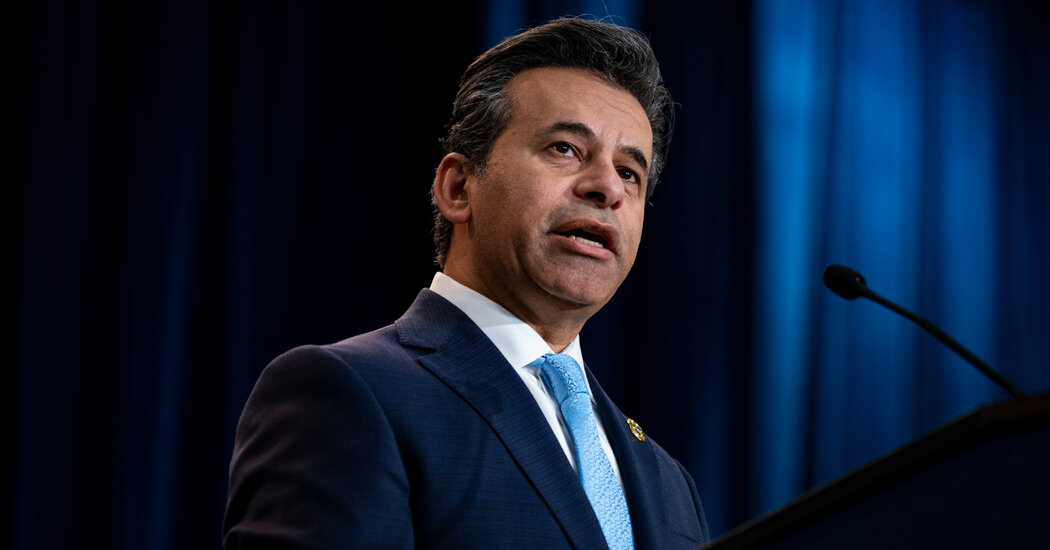
Dr. Marty Makary, the commissioner of the Food and Drug Administration, resigned on Tuesday, according to an administration official, after weeks of pressure and rumors that President Trump was planning to fire him.
Dr. Makary ultimately resigned over concerns about the administration’s decision to authorize fruit-flavored e-cigarettes, an action he opposed, according to four people familiar with the matter. Dr. Makary told those close to him that he could not in good conscience approve flavored vapes, given their appeal to young people, and would not do something he did not believe in.
His departure caps a tumultuous run at the helm of an agency that regulates medical treatments, vaccines and much of the U.S. food supply. Dr. Makary came to the F.D.A. as a reformer, instituting so many new initiatives that he became known — and sometimes mocked — for his white board on wheels, festooned with Post-it notes lining up announcements that he promoted on frequent television appearances.
But his efforts at times put him at odds with the powerful food, tobacco and pharmaceutical industries. In the process, he made a number of enemies in Washington and on Wall Street, including some biotech leaders, abortion foes, tobacco executives and eventually some members of the administration.
He also drew criticism from public health leaders who viewed him as pandering to anti-vaccine activists with the release of an unsupported memo claiming that there were deaths related to Covid vaccines. Criticism flared again when he allowed the renewed use of unproven peptides, or injectable compounds with uncertain effects, a policy favored by Health Secretary Robert F. Kennedy Jr.
“He has offended almost everyone involved in F.D.A. issues, which is not easy to do,” said Diana Zuckerman, the president of the National Center for Health Research, which weighs in frequently on F.D.A. decisions. “But it would still be a disaster if he is replaced by someone who appeals primarily to tobacco companies, anti-abortion activists” and pharmaceutical lobbyists, she added.
The resignation was first reported by Politico.
Kyle Diamantas, the F.D.A.’s top food regulator, was named the acting commissioner. Mr. Diamantas came to the agency from Jones Day, a law firm where he represented Abbott Nutrition, a leader in the infant formula industry. He has become a vocal champion for policies to remove chemicals from the food supply and increase transparency around food ingredients.
The most consequential clash of his tenure was over the authorization of flavored e-cigarettes, a step Dr. Makary resisted over concerns that fruity and candy flavors would lure young people to addictive vapes. The White House ultimately prevailed. Earlier this month, two fruit-flavored vapes were approved. And last Friday, the F.D.A. quietly issued a policy allowing them to be more widely marketed.
Mr. Trump told reporters Tuesday afternoon that he wished Dr. Makary well.
“Marty’s a terrific guy, but he’s going to go on and he’s going to lead a good life,” Mr. Trump said as he left for a trip to China. “He’s a great doctor, and he was having some difficulty.”
Dr. Makary also faced repeated calls for his firing from abortion foes who accused him of dragging out the timetable for a study of the safety of mifepristone, an abortion drug, viewing the exercise as one that could support their efforts to restrict the drug’s distribution.
Dr. Makary, who was a Johns Hopkins University cancer surgeon and health policy researcher before entering government, attempted to play to Mr. Kennedy’s Make America Healthy Again movement, going as far as sitting in a frigid plunge pool with the wellness influencer and biohacker Gary Brecka. He also led popular efforts to authorize natural food dyes and change how people talked about hormone replacement therapy for women.
With the support of MAHA voters, Mr. Trump framed Dr. Makary as a bold reformer, someone who would right an agency that had “lost sight of its primary role as a regulator.”
Early on, Dr. Makary and Dr. Vinay Prasad — his handpicked director of gene therapies, stem cell treatments and vaccines — drew scrutiny when they restricted the criteria for prescribing Covid vaccines to people older than 65 or with a list of health concerns.
Dr. Prasad resigned under pressure last summer after he was targeted by the right-wing influencer Laura Loomer, in part over his crackdown on a drug company tied to several patient deaths. Dr. Prasad was later brought back, but left the agency again in recent weeks.
Dr. Prasad and his counterpart in the agency’s drug division rejected a number of new drugs for rare diseases, citing flaws in a company’s research supporting an approval. As Dr. Makary went on television to defend the rejections, frustrated biotech leaders and investors vented to the White House and Mr. Kennedy’s office.
“On vaccines and mifepristone, Makary rarely prioritized rigorous evidence,” said Lawrence O. Gostin, a professor at Georgetown Law who studies the F.D.A. “Ironically, his one stand for high-quality science — on flavored vapes — created the friction with the White House that contributed to him losing his job.”
Dr. Makary also faced a series of challenges inside his agency. He started his work last year contending with a haphazard array of staff cuts led by Mr. Kennedy and Elon Musk’s Department of Government Efficiency. Some staff members vital to reviewing complex surgical devices, inspecting food manufacturers and monitoring drug safety were laid off.
Though some people were hired back, another wave of voluntary departures left the agency without more than 4,000 staff members, or about a fifth of its work force.
Dr. Makary ultimately became a champion for the agency’s staff, fighting to get authorization to hire about 3,000 employees. The process of recruiting and hiring has moved slowly, though, leaving staff members at the agency and those who watch it concerned about its future.
Nathan Cortez, a Southern Methodist University law professor who studies the F.D.A., said that finding a permanent replacement could be a major challenge.
“The new commissioner will have to walk a tight rope between what the administration wants — Trump and R.F.K. Jr. — and what federal law commands of F.D.A.,” he said in an email, adding: “Historically, the expectation is someone with an M.D. or PhD and real scientific chops. It’s a lot of pressure.”
Karoun Demirjian contributed reporting.

