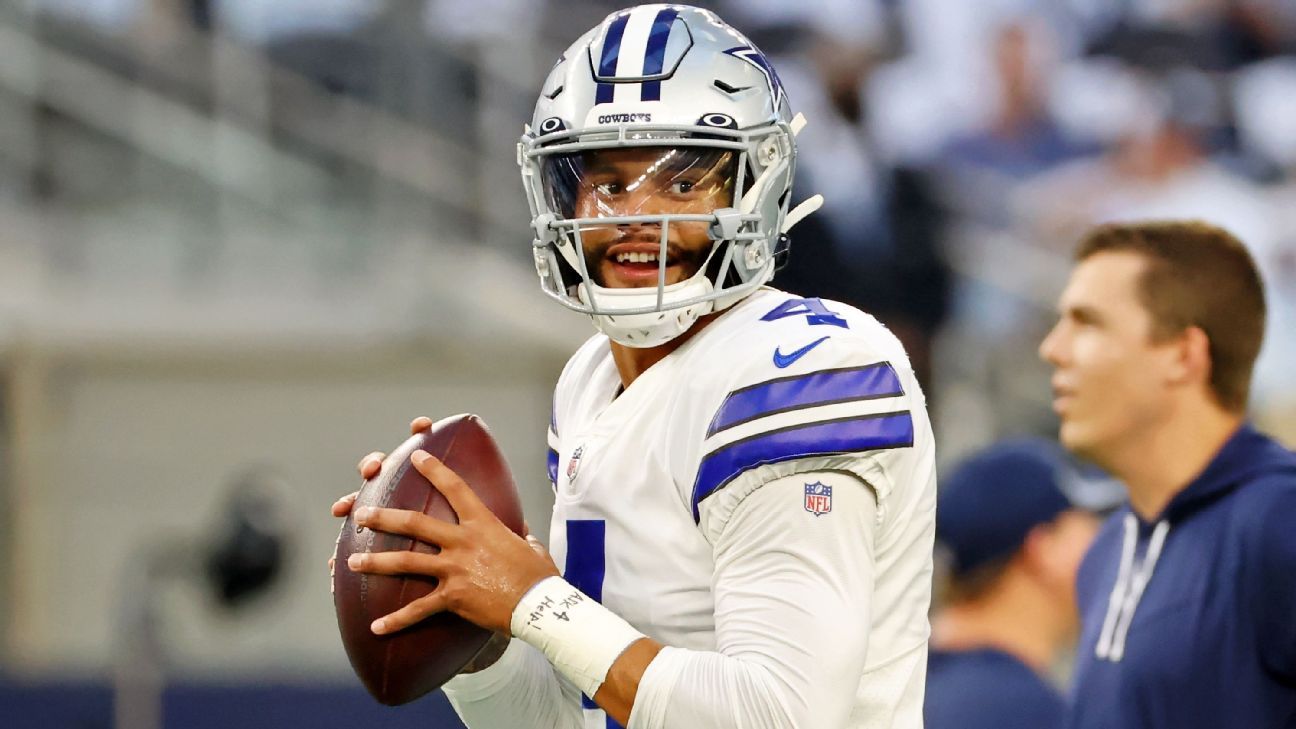
FRISCO, Texas — For the briefest of moments between each play, Dak Prescott can take a breath. But only one.
Coach Brian Schottenheimer’s voice is quickly in the quarterback’s ear, calling the next play. From there Prescott delivers the call to the rest of the Dallas Cowboys players in the huddle.
As Prescott walks to the line of scrimmage, he gets his first look at the opposing defense. What’s the front? Where are the safeties? Where is the middle linebacker? Are the corners playing off or in press coverage? How many defenders are in the box?
He considers whether those things force him to change the play.
Then the game circumstances come to mind: the quarter, time remaining, the score, the down and distance. How about the weather? Or how a loud crowd can make communication more difficult?
With center Cooper Beebe, he sets the protection. He uses hand signals to his pass catchers. He might need to kill the original call and go to the second play he called in the huddle.
The drama builds as thousands in the stands yell and scream as the seconds tick off the clock.
All this — and more — happens in 40 seconds before the ball is even snapped, Prescott told ESPN this spring, when he sat down to go through a single play and everything it entails.
At the snap, what can look like chaos to many is choreography to Prescott.
His hours of film study — learning the tendencies of the opposing coordinator, the subtle tells of a defensive tackle aligning over the inside shoulder of the guard or a linebacker mugging the A-gap — give him all the information he needs.
When he drops back, he sees players flash all around him. It happens in a blur, but he knows where things are supposed to be. On a pass, he needs to decide whether the throw needs to be layered over the top, away from a defender or low so only his receiver can catch it. Does it need to be a fastball or a changeup?
All this happens in seconds.
Prescott estimates a normal play will have anywhere from two to 10 decisions. He can see things the way Matt Damon’s character saw things in “Good Will Hunting,” solving the most difficult equations with ease and speed.
“Some of those decisions you make are naturally from your practice and from the repetition and the work that you put in throughout the week,” Prescott said. “It’s just unconscious.”
Seeing a play through Prescott’s eyes
To protect their current offensive calls, the play Prescott dissected was against an uncommon opponent for Dallas, the Cleveland Browns. The 21-yard touchdown pass to receiver Brandin Cooks took place in the 2024 season opener, hours after Prescott agreed to a contract extension that made him the highest-paid player in the NFL at the time.
The Cowboys faced third-and-5 from the Cleveland 21-yard line on their first possession of the season.
“We knew when we got down in the red zone fringe,” Cooks said, “Cleveland at that time liked to bring Cover 0 [no deep safeties]. We’re in three-by-one and I’m at the three [closest to the offensive linemen]. [Browns safety] Grant Delpit, he’s inside on me and Dak sees at the line it’s Cover 0 and he checks. We both see it.”
As he surveyed the defense, Prescott signaled tight end Jake Ferguson tighter to the formation to face defensive end Myles Garrett. Having a tight end block an All-Pro edge rusher alone is never the best answer, but Prescott knew he would be getting the ball out quickly.
“Not ideal,” Prescott said. “But all Jake has to do is get in his way.”
At the snap, the picture changed. The Cowboys had six blockers in for the six Browns defenders. They should have been protected.
Browns linebacker Jordan Hicks, however, ran free between left tackle Tyler Guyton and left guard Tyler Smith, with a direct line on Prescott — whose eyes were looking downfield.
“It’s Game 1. [Smith] is an All-Pro. He just makes a little [missed assignment],” Prescott said. “Trust me, I’ve done them. I do it here and there; interceptions.”
Hicks sprinted six steps and raised his left arm as Prescott cocked back to throw. His mechanics weren’t great. His legs were almost parallel to the line, and the pass was all arm strength as he drifted back to the 30-yard line.
“That’s a flash of color,” Prescott said. “I’m looking at that corner.”
Cooks was at the 14 as Prescott started to throw the ball. Delpit was at the 9 but flat-footed.
“I actually throw this ball much earlier than I want to,” Prescott said. “I would love to be able to get this ball all the way into that pylon box because I’m having to throw it now and in an awkward stance and Brandon’s not there.”
The pass is high, but he had to let it go early so Cooks could run under it. During the week of practice, the two discussed Cooks looking up in the air, not back to Prescott, knowing the type of throw it would take.
“Just putting air under it, boom! Thankfully the safety didn’t play it very well,” Prescott said. “Thankfully we caught him flat-footed, which happens in zero because he expects the blitz to get home.”
Dak ➡️ Brandin
We are COOKin’ 🍳
📺: #CLEvsDAL on FOX
📲: Stream on NFL+ https://t.co/LvklCbYJ1e https://t.co/BtlWfyuHV9— Dallas Cowboys (@dallascowboys) September 8, 2024
Cooks, who recently joined the San Francisco 49ers, counts his time with Prescott as a plus.
“I was fortunate enough to play with a lot of the greats, and I’ll put Dak in that variety when it comes to that at-the-line-of-scrimmage, pre-snap ability to read and think it through,” Cooks said. “They’ve got to get through so much. They’ve got to know the protection, get the check to the offensive line to pick up that pressure, then they need to know the receiver’s [job].
“Not every quarterback can do it, but when you can, it makes your offense a lot better. Guys like Dak, [Tom] Brady, Drew [Brees], they’re an extension of the coach at that point.”
Prescott’s work ethic shines on game days
For Prescott, it all started to click in 2018 after the Cowboys made a trade for wide receiver Amari Cooper. It was Prescott’s third year and he was making his 40th regular-season start when the Cowboys played the Tennessee Titans in Cooper’s first game.
The Cowboys lost 28-14 and Prescott was 21-of-31 for 243 yards, two TDs and one INT, but something changed that day in how he saw the game.
“When [the game] slows down is when you understand the only little things you need to think about,” Prescott said. “One of those football sayings is, ‘See a little, see a lot; See a lot, see little.’
“And it’s no different with the mind. If I’m trying to think about a lot, too much is going on. But if I know exactly what I need to do, if I know my purpose and my plan on this play, it’s easy and it’s simple.”
Since that game, Prescott has had four 4,000-yard seasons and all four of his 30-touchdown seasons (including a career-high 37 in 2021).
The hours it takes to prepare for a game seem endless. Prescott’s teammates marvel at the work he puts in.
“Bro, his truck is the last one up here a lot of the days,” Smith said. “I’ve stayed here a while after the final bell is rung and you can technically go home. For hours I’ve stayed here, and I’m leaving, his truck is still here.
“If people think this is just natural talent — well obviously he’s naturally talented — but if people think he’s not working just as hard to be the best version of himself and be one of the best quarterbacks in the league, they’re dead wrong. The body of work is put forth every day, and ultimately that body of work will show up.”
Said Cowboys receiver Ryan Flournoy: “As a receiver, there’s a lot going through our mind, and we don’t have to know what the linemen are doing, what the running back is doing. For him to dissect the defense, get everybody on board with one play, it’s amazing. Even spitting out a play in the huddle, it’s amazing, honestly.”
Each playcall can carry a check to another play, depending on what the defense is showing when the offense gets to the line of scrimmage. Sometimes it can be wordy, which can eat away at the time on the play clock. Offensive coordinator Klayton Adams said they are mindful of how many words they have in a call.
“Dak is pretty prideful about not wanting to be a guy that has a [play sheet] wristband. He wants to really be able to verbalize the playcall, and he wants to own it, and he works very, very hard at that,” Adams said. “So we try to shorten the verbiage as much as you can. Now you also get greedy because you’re giving it to him directly in his headset.
“So sometimes you’re throwing something on there that’s like, ‘Hey, want to make sure that the tight end knows what he’s doing here. I want to make sure that the back knows what he’s doing here,’ because there’s nuance to it. We try to get those things assumed as much as we can so that there’s less words.”
Keeping it quiet for Prescott
Once the play is called, Prescott wants to hear nothing else from Schottenheimer in his ear before the coach-to-player communication system goes out with 15 seconds left on the play clock.
“Love ’em all to death, love my coaches, appreciate ’em, but we talk enough throughout the week that on game day, give me the play and let me go,” Prescott said. “It’s a testament to our trust — to us knowing exactly our plan that I don’t need the extra stuff.”
Schottenheimer respects Prescott’s ability to process each play as it happens.
“Some people say the hardest thing to do is hit a baseball — which I can’t hit one. So I’m not saying it’s not, but playing quarterback’s got to be up there,” Schottenheimer said. “These guys are on a time clock against some of the best athletes in the world and they have to process a lot of information. They got to bail us out when we make s—ty calls. It’s really hard.”
It’s that difficulty that Prescott enjoys. Each week is a head-to-head test against a coordinator trying everything to make him look foolish. Now in his 11th season, Prescott feels like he has the answers, although there are times he will still get tricked by something.
There is joy in the process.
“There’s a lot of guys that can throw the ball. There’s a lot of guys that can make plays. There’s a lot of guys that can play this position well,” Prescott said. “But who can adjust? Who can adapt? Who can make changes? Who can lead and get all 10 guys on the same page? Actually more, making sure the sideline and coaches are on the same page. So much goes into it more than throwing the ball.
“That’s the chess piece of it, the mental part, the pre-snap. Throughout the week studying what are they going to do? What do we need to do and how are we going to beat it? That, by far, is the greatest reward for me.”