
To enter the John F. Kennedy Center for the Performing Arts, you must walk past a billowing white tarp that hides the place on the facade where President Trump’s name used to be, before a federal judge ordered it removed. This covering manages the trick of obscuring the president while drawing attention to him.
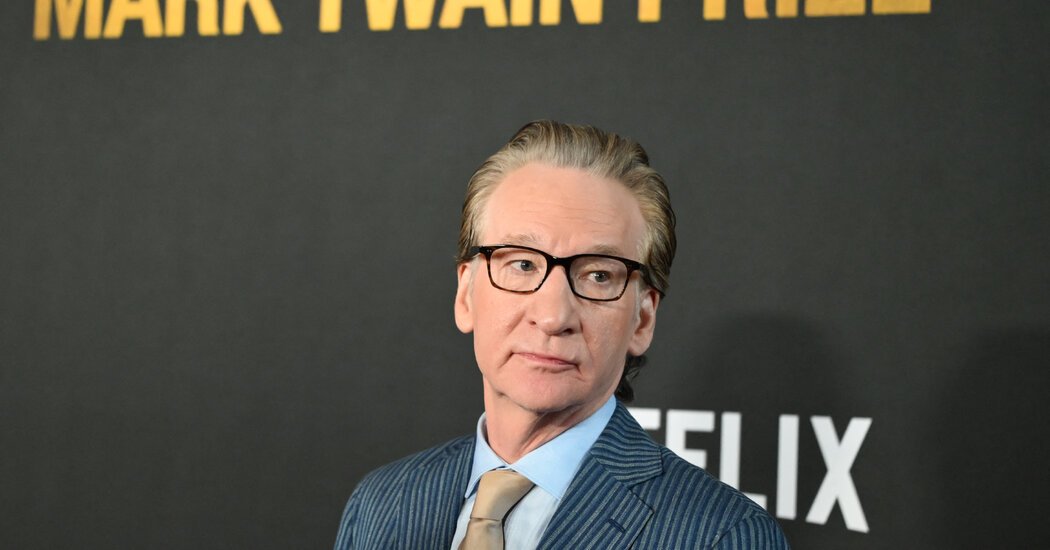
Inside the building, where Bill Maher accepted the Mark Twain Prize for American Humor on Sunday night, Trump’s absence played a similarly distorting role, making him loom large over the ceremony, even at times edging out the honored standup as the main character of the night.
In front of an audience that included members of the Trump administration, like Commerce Secretary Howard Lutnick and Dr. Mehmet Oz, as well as Democratic politicians like Senator John Fetterman of Pennsylvania and Representative Ro Khanna of California, many speakers (Maher included) took time to mention that President Trump wasn’t in attendance. Most made jokes about him. The standup Whitney Cummings got the event started with the most stinging example, making a reference to the president’s connection to Jeffrey Epstein. “I actually heard Trump may come tonight,” she said. “He got caught in sex traffic.”
Then she informed the crowd that she was told not to use that bit. Louis C.K. followed her, telling an intentionally weak Trump joke to prove a point about how hard it is to do the kind of political humor that Maher specializes in. Jay Leno punned: “For the second time in the nation’s capital, there’s a big, beautiful Bill.”
The primary reason President Trump haunted the evening was not the jokes, but the context in which they were made. On his HBO talk show, “Real Time With Bill Maher,” and elsewhere, Maher fashions himself an equal opportunity critic, writing about the political divide in a recent book that “both sides are smug,” which is like the pot calling the kettle the pot. But while he has mocked President Trump for many years, earning his ire in social media posts and even a lawsuit, it was only after Maher played nice with him and visited the White House last year that he was given the Mark Twain Prize. This earned criticism, especially after Maher reported back on his show that President Trump, in private, was more reasonable and less belligerent than in public.
The Mark Twain Prize is always presented by the Kennedy Center, where President Trump made himself chairman. You could tell Maher was concerned about how transactional the situation might look by having the impressionist Matt Friend interrupt his acceptance speech doing a version of President Trump ranting about the talk-show host. This enabled Maher to correct the record, saying about their meeting: “There was no quid pro quo.”
Previous Mark Twain awards ceremonies have tended to feature tributes from funny friends, protégés and mentors. There was some of that here. His pal and business partner Woody Harrelson did some light roasting. But there were fewer comics than usual this time. Arianna Huffington gave the most personal speech, one that poked fun at Maher for his young girlfriends and his lack of religious faith, saying, she thought he was a “mystical atheist,” whatever that means.
Several speakers shared Maher’s lightning-rod status, and the night was a who’s who of people the internet likes to hate. The sports hot-take artist Stephen A. Smith, who like Maher, has been accused by critics of moving politically to the right to court audiences (they both vehemently deny this), praised the comic as a “guy you can actually hang with.”
The most unintentionally revealing speech came from Louis C.K., who told very few jokes and said he wanted to talk about Maher personally. They had known each other for years but weren’t friends, Louis C.K. said, until he became an “outcast” after admitting to sexual misconduct. Louis C.K. praised Maher for asking him to be on his show, calling him a “good guy” for sticking by him and saying to him in a low moment: “I want to throw you a rope.”
Louis C.K. is an unlikely authority on virtue. Most would agree he is on more solid ground on questions of comedy. “As a comedian, what gets overlooked is he’s really funny,” he said of Maher, adding a curse word for emphasis. It’s an odd thing to say about someone winning the highest honor in American humor. Then Louis C.K. doubled down, calling Maher “underrated.”
This jarringly faint praise gave voice to what many people in comedy think. Maher did not win the prize because he’s the funniest comic out there. The case for him — a plausible one, to be sure — involves his longstanding influence on the culture as a biting political comic.
Before Jon Stewart, Dennis Miller or John Oliver regularly delivered long political monologues on television, Maher did. Before the left’s excesses were called cancel culture, there was political correctness — and in naming his first show “Politically Incorrect,” Maher did as much as anyone to mainstream that term. And over three decades and two networks, Maher pioneered comedy that blurred the lines between celebrities and politicians.
And this is also how Donald J. Trump dominated the evening, because what came into focus is what he shares with Bill Maher. Prickly, inexhaustible performers unafraid to flaunt their egos, who both grew up close enough to New York (Trump in Queens, Maher in New Jersey) to develop chips on their shoulders, then got their first taste of stardom in the 1980s before building careers that merged pop culture and politics.
They also both care deeply about awards. You can tell because they complain about them so much. Trump shares insults online about the Oscars and rants about the Nobel Peace Prize so often that the last winner gave him her award. In a recent episode of his podcast Club Random that left David Cross speechless, Maher said that the fact he never won an Emmy Award is an example of his being “soft canceled.” He brought this supposed injustice up again on Sunday.
After accepting the Mark Twain Prize, he immediately trashed the entire awards industry, before pivoting again to gratitude. “I couldn’t be more thrilled to be part of the hypocrisy,” he said, in one of his better delivered lines.
Then he aired grievances about his lack of press and described his viewers as the only one that wants to hear the truth or to be challenged. He finished by thanking his haters. It was the kind of sore-winner performance that seemed awfully familiar to anyone who pays attention to Truth Social.
Accepting the Twain award last year, the first major Kennedy Center event of the second Trump administration, Conan O’Brien celebrated comedy that was “self-critical, deflating and dedicated to the proposition that we are all flawed, absurd and wallowing in the mud together.” He aligned himself with Twain.
At what might be the last major event at the center for awhile, if Trump’s plans for renovations go forward, Maher celebrated Twain’s righteousness and honesty, then used controversies over his novel “Adventures of Huckleberry Finn” to make an argument that today’s liberals have become too censorious and sensitive.
Each comic’s vision of the man whose name is on the prize says more about how they see themselves — and, also their relationship to President Trump. O’Brien made indirect points with intent, while Maher was blunter, revealing himself by accident. “If you want to know what I actually live for,” he said, drawing a line between us and them as opposed to finding a way to wallow together, “it’s to be a hero to my audience.”

