
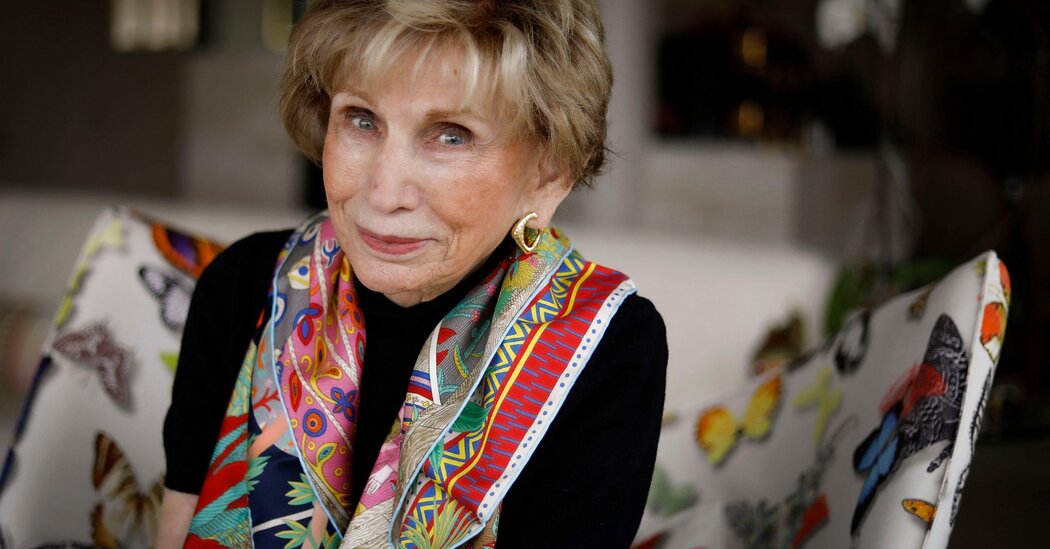
Edith Eva Eger, a clinical psychologist and best-selling author whose traumatic experiences as a prisoner in Nazi concentration camps — including being forced to dance for Josef Mengele, the notorious physician known as the “Angel of Death” — enabled her to identify with and treat emotionally troubled patients, died on April 27 at her home in San Diego. She was 98.
Her daughter Audrey Thompson confirmed the death.
Dr. Eger (pronounced eager) became a psychologist in her 50s, after immigrating to Baltimore, working in a clothing factory, raising her children and going to college.
Her emotional recovery took time: For two decades after the war, she did not discuss the privations she had endured or the atrocities she had witnessed. The buried memories stalked her nightmares.
She learned that she had to forgive herself for surviving — which she barely had. When American soldiers liberated Gunskirchen, a sub-camp of Mauthausen in Austria, in May 1945, she lay nearly motionless in a heap of corpses, weighing barely 70 pounds and suffering from pneumonia, typhoid fever and pleurisy.
“I release them,” she told the U.S.C. Shoah Foundation in the 1990s, referring to her Nazi captors, adding: “It’s not me forgiving them for what they did to me. I think it’s mostly liberating myself, to invest my energy in the future.”
A critical step in her ability to move forward was reading “Man’s Search for Meaning,” a 1946 memoir by Viktor Frankl, an Austrian psychiatrist and concentration camp survivor. He wrote about the choices that some prisoners had made.
“We who lived in concentration camps can remember the men who walked through the huts comforting others, giving away their last piece of bread,” he wrote. “They may have been few in number, but they offer sufficient proof that everything can be taken from a man but one thing: the last of the human freedoms — to choose one’s attitude in any given set of circumstances, to choose one’s own way.”
Dr. Eger described her own style of therapy — for clients who included cancer patients and military personnel with post-traumatic stress and traumatic brain injuries — as a choice to find freedom from suffering, a psychological journey in which compassion, humor, optimism, curiosity and self-expression were paramount.
“These are the tools my patients use to liberate themselves from role expectations, to be kind and loving parents to themselves, to stop passing on imprisoning beliefs and behaviors, to discover that love comes out as the answer in the end,” she wrote in her autobiography, “The Choice: Embrace the Possible” (2017, with Esmé Schwall Weigand), a New York Times paperback best seller about which she was interviewed by Oprah Winfrey on Ms. Winfrey’s network.
A documentary about her, also called “The Choice,” will be screened at the Berkshire International Film Festival in Massachusetts later this month.
In the book, she described treating a 14-year-old boy who was spouting bigotry.
“I struggled with the inclination to wag my finger, shake my fist, make him feel accountable for his hate — without being accountable for my own,” she wrote. “This boy didn’t kill my parents. Withholding my love wouldn’t conquer his prejudice.”
Gradually, over the course of their first session, “he was no longer talking about killing,” she wrote. “He had shown me his soft smile. And I had taken responsibility that I not perpetuate hostility and blame, that I not bow to hate and say, ‘You are too much for me.’”
Edith Eva Elefánt was born on Sept. 29, 1927, in Kosice, Czechoslovakia, in what is now Slovakia and had been part of the Austro-Hungarian Empire. Her father, Lajos, was a tailor and couture designer, and her mother, Ilona (Klein) Elefánt, managed the home.
Young Edith was a ballerina and gymnast. As antisemitism grew in Hungary, she was expelled from the Hungarian Olympic training team because she was Jewish. (The 1940 and 1944 Summer Games had already been canceled because of World War II, but there was hope of competing in the 1948 Games.)
But her coach insisted that she train her replacement, which she did, determined to make the other girl as good as possible.
Soon after Germany invaded Hungary in March 1944, the Elefánts’ home was raided. Edith, her sister Magda and their parents were sent to Auschwitz; Lajos and Ilona went to the gas chambers the day they arrived. Edith’s sister Klara, a child prodigy violinist who was blonde and blue-eyed, survived the war in hiding at her teacher’s home in Budapest.
That night, after Mengele learned that Edith was a ballerina, he demanded she dance for him. As she performed in the barracks to the “Blue Danube” waltz, played by an orchestra of prisoners, she imagined herself performing at the opera house in Budapest although, as she wrote later, she knew she was “dancing in hell.”
As a reward, Mengele tossed her a loaf of bread that she shared with her sister and the other prisoners. Over the next year, she and her sister and others left Auschwitz, were forced to ride atop boxcars in striped dresses to deter Allied bombing, and worked in factories. After some time in Mauthausen, they were forced to march the 27 miles to Gunskirchen, which was liberated by the U.S. Army in early May 1945.
During her recovery, Dr. Eger met Albert Bela Eger, a partisan fighter whose family had owned a wholesale food business, in a tuberculosis hospital. (He had the infection; she had fluid on her lungs.)
They married in November 1946; their first child, Marianne, was born the next year. The family immigrated to the United States in 1949, living first in Baltimore and then in El Paso, where a cousin of Mr. Eger’s lived.
Mr. Eger became a certified public accountant. Dr. Eger eventually entered college, receiving a bachelor’s degree in 1969 and a master’s in 1974, both in psychology, from the University of Texas at El Paso, and taught high school psychology for a few years.
She trained in the department of psychiatry at the William Beaumont Army Medical Center in El Paso, on the grounds of Fort Bliss, and earned her Ph.D. in clinical psychology from Saybrook University in Oakland, Calif., in 1978. She treated patients in private practice in El Paso before moving to San Diego in 1987.
She studied psychology because “she liked talking to people about their emotional lives,” her daughter Marianne Engle, who is a clinical and sports psychologist, said in an interview. “She wanted you to talk to her so you could find something in yourself you hadn’t seen.”
Dr. Eger and Ms. Weigand also wrote “The Gift: 14 Lessons to Save Your Life” (2020) and “The Ballerina of Auschwitz” (2024), a young adult version of “The Choice.”
In addition to her daughters Dr. Engle and Ms. Thompson, a leadership coach, Dr. Eger is survived by a son, John, an accountant; five grandchildren; and 12 great-grandchildren. Mr. Eger, whom Dr. Eger divorced in 1969 and remarried in 1971, died in 1993. A short marriage to Mort Winski ended with his death in 2003.
In 1981, Dr. Eger was invited to speak to a group of 600 Army chaplains in what had been a meeting place for SS officers in Berchtesgaden, Hitler’s retreat in the Bavarian Alps.
She had spoken to military audiences before, but this was different. She wondered if the trip would trigger flashbacks. After she initially decided she did not want to go, Mr. Eger told her, “If you don’t go to Germany, then Hitler won the war.”
She made the trip — during which she and her husband slept in a room once assigned to Joseph Goebbels, Hitler’s propaganda minister — and then continued on to Auschwitz.
“She was walking around and saw this man in a uniform and started to panic,” Dr. Engle said. “Then she realized that she’s got a Prada handbag and an American passport, and she’s free to leave, but the guy working there could not. My father said the most amazing thing is that she left Auschwitz kicking and dancing. She was happy.”
She added: “My mother was beautiful, but there was always a sadness in her eyes. When she came back, all the sadness was gone.”

