
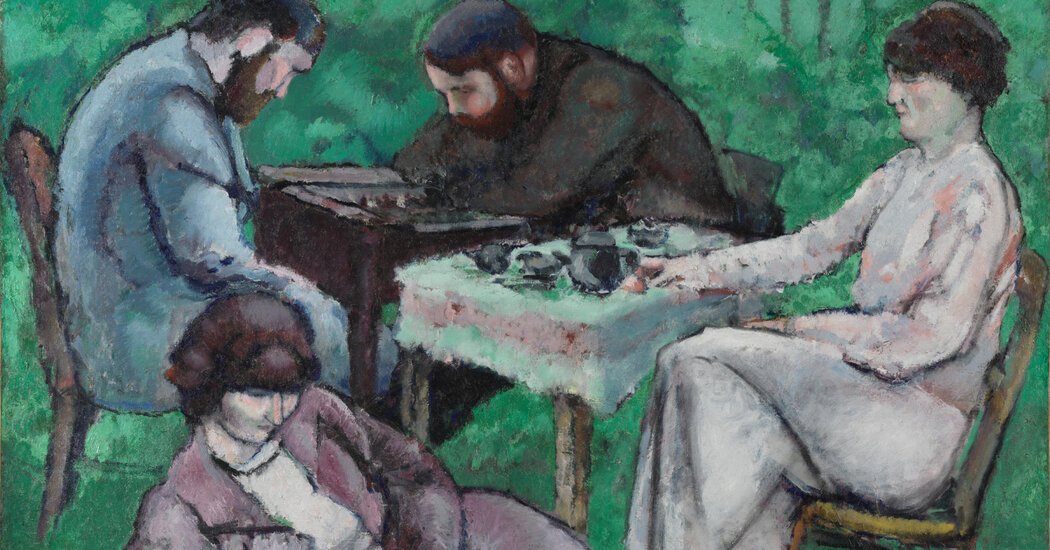
Marcel Duchamp, a founder of the Dada movement, is probably the first artist who improved his reputation when he announced that he was abandoning art. He preferred, he said, to spend his time playing chess. A transplanted Frenchman who settled in New York, he assiduously studied chess moves and competed in professional tournaments. His supposed withdrawal from art-making came to be regarded as its own triumphant endgame.
On July 28, in sportive observance of what would have been Duchamp’s 139th birthday, the Museum of Modern Art will be hosting a chess extravaganza in his honor. Visitors will have the option of heading upstairs to see the sprawling Duchamp retrospective that fills the sixth floor, or lingering in the lobby, where Susan Polgar, a celebrated Hungarian-born, Florida-based grandmaster, will be facing off against some 50 artists, historians and other members of the art scene in a so-called simul — that is, a simultaneous exhibition in which she plays all the contestants, on 50 different boards, at the same time.
Truth be told, her art-world opponents are not necessarily major chess talents. “I would trade in my whole art history career to be a great chess player, but I’m not good at all,” said Francis Naumann, a former art dealer and leading Duchamp scholar who initiated the MoMA event. It’s intended to re-create a simul held at the museum in 1974, during the run of its first Duchamp retrospective.
A thin, reserved man with the bony face of a saint and a taste for Cuban cigars, Duchamp died in 1968, at the age of 81. He remains vastly influential as an artist-thinker who pushed painting and sculpture away from craft and toward philosophy. Although initially pilloried for drawing a mustache and goatee on a reproduction of the “Mona Lisa” and elevating a store-bought snow shovel to the realm of high art, Duchamp laid the groundwork for the Conceptual art movement that took off in this country in the 1960s and enshrined him as its enigmatic prophet.
Chess began as a family affair for him. The MoMA retrospective opens with a psychologically bewitching early painting, “The Chess Game” (1910), which is set in a green-splotched garden and depicts his two older artist-brothers in the midst of a game, locked in deep concentration. Their closeness contrasts with the remove of their wives, stiff figures staring in different directions, apparently thinking non-chess thoughts.
Other women in the Duchamp family registered their boredom with chess more dramatically. Man Ray, the Brooklyn-born Dadaist, claimed in his memoirs that Duchamp’s first wife, Lydie Sarazin-Levassor — tired of spending long nights alone in a Paris apartment as her husband stayed out playing chess with his friends — once registered her displeasure by gluing the pieces of his chess set to the board. It did not cure him of his addiction, but it did precipitate the couple’s divorce.
Fortunately, Duchamp’s second marriage, to Alexina (Teeny) Sattler, who grew up in Cincinnati, was far more companionable. It helped that she was enamored of chess. In 1959, the couple moved to West 10th Street in Greenwich Village expressly to live across from their favorite haunt, the Marshall Chess Club where they played daily — and kept mum about the “Étant Donnés,” the clandestine room-size installation that consumed him for years despite his public boast of having stopped making art.
“Life begins at 76 with a one-man show,” Duchamp wrote cheerfully to a friend in 1963, when the Pasadena Art Museum (now the Norton Simon Museum) mounted the first retrospective of his work. In a famous photograph taken on the premises, he sits playing chess with a nude woman, her dark hair swung to conceal her face. She was Eve Babitz, a 20-year-old art student who would later achieve renown as a California novelist and memoirist.
The Museums Special Section
The oft-reproduced photograph, by Julian Wasser, tends to be seen as an icon of avant-garde derring-do. But you can also read it as plainly outdated. The image of the septuagenarian male genius basking in attention beside an anonymous, unclad and much younger woman can strike you as a betrayal of the female-empowering spirit of chess.
And, frankly, chess is a proto-feminist game. (I hereby disclose that I will be playing — clothed — in the MoMA simul.)
Initially invented in India in the sixth century, chess was redesigned in the Middle Ages to reflect the power that queens held in feudal society and provide a diversion for nobles ensconced in dim castles. Of all the pieces, the queen is the only figure permitted to whisk across multiple spaces in every direction in a single move. The king, by contrast is limited to crossing one square at a time, as if hampered by a case of plantar fasciitis.
Can we say that chess represents an art form? Duchamp, of course, believed it did. “I have come to the conclusion that while not all artists are chess players, all chess players are artists,” he generously remarked in 1952, in a speech before the New York State Chess Federation.
On the other hand, many intellectuals have dismissed the game as a waste of time. Although Albert Einstein was known to play, he publicly stated that chess stifled free thought, “shackling the mind and brain.”
Some of those playing in the MoMA simul harbor a similarly unromantic view of the game. “Chess is not an art form,” says Amy Cappellazzo, the prominent art adviser. “It does for your brain what yoga does for your body. With art, the potential for innovation has to be there, and there is no potential for innovation in chess. You can’t change the rules of the game.”
True enough. Chess, in the end, is a game of war or military strategy set on a mini-battlefield. To my mind, it remains at odds with the basic impulse of art-making, which requires that artists pull deep into themselves and try to breathe life into new forms, rather than crushing the competition.
Artists are better off ignoring their enemies and focusing instead on their own creative development. “An artist’s main enemy is time,” said Marcel Dzama, a Canadian-born, Brooklyn-based artist whose neo-surrealist drawings and films are stocked with images of black-and-white chessboards, and who will be playing in the MoMA simul.
WHETHER OR NOT CHESS is an art form, the design of chess boards certainly qualifies as one. The sculptor Carol Bove, whose buoyant retrospective at the Guggenheim Museum is now in its final weeks, has supplied the museum lobby with five handsome chess tables, their knights and bishops reconfigured as weighty steel chunks, each a Minimalist mini-sculpture. Visitors are encouraged to sit down and play in defiance of the usual do-not-touch rules.
MoMA owns no shortage of artist-designed chess sets — although you will be promptly banished from the building if you touch Man Ray’s “Chess Set,” circa 1926, an emblem of good-taste design that has been widely replicated. Extra-large pieces in silver and black — cones, pyramids and other starkly geometric shapes — rise up from a flat plane, imbuing a feudal battlefield with the vertical energy and mirrored reflections of a 20th-century city.
Man Ray, by the way, described his chess level as that of a mere “wood pusher,” according to Larry List’s scholarly new book, “Permanent Attraction: Man Ray and Chess.”
Surely not enough has been written about another MoMA game set, Yoko Ono’s “White Chess Set,” circa 1966, a brilliantly efficient instrument designed to thwart cut throats and promote a give-peace-a-chance worldview. Ono’s creation, an all-white board with all-white pieces, leaves players unable to distinguish their kings and queens from those of their opponent and dooms any effort at vanquishing the enemy. ((Later versions of the set are titled “Play It by Trust.”)
Today, in the place of Dada, we have data — and gaming platforms like Chess.com, which have led to a global surge in the game’s popularity. A wave of younger players arrived in 2020, when the Netflix series “The Queen’s Gambit” became a hit. It replaced the popular image of frizzy-haired chess nerds with the seductive radiance of Beth Harmon (Anya Taylor-Joy), a wide-eyed red head who wore her hair in an early-1960s flip and lay awake in bed at night, visualizing chess moves on the ceiling above her.
True, she was addicted to sedatives — a completely unrealistic detail, according to Polgar, the grandmaster presiding over the MoMA simul. In a recent telephone conversation, Polgar, 57, the oldest of three sisters who began life in Budapest as chess prodigies, and the author of a pointedly titled memoir, “Rebel Queen,” emphasized that she could not have become the first woman to earn the grandmaster title in 1991 had she followed Beth Harmon’s pill-popping example.
“I very much believe in fit body, fit mind,” she explained. “I never drank alcohol except for a New Year Eve’s toast.”
In the upcoming MoMA simul, Polgar has kindly agreed to give her opponents a clock advantage. She will have much less time than everyone else to make a move. She has to walk from one board to the next (and the next and the next), calibrating 50 blink-of-the-eye moves, while each of her opponents uses the time to make just one move.
Not unlike Duchamp, she believes that chess games possess a fierce beauty.
“When you look at Michelangelo’s Sistine ceiling, you know it’s beautiful, and it’s the same in chess, except you need more knowledge to understand it,” she said. “You need to know how the pieces move to appreciate the beauty in front of you. It’s a hidden beauty.”

