
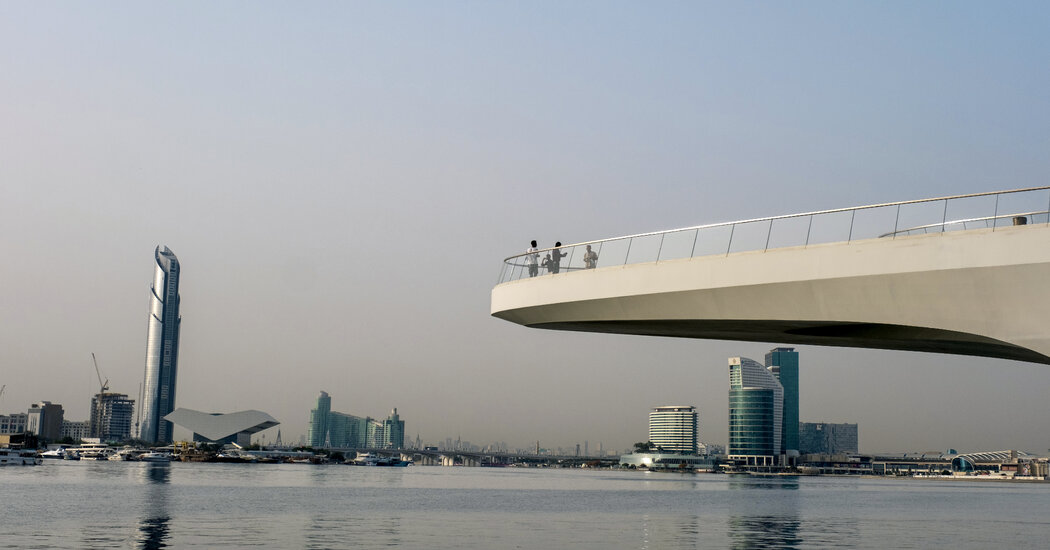
Dubai was billed as the ultimate globalized city — a Switzerland on the Persian Gulf, an authoritarian monarchy offering refuge from taxes and the conflicts that have long unsettled its neighbors.
Swarms of Iranian drones and missiles shattered that illusion on Feb. 28.
Flaming debris scarred the facades of five-star hotels along Dubai’s skyline, including the sail-shaped Burj Al Arab. Three months later, it remained closed. Nearby, the Jumeirah Al Qasr kept its towering floral arrangements fresh and its artificial waterways flowing, but on a recent weeknight, its great entry hall stood empty.
The arrival of danger — and the disruption to air travel and seaborne trade that followed — struck at the foundations of Dubai’s economy. Other Arab kingdoms still depend on oil, but Dubai moved beyond that model long ago. Here, stability itself was supposed to be the product.
The war has become a stress test of Dubai’s model of durability. Jim Krane, a research fellow at Rice University and author of “City of Gold: Dubai and the Dream of Capitalism,” said the city prospered by serving as a crossroads of global talent and business, attracting a population comfortable moving across borders.
“It’s also the big disadvantage when things go wrong,” Mr. Krane said. “Capital can flee, and the people can, too.”
Dubai, the most populous of the seven emirates that make up the United Arab Emirates, sits roughly 90 miles across the gulf from Iran’s southern shore, on the blocked side of the Strait of Hormuz. As a new ally of Israel and a host to American military bases, the Emirates found itself in Tehran’s sights when the war broke out.
Advanced defense systems neutralized most of the barrage. Since those early days, the skies over Dubai have been quiet, but the war has never felt far away.
Last month, the national Emirati government said Iran had launched 2,265 drones, 551 ballistic missiles and 29 cruise missiles since the beginning of the war. Officials reported 13 deaths, most of them foreign civilians, and 230 injuries. Three weeks ago, drones struck a nuclear facility in Abu Dhabi, the Emirates’ capital, a reminder that the threat remains.
Yet the conflict’s true measure may be economic rather than military — whether the very qualities that fueled Dubai’s rise can now help it weather the crisis. Unlike its oil-dependent neighbors, Dubai built an economy around trade, logistics, tourism and finance.
Just before the war, Dubai’s ruler announced that the Emirates’ non-oil trade had exceeded $1 trillion for the first time in 2025, making it the only trillion-dollar trading hub in the Middle East.
Now, many of the industries that drove that growth are under pressure.
Last month, the research firm Moody’s Analytics forecast that occupancy at Dubai’s gleaming hotels could fall to just 10 percent in the second quarter, down from 80 percent before the war. Dubai International Airport, the world’s busiest hub for international flights last year, reported a two-thirds drop in passenger traffic in March. Although airspace restrictions have been lifted, more than a dozen airlines have canceled all flights to Dubai.
About 20 miles southwest of Dubai, Jebel Ali — the largest port for container ships outside East Asia — closed in March after several ships were shot at. DP World, the state-owned port operator, has since reopened the facility, but traffic remains well below prewar levels. Ship-tracking data shows daily arrivals have fallen to fewer than 10 vessels from about 50.
The disruptions to travel and trade are rippling through the economy. The Emirates economy, which includes oil-rich Abu Dhabi, is now expected to contract 5.6 percent this year, according to projections by Goldman Sachs, a sharp reversal from 6 percent growth last year.
Dubai has been a trading hub since ancient times, when barges laden with spices, gold and textiles paid tolls along its brackish creek. Its rise as a modern commercial center began in 1978, when the emir ordered a port built at Jebel Ali, then a fishing village.
The first great wave of migrant workers arrived from South Asia to build the port. Today, about nine in 10 people living in the Emirates are foreign nationals.
For Dubai, the economic squeeze now is most visible in the thousands of businesses that move goods across borders.
Far from the city’s flashy waterfront, on its barren outskirts, Dhinakar Chandran sat in an air-conditioned office in one of the emirate’s proliferating free-trade zones. He is one of the millions from India who have made Dubai their home. He arrived 28 years ago and, after 16 years working in its financial center, left a job at Citibank to pursue his passion for cars.
His company, Oasis Cars, operates from a trade zone dedicated to importing cars from around the world and exporting them to buyers across Asia and Africa. His inventory has everything from Suzukis, Teslas and Cadillacs to Chinese electric sport utility vehicles like the Jetour T2.
Businesses like his pack tens of thousands of cars onto these lots, paying little in taxes and benefiting — before the war — from the promise of frictionless trade with minimal interference from customs officials or port authorities.
The war has disrupted the very system that made businesses like his possible. With Dubai’s main port stranded on the closed side of the Strait of Hormuz, the trade routes that once made the emirate so efficient are now far more circuitous. Vehicles now move through Saudi Arabia or Oman instead, tripling transport costs and pushing prices up by as much as 12 percent.
The government pledged $272 million in aid for businesses affected by the war, but the money is not earmarked for businesses like Mr. Chandran’s company. For now, there is little to do but wait.
“It has to end,” he said. “It can’t continue.”
Even as the economic strains grow more visible, the government has kept a tight lid on bad news. The Emirates has arrested dozens of residents for posting information on social media about the effects of the war.
Still, the city’s allure has faded for some outsiders. David McKenzie, a British headhunter focused on executive recruitment, said his business fell by a third after the initial shock of the war. Most of the remaining business comes from clients already based in the region. The Europeans who once arrived in Dubai without a job, confident of finding work, have largely disappeared.
Across Dubai, people compare the moment to the Covid-19 pandemic, when tourism dried up and logistics seized under newfound complexity. At Dubai International Academic City, many classes are now taught both in person and online to accommodate students whose parents have sent them to their home countries for safety reasons.
In late May, the open-air core of the Dubai International Financial Center was buzzing with bankers at lunchtime despite the heat. The local stock market’s benchmark index shed 22 percent in the war’s first two weeks, but within 10 weeks it had clawed back to roughly where it stood a year ago.
Ziad Daoud, the chief emerging markets economist at Bloomberg Economics, a research service, said Dubai’s “reputation, the brand and the network effect” were what drew elite finance and legal professionals in the first place. Those advantages have not disappeared.
“People who get used to living in Dubai get addicted to it,” Mr. Daoud said.
Even Dubai’s red-hot property sector has been affected. In March, real estate transaction value fell sharply, according to the real estate firm Hamptons International, plunging nearly 30 percent from the month before.
Yet developers remain largely unfazed. Construction continues despite a 30 percent increase in building-material costs, and executives describe the downturn as a temporary interruption rather than the start of a prolonged slump.
Amira Sajwani, managing director of Damac Properties, the largest private developer in the Middle East, said bargain hunters had inundated her with calls.
“I’ve never gotten as many calls in my life,” she said.
The war is also testing one of the country’s biggest bets on the future. Abu Dhabi has invested an estimated $150 billion in artificial intelligence projects with the aim of making the Emirates a regional technology hub.
In early March, Iranian drones damaged data centers operated by Amazon and Pure Data Centers, disrupting services or forcing changes in spending plans.
Omar Al Olama, the country’s A.I. minister, acknowledged the damage but said future facilities would be hardened against attack.
The rebuilt data centers will have “an order of magnitude more protection than we have today,” he said. The goal is to “provide services regardless of conflict.”

