
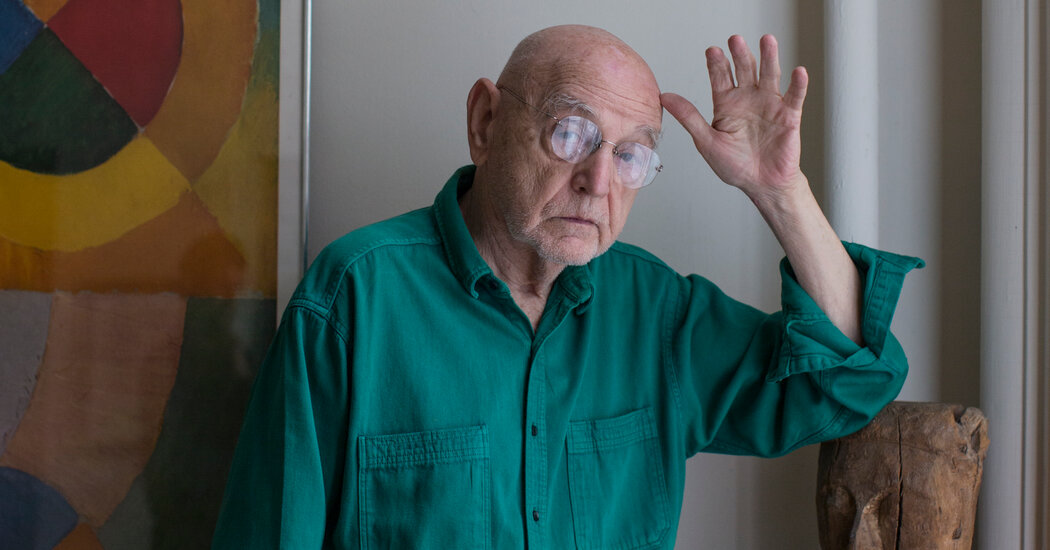
Duane Michals, an impish, provocative artist who used his camera to tell stories with quirky, cosmic, enigmatic or autobiographical themes, helping introduce narrative to modern photography, died on Tuesday in Manhattan. He was 94.
His death, at a hospital, was confirmed by Bridget Moore of DC Moore Gallery, which represented him.
A self-taught photographer and proud misfit, Mr. Michals neither belonged to a particular school of art nor founded one. His influence derived chiefly from proving that someone could succeed without conforming to genre or technical norms.
He published more than 25 books; exhibited regularly at galleries starting in the late 1960s and continuing into his 90s; and had retrospectives at the Carnegie Museum of Art in Pittsburgh in 2014-15 and the Morgan Library and Museum in Manhattan in 2019.
While other photographers of his era found material in the chaos of street life or the majesty of nature, he took inspiration for his pictorial storytelling from the images and writings of William Blake, Lewis Carroll, Joseph Cornell and René Magritte.
A typical Michals work might be structured like a comic strip, with multiple panels of black-and-white photographs accompanied by handwritten titles or captions, or both.
The prints were usually small and not individually consequential. He might need as few as four or as many as 30 to complete a piece. His works could depict a metaphysical reckoning between strangers (“Chance Meeting,” 1970); a ribald sex comedy (“Take One and See Mt. Fujiyama,” 1975); a cryptic parable with biblical overtones (“The Return of the Prodigal Son,” 1982); a children’s fable with a moral (“Grandmother and Odette Visit the Park,” 1992); or a reminiscence of growing up (“The House I Once Called Home,” 2003).
Sometimes he would write beneath each photograph in a sequence; other times he relied on the title alone to do the explanatory lifting.
“Death Comes to the Old Lady” (1969) consists of five panels without text. In the first, a seated woman stares at the camera. In the next two panels, a man in a dark suit appears by her side. He is first seen as a blur and then dissolves into a black shadow except for his hand, placed on her shoulder. In the last photo, she rises and dissolves into blurry shadow herself. (To play the Old Lady, Mr. Michals enlisted his grandmother; he chose his father to be Death.)
“When I write, it’s to talk about what you cannot see in the photograph,” he said in a 2019 interview. “It’s to augment the photograph, to give voice to the silence of it.”
These literary accompaniments were often wry or lyrical. “My Father Could Walk in the Sky” (1989), a double exposure of a naked man seen from below against a dark, starry sky, was accompanied by rhyming couplets: “My father could walk in the sky / He promised to teach me how / But he left without saying goodbye / I don’t cry, I’m a grownup now.”
Despite early recognition for Mr. Michals’s photographs — they were included in the landmark “Contemporary Photographers: Towards a Social Landscape” exhibit at the George Eastman House (now Museum) in Rochester, N.Y., in 1966, and he had a solo show at the Museum of Modern Art in 1970 — they never commanded particularly high prices.
That rankled him as he aged — he had a curmudgeonly side — and he openly satirized younger artists like Cindy Sherman and Andreas Gursky, who were able to make a living by selling prints to collectors. Mr. Michals supported himself from the 1970s to the ’90s with corporate commissions and by doing celebrity portraits for Newsweek, Fortune and other magazines.
Duane Stephen Michals was born on Feb. 18, 1932, in McKeesport, Pa., a suburb of Pittsburgh. His father, John, was a steelworker; his mother, Margaret (Matik) Michals, was a live-in domestic who saw her son and his brother, Timothy, only on weekends.
As a boy, Duane had an interest in drawing that was nurtured by classes at the Carnegie Museum, and in 1949 he earned a scholarship to study graphic design at the University of Denver. After graduating with a bachelor’s degree in 1953, he enlisted in the R.O.T.C., serving two years in Germany before moving to New York City in 1955 to work in publishing.
He discovered photography by chance in 1958, after borrowing a camera from a friend to take on a trip to the Soviet Union. His first efforts were documentary in nature. They found their fullest expression in “Empty New York” (1964-65), a series that portrayed Manhattan’s deserted streets, subway cars, lunch counters and shop fronts in the detached style of Eugène Atget’s photographs of Paris at the turn of the 20th century. (Mr. Michals’s documentary images were largely unknown as a series until 2018, when he published them as a book.)
Atget’s work led him toward the surrealism of Magritte, Cornell and Giorgio de Chirico. Eventually Mr. Michals renounced documentary photography as insufficient for his artistic ambitions. “To photograph reality,” he once said, “is to photograph nothing.”
He considered himself lucky that he didn’t have to “unlearn” what was taught in art school. “I didn’t know that you weren’t supposed to write on a photograph,” he said.
Although his sequenced photographs were staged, the theatrical constructions were seldom costly or elaborate. The sets were spare; the props, often little more than a chair, a bed and a potted plant. In “The Spirit Leaves the Body” (1968), the first of seven panels shows a naked man lying on a covered table. Double exposures of his body then depict a shadowy figure sitting up, standing and walking toward the camera until the figure fills the frame.
Short and slight, and bald by the time he was in his 30s, Mr. Michals was openly gay well before it was widely accepted. For more than 50 years, he shared an apartment in Manhattan with Frederick Gorree, an architect. They were married from 2011 until Mr. Gorree’s death in 2017. Mr. Michals has no immediate survivors.
Mr. Michals ignored trends in political or conceptual art. His art often empathized with the anxieties of the very young (“The Bogeyman,” 1973) or the old (“Grandpa Goes to Heaven,” 1989). In recent years, he collaborated with Josiah Cuneo, a director, to make short films on comical or fantastical themes that were recognizably akin to his photographic sequences.
Seeking to bridge the chasm between the phenomenal and spiritual worlds, his work often illustrated his frustrations as well as his questions. As an artist, Mr. Michals devoted himself single-mindedly, but seldom without humor, to what could — and couldn’t — be said in words or shown in a photograph.
“I believe the only true knowledge is through experience,” he said. “You read a love story, and then you fall in love — then you realize the difference. I want to know what something feels like, not what it looks like.”
Richard B. Woodward, a journalist and critic who wrote widely about the arts, died in 2023.
Ash Wu contributed reporting.

