
I am not a collector, but in 1983, I scraped together $800 in cash and walked over to the Sidney Janis gallery to buy my first work of art. The director raised his eyebrows at the inelegant wad of bills I handed him, but he wrapped up the five-frame Duane Michals sequence I was buying, called “The Return of the Prodigal Son.”
It begins with an older man sitting at a table reading a newspaper; a naked young man enters the room with his head in his hands, in shame. The older man stands up in surprise, a look of judgment on his face. The narrative shows the father — Duane himself — removing his clothes and handing them to his son. In the last frame, the father, now naked, embraces his clothed son.
It’s a beautiful tone poem with a moral. The prodigal son went off in defiance of the father to explore the world and came back defeated. In Duane’s prodigal son the father forgives and shows him love.
I am old enough to say that I knew Duane Michals for almost 50 years. The artist, who died Tuesday at age 94, was a mentor to me, an older friend who set examples that were worth paying attention to (like the father in his sequence). In the world, Duane was an artist of serious consequence, the father of the photographic narrative sequence. His sequences established a genre of storytelling within the history of photography, and that is no small feat. In “Stories,” an exhibition of his work at the Museum of Modern Art in 1970, his multiple frame image-and-text pieces were referred to as “evocative mime fables.” One example is “Paradise Regained” (1968), which underscores the edenic fantasies of two New York City apartment dwellers.
His sequences are often jewel-like parables that identify some true thing about human experience, staged with the care of an auteur. Photographs are constructed with natural light, optical clarity, nuanced tonality, and classical composition, accompanied by simple text that he scratched out in a childlike hand. They reminded me of the seemingly tossed-off descriptions of a New York City street in the poems of Frank O’Hara, or a droll New Yorker cartoon. He could parse out truths about the perplexing enigma of being human on this planet at this point in time. Often, Duane’s sequences left me with a catch-your-breath awe, wondering how he was able to tell so large a story in so few beats.
Duane had a quick, peripatetic mind. Our conversations over the years were, at times, philosophical, metaphysical, honest about the daily circumstances of our lives, and dishy about the contemporary art world. Of course, he could be whimsical, always up for a good laugh. Because he lived around the corner from the Union Square Cafe and Gramercy Tavern, they were his default restaurants. I left many an evening with Duane feeling elevated, as if my consciousness had been slightly recalibrated.
His preternatural insight is evident throughout his work. His six-frame sequence, “The Human Condition” (1968) begins with a young man standing on the subway platform at 14th Street as the train arrives. In the subsequent frames he is bathed in light; the light gets brighter; it engulfs him in a circle; the circle of light tilts and whirls; and the last frame shows the light as a disc floating like a galaxy in the vast universe. One minute we are here in our prosaic existence; the next we are orbiting universes, whether molecular or quantum.
I FIRST SAW DUANE’S WORK in the early 1970s when I was at Pratt Institute studying painting and photography. His debut book, “Sequences,” had recently come out and it was controversial in the photography program since documentation of the actual world was the ascendant practice — Robert Frank, Diane Arbus, Lee Friedlander, Garry Winogrand. Duane’s sequences were surrealist and conceptual; their subjects constructed rather than discovered, and not contained within a single frame. “The Spirit Leaves the Body,” one sequence, repeats the same naked figure lying alone in an empty room six times, a transparent silhouette rising out of the body in the subsequent frames — sitting up, standing, and walking toward the camera — until the figure is left on the bed, inert and alone.
We met in 1978, when I was working at Aperture and was invited to a New Year’s Day brunch for the then very small photography world. He had a rock-star effect on me. He had brought with him a newly published book, “Homage to Cavafy,” his tribute to the early 20th-century Greek poet, who was gay. We sat on the couch and looked at the book together. The pictures echoed the feeling and attitude of Cavafy’s poems, capturing inhibited homosexual desire with lyricism, joy and melancholy. Duane was closer to my parents’ age, from a closeted generation. He was the first man I had met who was both conventionally accomplished and completely open and comfortable about his sexuality. His honesty gave me courage in my own assimilation into the professional world as an openly gay man.
Duane’s sequence, “Chance Meeting” (1970), is an ambiguous allegory of New York City street life. In six frames, we see two well-dressed men walk toward each other. As they approach each other, the one walking toward us looks sideways at the other, who passes him without acknowledgment. They continue to walk away from each other, the first man looking back again, but the second continues on his way. Only when the first man leaves the frame does the second turn back to look. Is it a case of one stranger recognizing the other too late, or a scene in which gay men are cruising each other, but missing the signals?
Duane addresses the issue of homosexuality more directly in his single image/text piece, “The Unfortunate Man” (1976) which is emblematic of the pain gay men endure in a homophobic society. It was embraced as an allegorical symbol of liberation in the struggle for gay rights.
Fred Goree, Duane’s life partner, was an architect. They were together for 58 years, married in 2011 when gay marriage became legal in New York. It was good for me to see how stable a gay couple could be, and how civilized their life was together, between their townhouse near Gramercy Park and their farmhouse in Vermont, where they escaped on weekends to work in their coveted garden.
Duane grew up in modest circumstances in McKeesport, Pa., a steel-mill town outside of Pittsburgh. He never denied the simple fact of his working-class roots; in fact, he talked about it as if a badge of honor, particularly in contrast to his world of urban sophistication. He grew up in the same circumstances as Andy Warhol, also from Pittsburgh, and they shared affinities when they met in New York in the 1950s. Duane made two portraits of Andy and his mother, often shown together. In both, Andy is seated behind his mother. In one, Andy is in sharp focus, and his mother is not. The other is reversed with his mother in focus. It’s an intended perceptual joke.
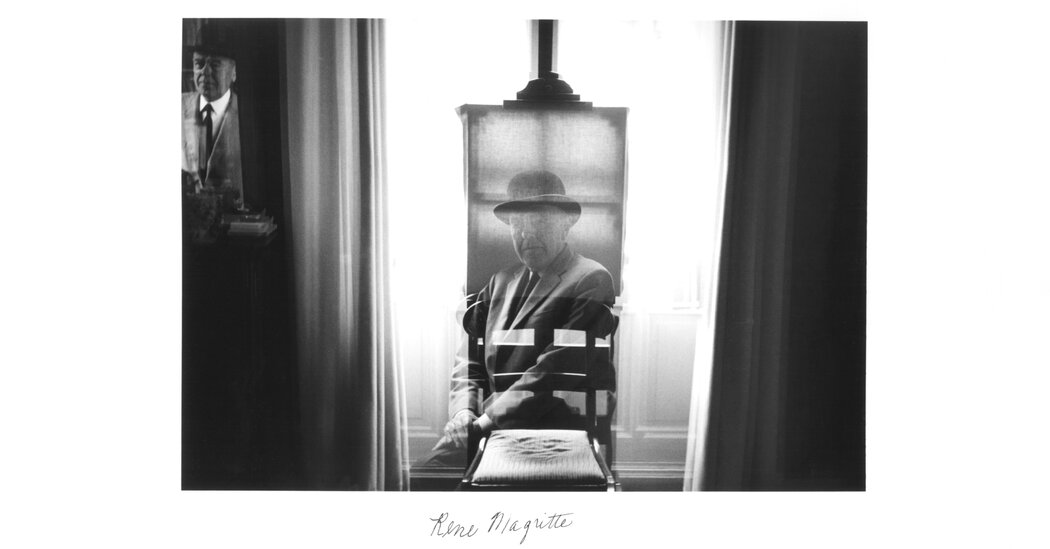
Duane loved the witty juxtapositions and perceptual challenges in Magritte’s work, whom he considered a major influence. He made several pilgrimages to Brussels to photograph the renowned artist, and he considered “Magritte at His Easel” to be his favorite portrait session. Less obvious, though, was his regard for Atget. In the early 1960s, Duane made a series of traditional, single-frame photographs of streets and public spaces in New York, absent any people. With forensic rigor, he brought the same formal consideration of the hard-edge urban architecture and the atmospheric, early morning light of midcentury New York that Atget brought to his documentation of old Paris and its environs in the early 20th century. His images from this series are collected in a book called “Empty New York,” published in 2018, which I consider a small masterpiece.
Michals not only successfully established a formidable place in the art world, he succeeded in the commercial world, as well. He photographed for the major magazines, making portraits of celebrated artists, writers, and Hollywood actors, as well as ad campaigns for famous fashion labels and he published over 30 monographs and books. At 94, there he was — photographing Jacob Elordi for a Bottega Veneta ad campaign that included multiple print images and videos.
I still have “The Return of the Prodigal Son” from 1982, each image framed across my dining room wall. It has enduring qualities as an allegory with ethical resonance and mythological scope. For me it will always be Duane’s self-portrait, made with the visual rigor and poetic grace of an auteur — and his essential spirit of generosity.

