
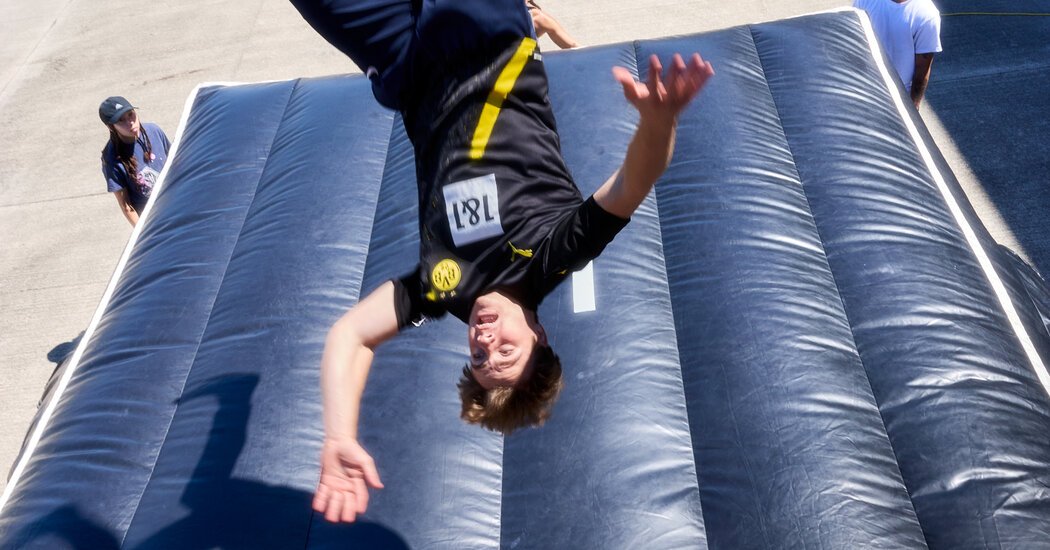
At the International Stunt School in Seattle, veterans of TV and film teach newcomers the art of falls, fights and fire.
There were stunts in films before there was talking. Long before Tom Cruise dangled from the wing of a plane, the silent film star Harold Lloyd originated an enduring Hollywood image, hanging from a clock face in “Safety Last!” (1923). Though the slapstick and sight gags of Lloyd and his peers Buster Keaton and Charlie Chaplin once shaped cinema, opportunities in the stunt industry, like many aspects of film production, are now changing because of technologies like CGI, A.I. and robots.
“If we find the right way to show our perspective in a way that a machine could never do, I think we can still make stories and do stunts and still provide a human element,” said Greg Poljacik, an instructor at the International Stunt School in Seattle with 18 years of film credits. Last summer, the school opened its doors to train a new class of performers on falls, fights, fire and the artistry of stunt work.
At a morning fight-choreography session in a gym at the University of Washington, R&B slow jams blared over speakers as students methodically worked through throwing punches and kicks at one another in slow motion. Alongside learning physical performance, students were coached on how to verbalize getting hit: Instead of repeating the same staccato sound (“oof!”) they were encouraged by teachers to “use the whole alphabet” (“ah!” “ugh!”).
Training covers 15 different skills over a three-week course, with a focus on fighting and falling down because those actions are the basis for most stunt work, Jeff McKracken, the school’s owner, explained.
Chuck Johnson, a stunt performer with over two decades of experience, led about 50 students through choreography rooted in martial arts, at times getting philosophical with his direction. There was talk of “swimming” through movements as performers pushed and pulled one another. Johnson used words like “clarity” and “beauty” to describe the impact of a precisely located hit on a performer’s body.
“A film fight is the hardest thing to do on film,” McKracken said. “You have to hit these exact marks. You have to hit them at the right speed. Everything. The reactions have to be right, exactly timed.”
Alex Ecker, a student and a former Marine, said he was shocked how much control was necessary to hit marks. “It’s frustrating with how precise you have to be,” he said.
As the choreography picked up speed, students were filmed in their fight sessions to give them an awareness of the camera’s relationship to the stunt — and the importance of selling the performance. The best side of a stunt always has to face the lens: The trajectory of a feigned punch, a few degrees off, can look fake to viewers. “If it doesn’t play to the camera, there’s no shot. You don’t have a product,” McKracken emphasized.
Under Washington State law, anyone can enroll at the Stunt School regardless of skill, but students in its nascent days often skewed toward a certain machismo. That’s begun to change in recent years, according to McKracken, who estimated that a third of enrollees are now women. “It’s evolved, especially during the time that I’ve been working, into more of an art.”
This year’s class is filled with gymnasts, martial artists, actors, former military members, and at least one former employee of the Cheesecake Factory. Jarrett Green, a former corrections officer, said that before signing up for Stunt School he’d been in multiple car accidents and had unintentionally caught fire a few times. He figured “it might be cool to actually do this stuff on purpose for once and get paid for it.”
After hand-to-hand fight instruction, practice weapons were introduced to the training. “The goal of all the fighting is how to be safe, but make it look good,” McKracken explained. “And the weapons are just an extension of that. Once you have something in your hand, you know you’re swinging something at a higher velocity, you have a greater chance of injuring people.”
From the basics of fight choreography, the school takes the lessons about safety and precision and applies them to other areas of the curriculum. Safety protocols have evolved considerably in industry education, particularly since the high-profile fatalities of two stunt performers in 2017. On the sets of “The Walking Dead” and “Deadpool 2,” stunt performers were fatally injured while performing, respectively, a high fall and a motorcycle stunt. Improved wires and padding to support falls, as well as CGI to replace artificial bullet hits and other impacts, now supplement the physical action. “You can’t remove risk. You can’t eliminate risk. It’s not possible for what we do, but you can reduce it, and that’s our goal,” McCracken said.
The instructors, many of whom are alumni of the program, can all perform utility work (a jack-of-all-trades role in the industry), but many also have specialties that can make their résumés read like the climax of an action script: stunt driving, fights, fire burns, high falls. They say on average it takes about five years after graduation to get established, a period when newcomers can expect to work their way up from assisting a stunt person and carrying gear to bit parts. After years of major jobs, Daniel Ford Beavis, an instructor and alumnus (class of 1997), said he and other seasoned performers look to teach. “Getting old happens, so we start looking forward to seeing the younger people come up to do the big high-action scenes and take the hard hits.”
Make It a Performance
It’s hard to act like you’re on fire, even if you’re actually on fire. Poljacik, teaching a class on fire burns, emphasized to students that they can’t just gyrate at the hips like a plastic hula dancer on a car dashboard.
“Step one — come out unharmed,” Poljacik said. “But step two is now to paint something with the flames, do something beautiful with the fire, and be able to move it in a way that the lens captures it.” Should the audience be horrified? Is the moment beautiful? Tragic? There needs to be motivation behind the performers’ reactions to being doused in flames.
Every fire burn began with deadpan direction: “You’re on fire.” From there, dressed in a kind of David Foster Wallace cosplay (denim, large flannels, bandannas over their hair), students’ backs were ignited.
Beavis, the instructor and alumnus, said that being aflame was actually the easier part of the stunt. “It’s your safety team keeping you safe that has the real job,” he said. Beavis invoked a mantra passed down from the school’s founder, David Boushey: “I could light my mother on fire if I have the right stunt team.”
Across town, outside a large gymnastics facility, students work their way up to high falls — those from multiple stories up. Beginning with a drop of just a few feet, they jump while referencing a Barbie doll that instructors used to illustrate proper form. Gradually, the height of their falls increases as a hydraulic lift cranks higher.
Ariel Lee, a gymnast-turned-instructor, demonstrated a handstand into a free-fall from multiple stories up. Letting out a bloodcurdling scream as she dropped, it was difficult to tell if her reaction was real or merely a performance.
Temper Expectations of Fame
Eventually, the same skills of motion and coordination are applied to stunt driving. “Vehicle stunts are the most dangerous stunts to do in film. That’s where a lot of accidents happen,” McKracken said. “Because the velocities are higher, because the masses are larger, everything gets exponentially more dangerous.”
Morgan Grody, an instructor with stunt performing and directing credits, had been workshopping burnouts and skids with students for most of a day at Evergreen Speedway, north of Seattle. He said he was still trying to piece together full-time income as a performer, looking for day jobs around town.
“I’ve been applying to be a regular driving instructor at all these places, getting no interview, no call back, nothing,” he laughed as he watched stunt cars being brought in from the track. “You think, I can’t teach one 16-year-old in the car with them how to [expletive] press a gas and brake and make a right turn or left turn and parallel park? Please.”
By design, there are only rare glimpses of on-camera glory for stunt performers, who are trained to be anonymous. McKracken pointed to one of his favorite “stair falls” ever filmed, from the movie “Fight Club.” Edward Norton’s character falls down a massive set of stairs, and, near the end of the shot, the stunt performer’s face is clearly visible.
“In the industry, a lot of people call it back-of-the-head-famous,” Shane Alexander, an instructor, said. But stunt performers will soon get a bit of recognition. After years of petitioning from stunt pros and the noted stunt enthusiast Tom Cruise, the first Oscar for stunt design will be awarded in 2028. There’s also the validation that comes without a trophy.
“You walk in like a relief pitcher,” Poljacik said. “And when you deliver, that’s the feeling for me, more than the rush of doing the stunt. It’s the accomplishment of, yeah, I did this really cool and hard thing, and then I go home and let the dog out and go back to normal life.”
Additional Footage by Rory Reshovsky.

