
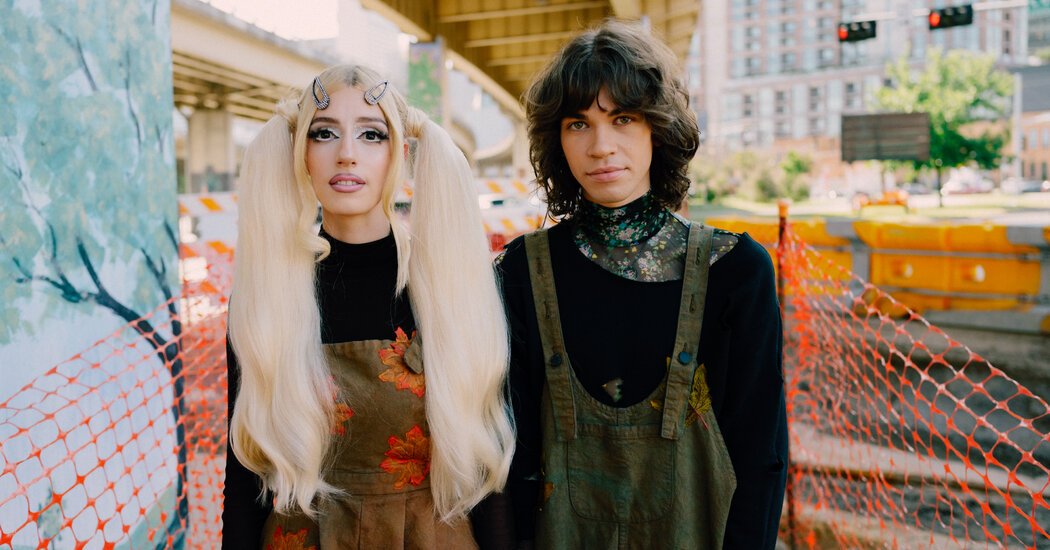
Domi & JD Beck is a duo of speed demons. The music they make flaunts dense harmonies, odd meters and breakneck motion, with Domi Louna’s flying fingers on keyboards — often joined by her feet playing counterpoint on bass pedals — backed by James Dennis Beck’s kinetic, microscopically dissected beats on the drums.
“Since I was 3 years old, I’ve liked to play fast,” Domi said in a shared video interview, sitting alongside Beck in their house in Dallas. Her eyes were made up with the glittery, silvery, glam-extraterrestrial look she wears onstage. “I don’t think we try to play fast. I think this is genuinely who we are. And the more we try to fight against ourselves, like, when you push stuff down, it will come back and explode.”
Beck added, “We’d rather just embrace what comes naturally.”
In 2022, Domi & JD Beck turned heads with their debut album, the untruthfully titled “Not Tight.” Their radically different second album, “Who Asked?,” arrives Friday. “We took a big gap and decided to hop into different territories,” Domi said.
In some ways, Domi, 23, and Beck, 26, are an unlikely partnership. She is French; he’s from Dallas. She’s conservatory-trained, often using sheet music onstage; he does not read music notation. But both of them have been completely immersed in music since childhood. “Our only true reference to life is through the lens of music,” Beck said.
Domi, born Domitille Degalle in Metz, France, started playing drums as a 2-year-old and switched to piano a year later. Her father, though not a musician, was determined that his children would have an artistic outlet, and Domi was required to practice piano for five hours every day.
From the age of 3 to 15, Domi said, she had no days off. “Not on Christmas, on your birthday, when you’re sick,” she said. “Nope, you will practice. So by 15 years old I had, like, 25,000 hours of practice. And I would not trade it for anything else. Even though it was super hard, I happened to love it. I still love it. Practicing by yourself is the most peaceful thing you can do.”
Domi enrolled in the Grand Nancy Regional Conservatory in France at 5 and later attended the Paris Conservatory. She came to the United States as a teenager with a scholarship to the Berklee College of Music in Boston.
Beck started playing piano at 5. “I learned that it wasn’t necessarily piano I liked — it was music in general,” he said. “And I had a lot of energy. I would play soccer with my dad all the time. I just liked fast-moving things. And drums fit my childlike first instinct.”
Musicians in Dallas, including members of Erykah Badu’s band, took the young drummer under their wing. Beck absorbed jazz, funk, soul, hip-hop and electronic dance music. Domi and Beck met in 2018 and started writing together almost immediately. They soon started posting prolifically to YouTube, Instagram and SoundCloud. In 2020, after the death of the rapper and producer MF Doom, they uploaded a four-minute medley of songs from “Madvillainy,” Doom’s 2004 album with Madlib, that drew millions of views.
Fellow musicians quickly noticed the duo, and so did musical-instrument makers. Their material was deep music-nerd territory, full of extended chords and tricky time signatures, usually a limited niche. But Domi & JD Beck escaped that pigeonhole with their youthful charm, clear melodies and an endearing stage presence. They were offered studio collaborations and got gigs as band members, notably with the bassist and funk experimenter Thundercat and with the rapper and bandleader Anderson .Paak.
They were in the studio with .Paak while he and Bruno Mars, collaborating as Silk Sonic, were trying to complete the song “Skate” and getting frustrated. “I was like, ‘Why don’t you guys try to help us make this [expletive] song?’” .Paak said in a telephone interview. “You can do all that difficult stuff, but what about something that’s just in the pocket?”
He gave them a demo of the vocal melody and they came back with the foundation for the song. “They helped put together the blueprint,” .Paak said.
When .Paak started a custom label distributed through the venerable Blue Note Records, Domi & JD Beck were his first signing. “I thought they were captivating,” he said. “I thought they were two people that you could just put in a room and people would be enamored just by their skill. They had a magnetic kind of thing to them.”
.Paak asked them to suggest possible collaborators for the album, and they gave him a multigenerational wish list, placing themselves at a nexus of jazz, hip-hop and twisted pop. The guests on “Not Tight” telegraphed the duo’s multipronged influences: the jazz keyboard master Herbie Hancock, the rappers Snoop Dogg and Busta Rhymes, the indie-rocker Mac DeMarco and the MacArthur Award-winning jazz guitarist Kurt Rosenwinkel, along with appearances from .Paak and Thundercat.
After the album’s release, Domi and JD Beck toured for two years, far and wide. Onstage, they faced each other in close proximity, with both hands and feet visibly zooming through the songs. It was real-time, physical virtuosity, not a programmed playback. Between songs, the duo shared giggly, self-deprecating banter. They continued to work social media, and their NPR Tiny Desk Concert drew 1.8 million streams.
Then, for two years, they went quiet. No social media clips, no gigs. They had written their first album piecemeal, amid touring and sideman work. This time, new music was their only project.
They decided to make an album without big-name guests. “We needed to find out, ‘Who are we without anything else?’” Domi said.
But a 2023 tour with the Dutch ensemble Metropole Orkest had opened their ears to the possibilities of orchestral instruments. They embraced the idea of hiring classically trained musicians, multiplying the possibilities for counterpoint. “Being players growing up, we’ve always had a thing in our head, like, ‘How is this performed live?’” Beck said. “And I think that was holding us back.”
On tour, they had been listening to an ever-broader array of music; they cited Björk, Deerhoof, Brian Wilson, Steve Reich, Stravinsky, Julius Eastman, Led Zeppelin, Scriabin and the electronic duo Autechre. While making the album, they repeatedly watched two movies they found especially inspirational: Stanley Kubrick’s “Barry Lyndon” and Akira Kurosawa’s “Dreams,” which both influenced the earth-toned palette of their new album cover and video clips. They had a story in mind for a film with the album — but not the budget for it.
They worked endlessly on details. Each orchestral musician was recorded separately in their small home studio, and “they all said it was the hardest part ever,” Domi said. “But they were very into it, because it was challenging.”
“It took us two years,” Domi said. “The first year was wonderful. We went through the writing, we went through playing our parts. We felt like it was going at the right pace and we were laying down all of our brains in a funny way, you know? And the second year was incredibly difficult. We encountered every single difficulty, like organizing and having to record the orchestra one by one. It took us 110 hours.”
“And 300 hours to mix,” Beck added. “We don’t want to be so isolated again. Two years of working on the same thing, 12 hours a day, seeing no one, it was — yeah, I don’t like it.”
Except for three instrumental tracks, the songs on “Who Asked?” have lyrics and distinct pop structures: verses, choruses, bridges. “The songs feel slower to us on this record, I swear,” Beck said.
But they are teeming with counterpoint at every level. Domi and Beck often sing simultaneous, crisscrossing melody lines, which in turn intersect with pointillistic motifs from keyboards, woodwinds, strings and more. Meanwhile, Beck’s drums spatter ever-changing cross-rhythms against the intricate chamber-pop constructions, and every so often there’s a swerve into improvisation.
The new lyrics are far less casual than they were on “Not Tight.” The underlying story isn’t obvious, but the songs ponder creativity, human connection, change, hope and the inevitable passage of time. In “Growing Older,” Domi and Beck sing, “Days cascading out of sight / Younger ways like fleeting light.” And they conclude “Climbing High,” the album’s last song with words, by singing “Facing the open / Ended / Questions / Answers.”
“We ended the record feeling excited and hopeful for more, a new one, the next one,” Domi said. “Let’s keep going.”

