
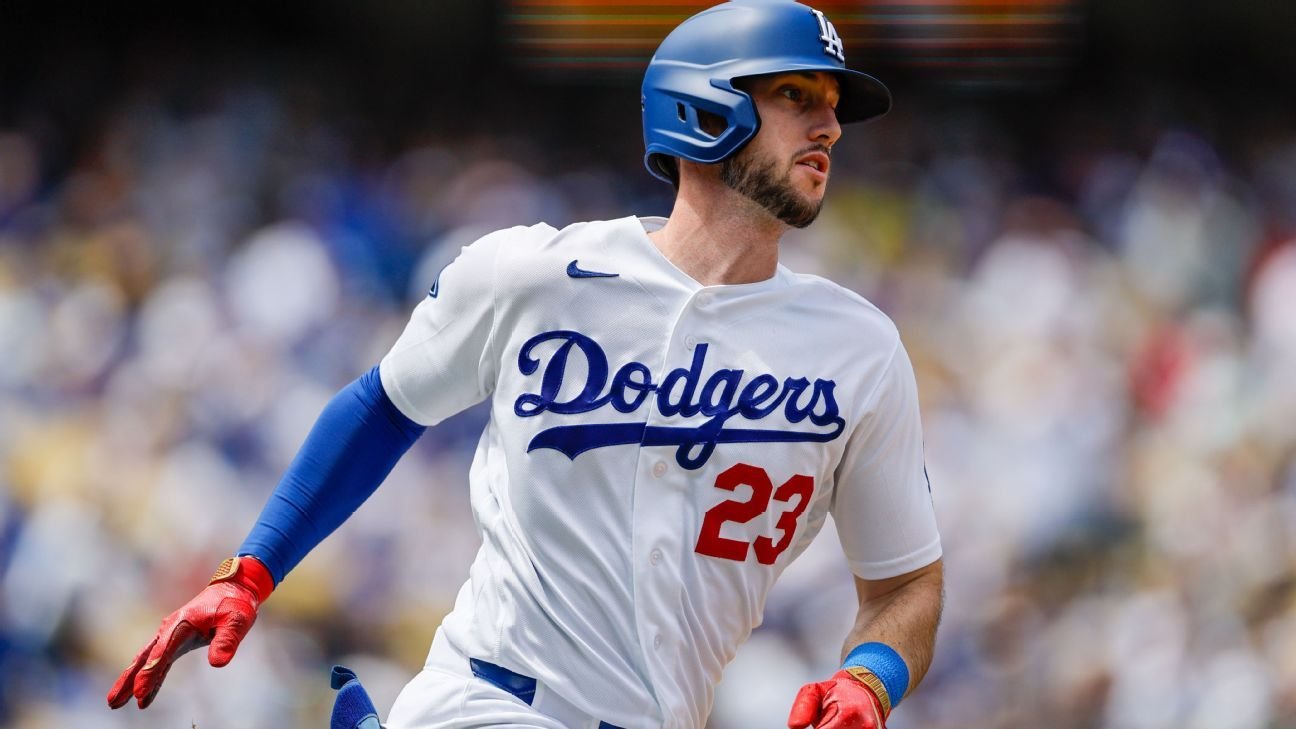
LOS ANGELES — A handful of times this season, Kyle Tucker has found himself inside a batting cage far later than he’s used to. His teammates have showered and dressed, some of them have left the ballpark entirely, and Tucker is still wearing his game pants, hitting front toss, searching for a swing that has continually eluded him. Before this year, postgame batting practice, a rarity in the major leagues, was completely foreign to Tucker. And yet, as he noted last week, “I normally don’t hit .220 for 80 games.”
Tucker’s batting average after the Los Angeles Dodgers‘ 80th game was .234, to be exact.
Over the past five seasons — a run he parlayed into a four-year, $240 million free agent contract, giving him the highest annual salary in baseball history — Tucker had never finished June with a batting average below .254 or an OPS below .811. Last year, after a scorching-hot start with the Chicago Cubs, he was slashing .291/.395/.537 by that point. And yet when the Dodgers began a series at Petco Park in San Diego on June 26, Tucker was batting .234/.333/.374, with an OPS that ranked 112th among 154 qualifiers.
The Dodgers’ left-handed-hitting right fielder went 0-for-3 in a loss that night, at one point stranding the bases loaded, and went back into the cage once more. What emerged from that is something closer to the version of Tucker the Dodgers had been waiting for.
In 10 games since, Tucker is 14-for-38 with as many walks as strikeouts (eight). A four-walk game on the first night of July was followed by a four-hit contest on the second. Along the way, there was also a home run to cap a nine-pitch at-bat, a pinch-hit single against Adrian Morejon, one of the game’s most dominant lefties, and several at-bats in which Tucker’s mechanics were more in sync and his swing was more on plane. To many who have watched him, it’s a sign that the Dodgers’ thoroughly disappointing offseason splash might be primed for a second-half breakout.
Said Tucker: “Even my takes have been a lot better.”
Despite Tucker’s struggles — and prolonged absences from Blake Snell, Tyler Glasnow and Edwin Diaz, three of the Dodgers’ most important pitchers — the Dodgers are once again the class of the sport, compiling baseball’s highest winning percentage and best run differential. Even before Tucker began to turn a corner, their offense ranked first in OPS, first in weighted runs created plus and second in runs per game. They were a dominant force without getting much of anything from the man who was brought in to be a catalyst.
If Tucker gets going, fellow Dodgers outfielder Teoscar Hernandez said, “This team is going to be a problem. For real.”
Tucker is far from the only big name in baseball who is struggling this year. Bo Bichette and Alex Bregman, two of the other free agent prizes this past winter, also got off to brutal starts. The same can be said for fellow stars Fernando Tatis Jr., Rafael Devers, Trea Turner, Vladimir Guerrero Jr., Manny Machado, Willy Adames, Austin Riley and Jackson Merrill, among others.
If the expectations of a massive contract had something to do with it, Tucker won’t let on.
“I don’t care about that,” he said. “I’ll play regardless of what my contract is or anything else. I’ll play the same regardless of any outside stuff.”
Besides, the issues are far more technical.
It all comes down to Tucker’s swing. It’s longer and flatter than that of most hitters, a benefit in that it stays in the strike zone a lot longer, allowing him to consistently barrel pitches and maximize exit velocities. But because of that, it is also especially important for him to stay balanced with his lower half. When he starts to drift forward while swinging, as he did so often at the start of this season, his bat leaves the strike zone quickly and, as a longtime talent evaluator said, “his timing is screwed.”
“He’s been caught in-between a s—load all season,” the scout added. “He gets drifty, and his swing almost looks like a two-handed tennis backhand. When he was at his best in Houston, he was grounded and staying on his backside longer, which allowed his barrel to really accelerate through the zone with leverage.”
While on loaded Houston Astros lineups from 2021 to 2024, Tucker slashed .280/.362/.527 with 112 home runs, 80 stolen bases and 18.9 FanGraphs wins above replacement, fourth most among outfielders. Tucker was having an MVP-caliber season in 2024, then he suffered what was later revealed as a fractured shin in early June and missed three months. His hot start with the Cubs last year was followed by a massive slump that lasted longer than a month and might have been caused, at least in part, by a hairline fracture in his right hand.
The Dodgers signed Tucker with the belief that, at just 29 years old, he might finally reach his ceiling in their uniform — but then his swing got out of whack.
By June 27, Tucker had posted his highest chase percentage in four years, was striking out more often than he had since 2019 and was making contact at the second-lowest rate of his career. He had gone from slugging .507 on changeups the past two seasons to just .269 on that pitch in 2026, a sign of how often he was off balance. He was seeing a career-high 3.98 pitches per plate appearance, which, according to Tucker, was a sign of his biggest problem: missing hittable pitches early in counts.
“Throughout the first half I just haven’t been able to put good swings,” Tucker said. “That’s where I’ll foul it off or swing through it. And then I’m just in worse counts, and they end up having more freedom to be able to throw whatever they want. And then you’ll just naturally start chasing, to where if I hit the ball in the first place and hit it for a single or double or whatever, just barrel something, I won’t even get in those counts to have to chase something.”
Tucker began the year hitting second, flanked by Shohei Ohtani and Mookie Betts, but was dropped all the way to seventh in June. The Dodgers were concerned with the amount of hittable pitches he was missing and how often he was chasing, especially below the strike zone.
Through that, they were learning how to reach him.
Tucker, according to those who have spent time around him, is very reserved. He prefers to work on his own and doesn’t often seek feedback. Like many hitters, he operates far more on feel than he does on mechanics. Aaron Bates, one of the Dodgers’ hitting coaches, learned that in order for Tucker to stay centered in his stance, he needs to feel as if he’s squatting.
“He’s not actually doing that,” Bates said. “It just helps him hold his back side, control his stride.”
In recent years, Tucker was among the best at maximizing the outcomes of swings. This year, though, his squared-up rate, which measures how often a hitter attains at least 80% of the maximum exit velocity available on a pitch, sits in the 56th percentile. His expected slugging percentage is barely above the bottom third because of it. His focus lately has been getting his hands back and “slotting my bat and everything in the right angle early on, just giving more time, and then just staying on the pitches.”
“I don’t know exactly how to describe it,” Tucker said. “I just kind of know how to do it right now.”
Over the years, some of the coaches and teammates who have shared a clubhouse with Tucker have described him as someone who is relatively apathetic about baseball and puts in less extra time working at it than most, instead letting his talent take over. But through struggle, the Dodgers have come to a different conclusion. They’ve learned that if he’s not performing to his standard, he’ll grind until he is. They’ve learned, as Dodgers manager Dave Roberts put it, that he won’t run from the work. A team official noted that Tucker has probably put in more extra work over these past three months than he has over these past three years, simply because he had never failed like this.
He won’t religiously show up for early on-field work like Betts and Freddie Freeman and so many of the Dodgers’ position players do, but, as Bates said, “You can care in a different way.”
Those postgame batting practice sessions are proof of that.
“He’s not a very vocal guy,” Bates said, “but he’s a guy who shows up every day to play. That’s what he’s been here. His attitude and his effort level have been that way. I think it’s just easy for anybody to poke holes at someone if they’re not out there doing all this work in front of everybody, and then if they’re not doing well they think it’s because they don’t care. With him, you give him the benefit of the doubt. He’s done it for a long time and had a lot of success.”

