
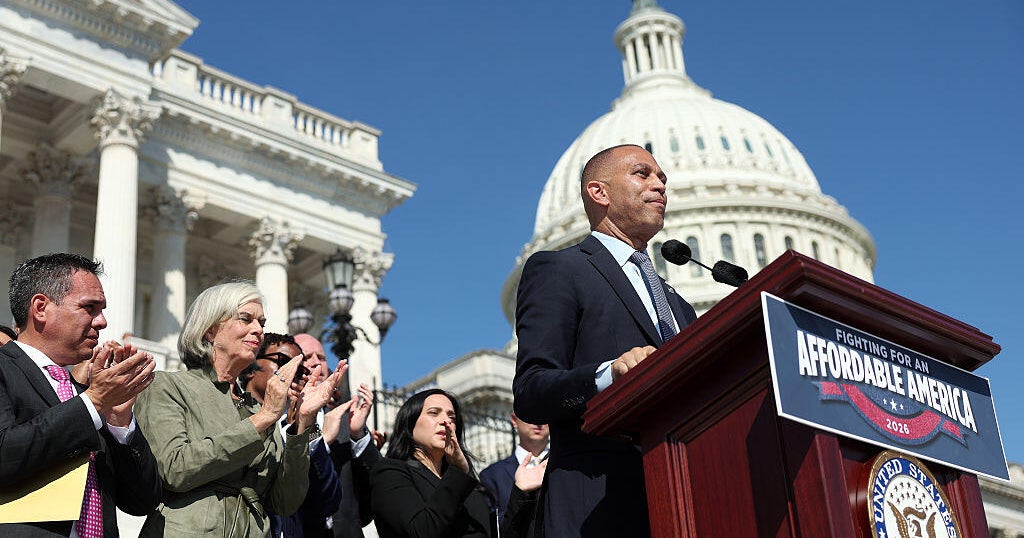
Washington — Democrats will capture enough House seats to retake control of the chamber early next year, CBS News projects, effectively halting President Trump’s legislative agenda and teeing up a wave of investigations into his administration and business ventures during his final two years in the White House.
Economic discontent over the cost of living helped Democrats flip control of the House after four years of a razor-thin Republican majority that ceded large parts of its legislative authority to the Trump administration.
The total extent of Democrat’s majority is unclear as votes in several competitive races continue to be counted.
What comes next
House Democrats are planning aggressive investigations when they secure subpoena power in the new Congress in January. They are expected to probe the president and his family’s business dealings, the administration’s immigration enforcement, the Jeffrey Epstein scandal, Mr. Trump’s pardons and the rushed construction projects throughout the nation’s capital.
The investigative blitz — expected to be spearheaded by Reps. Robert Garcia of California and Jamie Raskin of Maryland, the top Democrats on the Oversight and Judiciary Committees, respectively — sets up an all but certain clash with the administration over congressional oversight requests that could land in court.
Democrats, who will also have authority over federal spending, could withhold funding from the Trump administration’s priorities to pressure officials to appear for testimony or comply with other requests.
There’s also the question of whether Democrats will try to impeach Mr. Trump for a third time. Jeffries has maintained that “we haven’t ruled anything out” or “ruled anything in.” Though Mr. Trump has warned that he’s expecting Democrats to impeach him, few are eager to go through the process.
Jeffries has said the Democratic agenda will focus on affordability. He’s laid out a handful of their immediate priorities, including reversing cuts to Medicaid that were enacted as part of Mr. Trump’s One Big Beautiful Bill Act, extending the Affordable Care Act premium tax credits that expired last year, ending the Iran war and rolling back the president’s tariffs.
Midterm elections are historically rough for the sitting president’s party. Since 1934, there have been just three instances in which the sitting president’s party has gained House seats in non-presidential election years, according to the American Presidency Project.
Mr. Trump fanned the headwinds by lacking a strategy to exit the unpopular war with Iran that has stretched into its ninth month and initiating trade conflicts that have accelerated inflation as many Americans struggle to afford groceries and gas. Mr. Trump’s fixation on building a massive ballroom at the White House, along with other remodeling and construction projects in Washington, offered a stark split screen with voters’ affordability concerns. Mr. Trump largely dismissed cost-of-living concerns, while blaming his predecessor for high prices.
In the final weeks of the campaign, Democrats focused their closing message on the high cost of living and linked corruption in Washington to rising prices. A recent CBS News poll found most voters thought there would be more government corruption if Republicans maintained control of Congress and the issue was a factor in their votes.
Republicans framed the election as a choice between “common sense” and “crazy,” pointing to the wins of democratic socialist candidates.
At the president’s urging, Republicans in several states, including Texas and Florida, reshuffled the House map to create more seats favorable to their party in order to retain control of the lower chamber. But the 15 additional seats in seven states had minimal impact on saving their majority. Democrats also countered the move by redrawing congressional districts in California, which made five seats less favorable to Republicans.
House Speaker Mike Johnson’s tenure leading the lower chamber has been fraught with GOP infighting that was made more complicated by the president’s shifting demands. The Louisiana Republican joked that he was more of a therapist than House speaker as he managed a fractured majority. But Johnson also had to lean on Mr. Trump to get holdouts on board for important votes. The GOP’s narrow majority meant that, at times, just one or two Republicans had the power to derail the party’s agenda until their demands were met, or that a few Republicans could team up with all Democrats to bring legislation to the floor that had been ignored by GOP leaders.
The party breakdown for the 119th Congress — currently 218 Republicans, 214 Democrats, one independent and two vacancies — has shifted over the last two years as Mr. Trump poached members for his administration and there were several deaths, early retirements and resignations over misconduct allegations.
The defiance on a number of politically sensitive issues ranging from the release of materials related to Epstein, reining in Mr. Trump on Iran and a vote to impeach Defense Secretary Pete Hegseth has coincided with Johnson sending members on recess days, sometimes weeks, early.
Jeffries could face a similar dynamic with a handful of democratic socialists, some of whom ousted longtime incumbents in the primaries, and Democrats who represent districts that Mr. Trump won in 2024.
Jeffries’ ability to keep his caucus united was tested in September when two moderate Democrats — Rep. Marie Gluesenkamp Perez of Washington, who is running for reelection, and retiring Rep. Jared Golden of Maine — split from their party to help Republicans who were struggling to pass a party-line procedural vote. In defense of their defections, Perez and Golden said the underlying legislation — Russia sanctions and protections for Maine’s lobstermen — were too important to postpone their passage.
Several members of the democratic socialist bloc have not committed to supporting Jeffries for House speaker.
Rep.-elect Melat Kiros, who will represent Colorado come January, told CBS News she’s had “wonderful conversations” with Jeffries. But when asked whether she would support him for speaker, she declined to give a definitive answer.
“I’m going to support anybody who ensures that the agenda is in line with the priorities of the American people,” she said.
Rep.-elect Chris Rabb of Pennsylvania also declined to say whether Jeffries had his backing.
“I don’t know who’s running, and I’ll sit down with anybody who wants to earn my vote. But unless and until that meeting happens, it’s speculation,” he told CBS News.


