
For over a decade, something strange has been happening in a lake straddling the border of Vermont and Quebec.
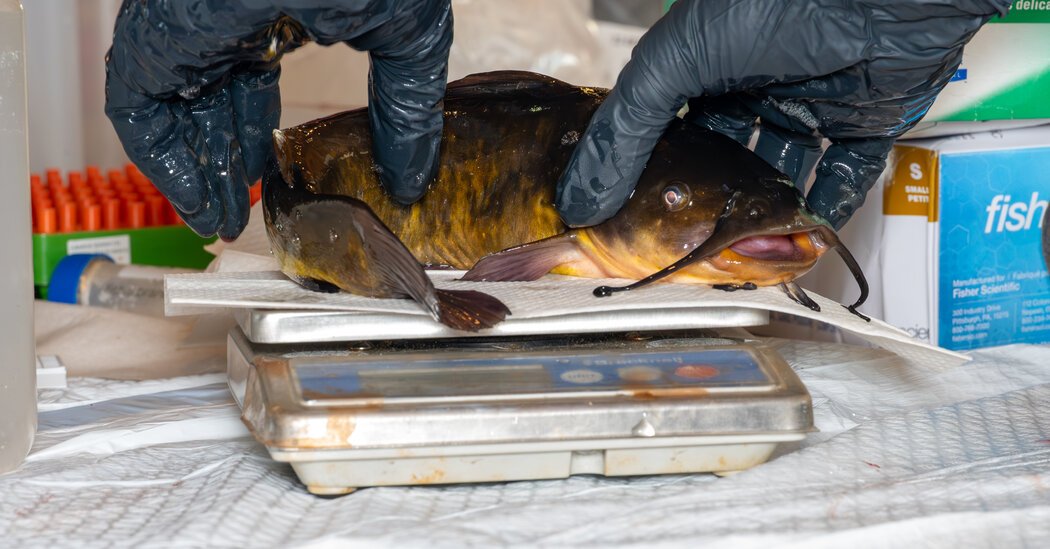
Lake Memphremagog is home to brown bullhead catfish, and in 2012, anglers began noticing that some of them were covered in velvety black growths. Wildlife biologists eventually determined that the fish had skin cancer.
So-called melanomas are exceedingly rare in catfish, but more than a third of the bullheads carried them. Now, researchers think they know why: A contagious form of cancer is spreading through the lake, they reported on Wednesday.
The outbreak started with a single catfish, the scientists believe. It developed a tumor, which shed cancer cells into the water. Those cells invaded other catfish, in effect beginning a plague.
Researchers have found contagious tumors in only a tiny, seemingly random collection of species: dogs, Tasmanian devils and a few kinds of clams and other shellfish. But those discoveries have been enough to raise a host of provocative questions.
Some scientists have asserted that transmissible cancers are new species in their own right. Others have even argued that some species of animals might have gotten their starts millions of years ago as cancer cells.
The discovery of the first transmissible cancer in fish is now prompting scientists to wonder how widespread the phenomenon may actually be. “Is this really as rare as we think it is, or are we just not looking?” asked Julie Dragon, a geneticist at the University of Vermont and an author of the new study.
Dr. Dragon did not set out to find a contagious cancer. In 2014, biologists at the Vermont Fish and Wildlife Department enlisted her to help figure out why Lake Memphremagog’s brown bullhead catfish were getting sick.
Ultraviolet light is a common cause of melanomas. But it seemed unlikely that catfish, which live in lake-bottom mud and are mostly active at night, would suffer from astronomically high levels of melanomas.
Dr. Dragon and her colleagues investigated several other possibilities, including the effects of pollution from a nearby landfill and infection with microbes, which can sometimes trigger cancer. But pollutant levels were low in the fish, and there was no evidence of cancer-causing viruses or bacteria.
Dr. Dragon decided to take a close look at the DNA of the catfish, as well as the mutated DNA in their tumors. Certain genetic variations can make animals (and people) highly vulnerable to cancer.
She expected that each cancer cell would be genetically most similar to the catfish it came from. Instead, all the cancer cells were closely related to one another, not to the animals on which the tumors were growing.
“I said, ‘We made a mistake. This can’t be right,’” Dr. Dragon recalled. The researchers started their analysis all over again and got the same result. The tumors did not arise from the catfish that carried them.
Each time they looked at DNA from a new fish, that pattern grew only stronger. The scientists began to consider a disturbing possibility: The catfish were victims of a contagious form of cancer.
As far back as the Renaissance, scholars speculated that cancers could be contagious. In 1603, the Portuguese physician Rodrigo de Castro envisioned tumors “exhaling a horrible vapor” that could transmit cancer to new victims.
When modern scientists discovered that cancer mostly arises from mutations in our own DNA, the notion of “catching” cancer fell out of favor. It wasn’t until the early 2000s that firm evidence emerged that a few transmissible cancers were real.
Dogs are hosts to one of them, known as C.T.V.T., short for canine transmissible venereal tumor. During sex, these cancer cells can spread from one dog to the other. Studies of the DNA in these tumors suggest that the malignancies all descend from a single dog that lived several thousand years ago.
C.T.V.T. is rarely lethal. The same is not true for a contagious cancer spreading among Tasmanian devils.
That illness, devil facial tumor disease, takes advantage of frequent and bloody fighting. When a Tasmanian devil bites off tumor tissue from another, the cancer cells will travel through its body to its own face.
This cancer only arose in recent decades, but it has already pushed Tasmanian devils to the brink of extinction.
In 2015, along the Atlantic coasts of Canada and the United States, researchers found soft-shell clams and other species devastated by a leukemia-like cancer. Infected clams shed cancer cells into the seawater, it turned out, and healthy clams nearby sucked them up.
More recently, scientists have found transmissible cancer in shellfish in the Pacific, as well as in European waters. Now, Dr. Dragon and her colleagues believe they have found a new contagious cancer in an entirely new host.
They are convinced that all the tumors in Lake Memphremagog came from a single ancestral cancer cell. The mating strategies of the brown bullheads may have given the melanoma cells a chance to spread, as the catfish crowd together in shallow water to spawn.
“They’re all on top of each other,” Dr. Dragon said. In these scrums, the spawning catfish can bite or scratch one another, and their wounds may expose them to floating cancer cells.
Michael Metzger, who studies contagious cancers in clams at the Pacific Northwest Research Institute in Seattle, observed that this is the first time a transmissible cancer has been discovered spreading in fresh water. Cells usually survive only in salty fluids.
“It makes us rethink how these things work,” said Dr. Metzger.
Dr. Dragon has also found hints that catfish in other parts of the Northeast may have suffered from the same cancer. Some of those clues came from the 19th-century journals of naturalist Henry David Thoreau.
Thoreau claimed he often came across catfish in Massachusetts rivers covered with spots. In 1858, he described one he saw on a visit to the Assabet River: “Nearly half the head, from the snout backward diagonally, is covered with an inky-black kind of leprosy, like a crustaceous lichen,” he wrote.
Dr. Dragon and her colleagues are now searching for transmissible cancers in catfish beyond Lake Memphremagog. And the scientists would welcome communications from anglers and biologists who have caught catfish with black, raised tumors.
They can email images of the whole fish along with its growths, along with information about where the animal was caught, to julie.dragon@med.uvm.edu. Dr. Dragon also asks that they freeze the whole fish if possible. Should she and her colleagues want to inspect the fish, they will make the arrangements to receive it.
“It’s hard to say if every black spot is our tumor, but we won’t know until we test them,” Dr. Dragon said.
Peter Emerson, another author of the study and a fisheries biologist at the Vermont Fish and Wildlife Department, recommended that anglers refrain from eating bullheads with tumors.
“We don’t have any evidence that the fish are unsafe to eat,” he said. “We just prefer to be cautious.”
For now, there’s little research to indicate that contagious cancers are circulating among people. But it’s conceivable that one will surface someday, said Elizabeth Murchison, an expert on transmissible cancers at Cambridge.
“This finding does reinforce the idea that transmissible cancers could emerge anywhere, including in our own species,” Dr. Murchison said.

