
For dealers, art fairs require tricky calculations.
Although the sales that occur during these events can have a significant impact on galleries, participation is costly. (Price tags for major fairs, including entry fees, shipping and other costs, can be well above six figures.)
And the competition can be tough. The dozens and sometimes hundreds of exhibitors must vie for attention amid a packed week of events, openings and additional fairs spread across a city.
Traditionally, dealers display a range of artists from their roster to attract a diversity of collectors and showcase the breadth of the gallery’s program, a tactic particularly beneficial for exhibitors from out of town.
So why, then, would a gallery devote its entire booth to just one artist? The practice is not new — some dealers have had great success with solo booths, selling out their stands and making institutional connections — but the motivations for such presentations vary.
“It’s a conscientious decision,” said Christine Messineo, Frieze’s director of Americas. “Galleries weigh the financial risk of showing just one artist alongside things like connections and educating future buyers.”
At the upcoming European Fine Art Foundation (TEFAF) and Frieze New York fairs, only about 10 percent of dealers opted for solo booths (apart from Frieze’s Focus section, which is subsidized and features single-artist presentations by emerging galleries).
Exhibitors who choose the less common approach offer insight into why solo booths seem to endure.
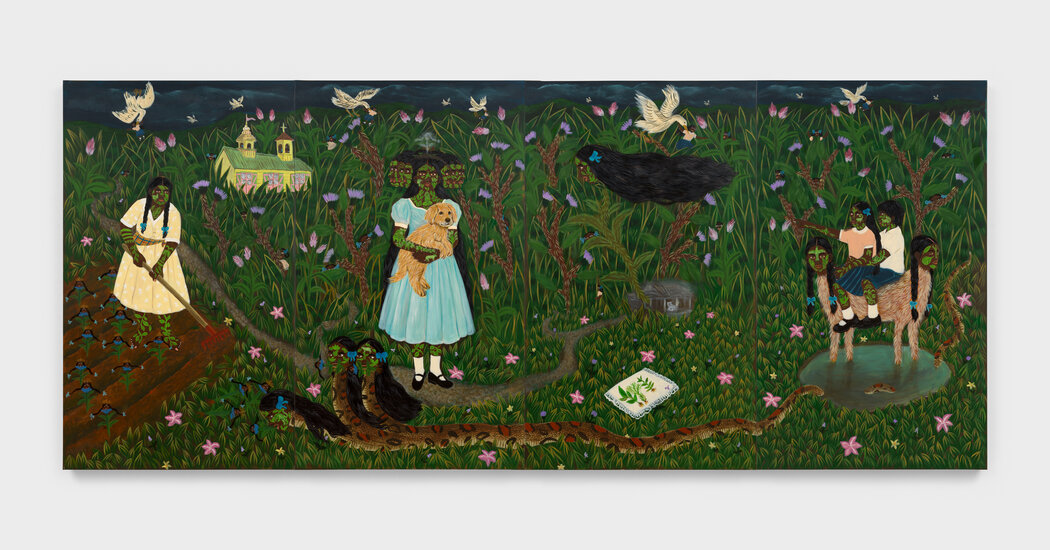
At Frieze, the James Cohan gallery in New York is presenting the Guadeloupean artist Kelly Sinnapah Mary, whose narrative paintings investigate folklore and heritage, focusing in particular on her ancestors who were indentured laborers from India. The gallery has exhibited at Frieze New York for years, but when the fair moved from a large tent on Randall’s Island to its current, smaller location at the Shed in Hudson Yards, it felt that the new layout was better suited for solo displays.
But the results can be mixed.
“The square footage of booths is much smaller now,” said David Norr, a partner at James Cohan. Smaller stands mean exhibitors are closer together, making it harder to compete for attention, which “can make it difficult to create an environment for collectors to make a good decision,” Norr added. To give a sense of a cohesive, museum-like display and help buyers focus, the booth’s walls will be covered in a hand-painted motif like the dense flora in Sinnapah Mary’s artwork.
At fairs like Art Basel in Switzerland, James Cohan typically opts for presentations of multiple artists to fill the larger exhibition spaces.
With previous solo booths, the gallery has seen the gamble pay off. Two years ago at Frieze, it exhibited the Vietnamese artist Tuan Andrew Nguyen. Since then, Nguyen has received the prestigious MacArthur Fellowship, known as the “genius grant” and was selected for the High Line Plinth commission, a public art program in New York; his work is being shown at this year’s Venice Biennale. “The Frieze presentation was part of why these things came into shape,” Norr said. “An enormous amount of people got to see his work in a very short time.”
Indeed, while dealers tend to agree sales are important, they are increasingly looking to art fairs for opportunities beyond the commercial. “Having an amazing conversation can be as valuable as selling work,” Messineo said.
Though the Belgium- and Hong Kong-based Axel Vervoordt gallery doesn’t often stage solo presentations, it is using its booth at TEFAF to showcase the overlooked artist Ida Barbarigo. The Italian abstract painter, who died in 2018, participated in major art events like the Venice Biennale, but is lesser known in America.
As was often the case for female artists throughout art history, “she was outshone by her male peers during her lifetime and never gained the international recognition she deserved,” said Boris Vervoordt, the gallery’s founder. “We think the time is ripe to show her in New York to present her to the American audience.” Part of this audience, Vervoordt noted, are collectors, but the dealer is also weighing the importance of giving Barbarigo exposure to curators, art critics and fellow galleries.
While art fairs are trade shows at their core, their ability to increase exposure is undeniable. “Art fairs have supplanted the galleries in terms of pure visibility of an artist’s project,” said Jessie Washburne-Harris, a global director at White Cube gallery. “We’re in this crazy system where people love coming to fairs.”
Capitalizing on this attention, dealers will often stage solo presentations to help build momentum for upcoming local shows. Sinnapah Mary in James Cohan’s booth will have her first U.S. museum solo show in 2027 across two institutions: the Aldrich Contemporary Art Museum in Ridgefield, Conn., and the Americas Society in New York.
Even more timely, the Ortuzar gallery in New York’s Tribeca and Marc Selwyn Fine Art in Los Angeles will jointly present a solo booth of sculptures by Akinsanya Kambon at Frieze that precedes a solo show at two venues beginning May 28 — SculptureCenter and the Center for Art, Research and Alliances, both in New York. Kambon’s work was recently featured in the “Made in L.A. 2025” show at the Hammer Museum in Los Angeles, “so he has some context in California, but he’s largely unfamiliar in New York,” said Kenta Murakami, a director at Ortuzar. “We want to funnel people to those exhibitions,” he added, referring to Kambon’s upcoming presentations in the city.
With lesser-known and overlooked artists like Kambon and Barbarigo, the solo booth format allows dealers to better provide context for the work. Education, Messineo said, “is particularly important for the next generation of collectors” who increasingly value artists’ stories.
Kambon, for example, has a complex practice. Exploring themes of Black resistance and Pan-African spirituality, Kambon draws from his experiences in the Marine Corps and as a member of the Black Panthers. “He deals with violent histories and topics that require context,” Murakami said. “Showing just one work can make it difficult to convey the urgency and meaning. We want to use the opportunity to start conversations.”
For its part, White Cube is staging a solo booth at TEFAF of work by the Chinese artist Cai Guo-Qiang. While the artist is known for outdoor spectacles that use fireworks and has had several museum shows, visitors may be less familiar with his paintings in a commercial context.
The gallery is exhibiting a selection made with gunpowder resembling bird motifs, as well as works inspired by the Renaissance.
“Cai draws from art historical sources, so we wanted to show his work in the context of TEFAF, which is an art historical fair,” Washburne-Harris said. Like other exhibitors, she noted that showing one artist can be a financial risk, but being able to display multiple pieces helps explain things like the creative process, such as the controlled explosions that form Cai’s gunpowder pieces.
If nothing else, the solo presentation can be a remedy for an overstimulating week of art.
“Solo booths give specificity in an era of profusion,” Washburne-Harris said. “There are so many fairs and booths that there’s a kind of sameness, but I can remember clearly solo projects from other galleries over the years. They really stand out in your mind.”

