
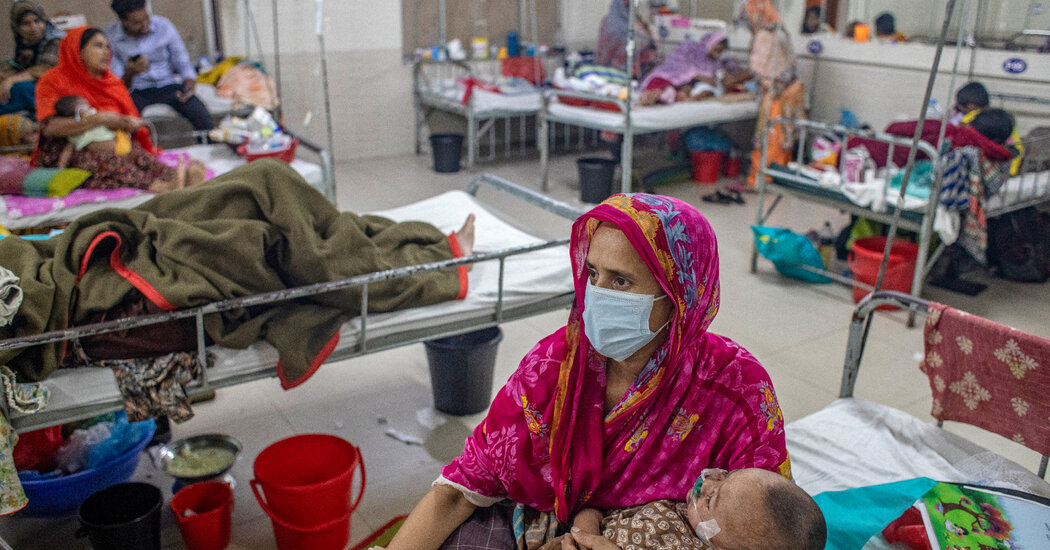
A measles outbreak has spread rapidly in Bangladesh, sickened thousands of people, most of them children, and prompted the government to launch an emergency vaccination drive.
The health authorities in Bangladesh said on Thursday that they had confirmed more than 8,000 infections since March, the highest number of annual cases in about two decades, and 80 deaths. The authorities reported 59,279 suspected cases and 401 suspected deaths from the disease since March.
Four out of every five people with measles in this outbreak are under age 5, according to Rana Flowers, the representative in Bangladesh for the U.N. Children’s Fund, or UNICEF.
The outbreak has put intense pressure on the country’s health system. All 120 beds dedicated to measles patients at Bangladesh Shishu Hospital, the largest children’s hospital in the capital of Dhaka, were occupied on Thursday. The waiting rooms were packed with anxious parents.
Sabina Akter was in one of the beds in a dedicated measles ward at the hospital on Thursday. The 3-year-old girl had been under treatment there for four days, said Miraz Hossain, her father.
“We were afraid when she fell ill with measles because we heard that many children are dying with measles this year,” he said. “We swiftly brought her here. Now her condition is better.”
Bangladesh launched an emergency vaccination drive early last month, supported by international aid agencies. This has helped slow down the spread of measles, said Dr. Halimur Rashid, director of disease control at the Directorate General of Health Services, Bangladesh’s top health agency.
Measles is a highly contagious, airborne viral infection that primarily affects children and can easily cross borders. It can cause serious respiratory symptoms, fever and rash. In some cases, especially in babies and young children, it can be fatal. In the United States, where the disease was declared eliminated in 2000, a drop in vaccinations has led to some of the worst outbreaks in more than 20 years.
Public health experts in Bangladesh have linked the outbreak there to a lack of vaccines. Ms. Flowers said in a news conference on Wednesday that government officials had failed to heed the agency’s repeated warnings since 2024 about an impending vaccine shortage.
“It is the children who suffer the most and that for us is absolutely unacceptable,” she said.
Political unrest has gripped Bangladesh in recent years, and disrupted many essential services. A youth-led uprising in ousted Prime Minister Sheikh Hasina in August 2024, and an interim government took charge until the elections in February.
Dr. Sayedur Rahman, a senior official in the interim government who oversaw the health sector, said on social media earlier this month that his administration had not changed the vaccine procurement system, and that it had continued acquiring vaccines through UNICEF. He did not address the issue of vaccine shortages in his post, and did not respond to repeated requests for comment.
Dr. Rashid, the director of disease control, said on Thursday that there was no shortage of vaccines and that he did not know why the measles vaccination campaign in Bangladesh had been delayed. Immunizations that were supposed to take place last year were only happening this year, he added.
Zahed Ur Rahman, a government spokesman and a senior aide to Prime Minister Tarique Rahman, said the delay would be investigated.

