
It was a delight that he presently flipped into a series of actual drives, deploying the latest in audio tape-players in his car trunk. He took guests at his Malibu cabin out into the surrounding Santa Monica mountains, keeping precise time through a succession of perfectly apt snippets of classical pieces (Sousa, Mozart, Schubert), and then cresting the final ridge and heading back toward the sea into which the sun was setting at that very moment (Wagner!).
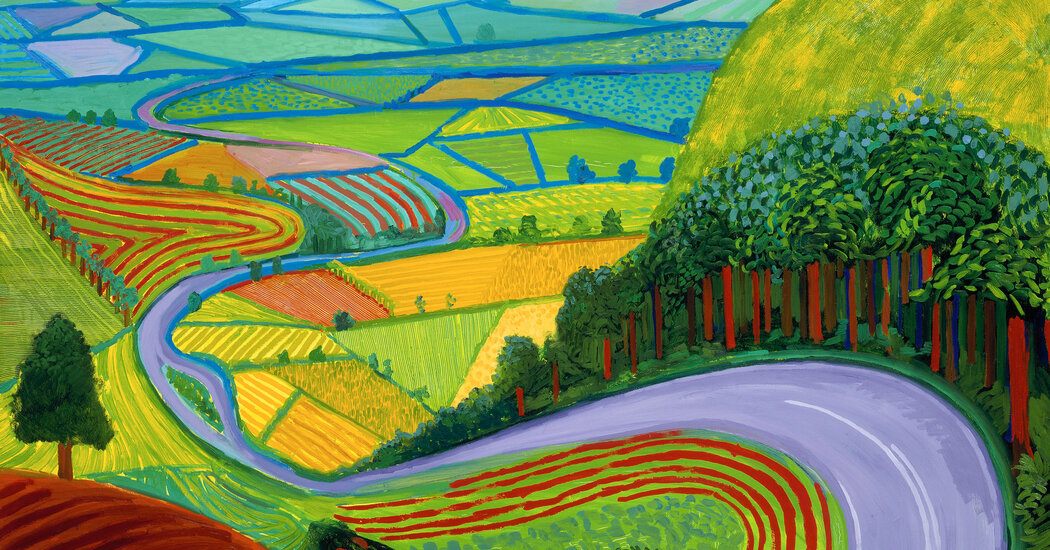
In painterly terms, the obsession culminated with “Garrowby Hill,” a heart-rending painting produced after a season of driving back and forth from his coastal Yorkshire base in England to a hospital in York to visit his dear boyhood friend Jonathan Silver, who was now dying. Back in L.A., after Silver’s death, Hockney launched into the final painting in the series, the view from the top of a ridge he’d had to drive over each fresh time with York Minster brooding in the distance, and all the fields splayed out in reverse perspective.
It was somehow clear that you were coming over that hill (overcoming it, as it were) in a car whose back wheels were on one side of the summit and front wheels already on the other. Instead of your eyes going for a drive, as in “Mulholland Drive,” you were now in the car, surging — a moving focus in an utterly moving moment — into the future.
But mortality — the cessation of movement — had already been a contrapuntal theme in Hockney’s work for some time. That period around 1982 were also the very years of the horrendous onslaught of AIDS. Hockney sometimes had the reputation of a bon-vivant, a lightweight, not an entirely serious person. He was even criticized at the time for not confronting AIDS directly in his work. Instead, people claimed, good lord, he’d taken to painting his dogs!
But as with his first paintings, he wasn’t taking to a bullhorn; the facts of the situation simply saturated the work. Indeed, his was a continual assertion of life against death, and more specifically love against oblivion. Those dachshunds, look at them: At a moment he could no longer heedlessly paint sleeping or cuddling naked young men, he took to portraying his beloved pooches in the very same sorts of languorous poses.

