
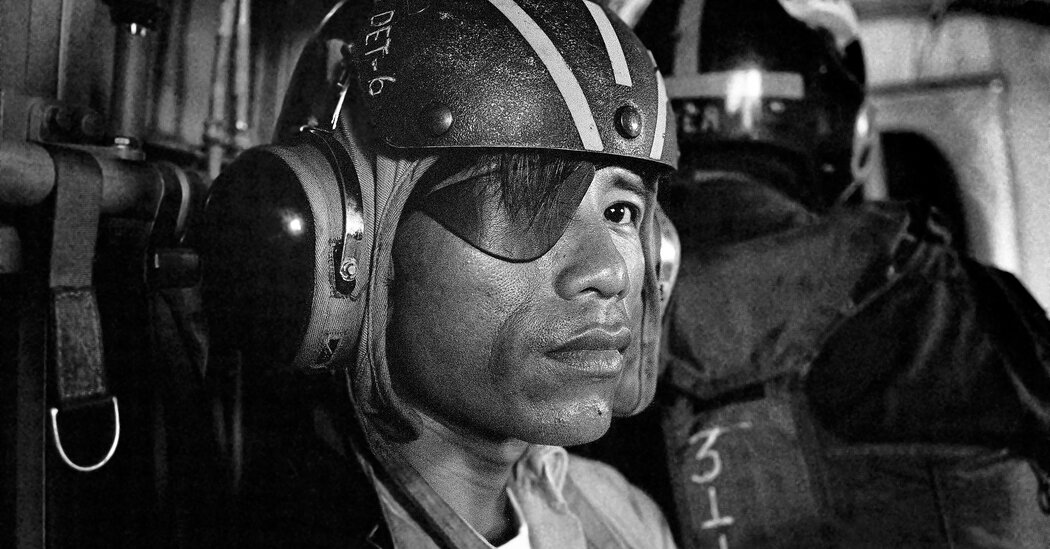
Dang Van Phuoc, a Vietnamese-born photographer for The Associated Press whose dauntless work on the front lines of the Vietnam War powerfully depicted scenes of bravery and terror, and who lost his right eye in a grenade explosion, died on May 23 in Newport Beach, Calif. He was 90.
The A.P. announced his death, which was confirmed by his nephew Van Nguyen.
From 1965 until the war ended in 1975, Mr. Phuoc roved South Vietnam — in Da Nang, Saigon, Hue and Khe Sanh — and traveled to North Vietnam for a daylight raid near the port of Haiphong aboard the heavy cruiser Newport News.
One of his most moving photographs was of an American soldier stooping slightly to help a fragile old woman resettle in a refugee camp when other villagers refused to help her. In the Ho Bo Woods, north of Saigon, he came upon a barren landscape where soldiers had taken refuge in an enormous crater created by a bomb dropped from a B-52.
He snapped the moment when a South Vietnamese marine held a knife to the throat of a suspected Vietcong guerrilla to force him to divulge the location of his comrades. He also captured a scene in which South Vietnamese soldiers tied up a Vietcong guerrilla, who had just been forced from a swamp, before interrogating him. Another shot showed two wounded Communist prisoners, one of them looking terrified, as they waited to be sent to an interrogation center.
Mr. Phuoc said the photographs gave him a voice to speak to the world.
“I am like small sand in the beach,” he said in an interview for an A.P. oral history in 2012, “but I cannot say, so I have the picture, can tell more than I do.”
Horst Faas, the chief photographer in the A.P.’s Saigon bureau, who won a Pulitzer Prize in 1965 for his combat pictures, once called Mr. Phuoc “our secret weapon.”
“The idea doesn’t bother him that he gets injured,” Mr. Faas said in “Vietnam: The Real War” (2013), an illustrated history of the war published by The A.P. “He wants to take pictures.”
Mr. Phuoc was wounded several times. According to the A.P.’s obituary of him, he took shrapnel to a leg and his chest from a grenade explosion, had a concussion from being hit in the head by a rocket and lost his right eye when a grenade exploded while on patrol with an Army Ranger battalion near Da Nang in 1969.
“He got shot many times, but he always wanted to go back, like me,” Nick Ut, who worked with Mr. Phuoc at The A.P. and who also won a Pulitzer for his Vietnam coverage, said in an interview. “I got wounded three times, and I went back and did my job.”
Mr. Phuoc replaced Mr. Ut’s brother, Huynh Thanh My, a photographer working for the news agency who was killed while covering combat operations in 1965.
David Hume Kennerly, a Pulitzer-winning photographer for United Press International who worked on assignments alongside Mr. Phuoc in Vietnam for two years, said in an interview that “among his colleagues, Phuoc was the man.”
He added: “He was always willing to go the extra mile for a good picture, which meant putting his life on the line. Any of us out there had various degrees of insanity or courage. It was a close line between the two. He wasn’t nuts. He didn’t take what I’d say were unnecessary chances, but he deliberately took what it required to get good photographs.”
Mr. Phuoc quickly adjusted to photography without his right eye. “When I was with him three years later, it didn’t seem to be an impediment at all,” Mr. Kennerly said.
He wore an eye patch and later used a fake eye.
Dang Van Phuoc was born on Oct. 2, 1935, in a village near Quang Ngai province, south of Da Nang, on the South Central Coast of Vietnam. He was 10 when he saw his father, the village’s mayor or chief, buried alive in sand and beheaded by the Viet Minh, the Communist-led nationalist insurgency led by Ho Chi Minh. His mother died a few years later.
Homeless, Mr. Phuoc found his way to Saigon and lived with one of his sisters. He worked for a film cameraman, then for a movie studio where he learned about elements of still and motion picture photography and film developing. He was eventually introduced to Mr. Faas and hired at The A.P.
In 1968, Mr. Phuoc received a commendation from the U.S. Army’s Ninth Infantry Division for carrying a wounded soldier through sniper fire.
Mr. Phuoc, his wife and two children fled Vietnam for a refugee camp in Guam around the time that Saigon fell in late April 1975, then flew with other Vietnamese refugees to the Marine base at Camp Pendleton in Southern California.
He moved to Hong Kong with The A.P. for a year or two before settling in the United States. He later became a portrait photographer.
He is survived by his wife, Hoa Thi Pham; a daughter, Diemtrang Phuoc Dang; and two grandchildren.
One particular photo by Mr. Phuoc illustrated the barbarous impact of the war felt by his own people.
In December 1968, in a village southwest of Da Nang, Mr. Phuoc photographed a Vietnamese woman from behind as she carried the body of her 6-month-old son. They had been hiding in the family bunker when Allied aircraft dropped napalm on suspected enemy positions in the area. The boy’s apparently burned head rested on his mother’s right shoulder; one of his arms hung limply.
She looked away, toward the wreckage in front of her.

