
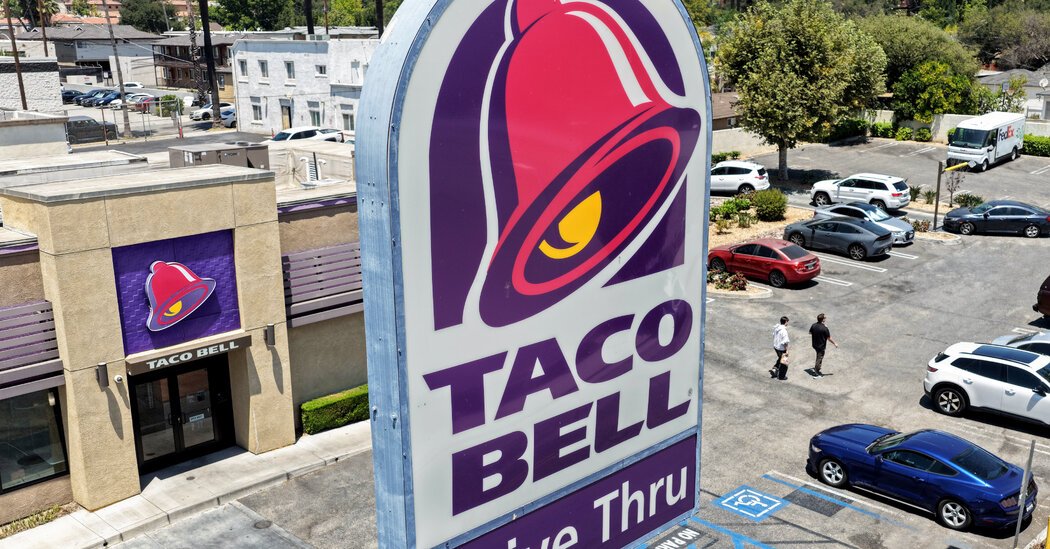
The Centers for Disease Control and Prevention has linked an outbreak of cyclosporiasis to iceberg lettuce that Taylor Farms supplied to Taco Bell, according to two federal officials who declined to be named.
The C.D.C. said the shredded lettuce was sent to Taco Bell locations in Indiana, Kentucky, Michigan, Ohio and West Virginia. In a notice posted Thursday night, the agency warned the public not to eat shredded iceberg lettuce served at Taco Bell locations in those states.
It remains unclear if Taylor Farms sent the lettuce to other vendors, said one of the officials, who was not cleared to speak for the administration. The C.D.C. has not publicly named Taylor Farms in its investigation.
A spokeswoman for Taylor Farms did not respond to requests for comment.
More than 1,644 people reported eating at Taco Bell before becoming sick with the parasitic infection, and 94 had been hospitalized, according to the C.D.C.
Food and Drug Administration officials also said the lettuce was grown by a single supplier in Mexico. The agency has stepped up screening at the border for the company’s lettuce, according to an agency update posted Thursday night.
The F.D.A. said that other restaurants and stores might be implicated as health officials continued their investigation. And not all Taco Bell locations in the five states had received the affected lettuce.
In a statement Thursday night, Taco Bell said it was voluntarily removing potentially affected lettuce it had received from a supplier in select states. It did not identify the supplier but said that the lettuce from that supplier would be “indefinitely removed” from its supply chain nationwide and would be replaced quickly.
The United States is on track to have more cyclospora cases in 2026 than in any previous year, with 1,645 confirmed cases and 141 hospitalizations across 34 states as of Monday, according to the C.D.C. The agency is investigating more than 5,100 additional illnesses that may have been caused by the parasite, which is transmitted through food or water contaminated with feces.
Health officials are also investigating other cyclosporiasis illnesses and outbreaks in other states that are unrelated to the one linked to Taco Bell, the C.D.C. said in its notice posted Thursday night.
Dr. Natasha Bagdasarian, the chief medical executive for Michigan, said in an interview on Tuesday that not everyone sickened in the state had reported eating at a single restaurant. A supplier that sells a product to restaurants may also stock grocery stores, she said.
Many people who have gotten sick said they did not eat at Taco Bell.
Other states with higher than usual cyclospora cases this year include North Carolina, Illinois, Maryland and Texas.
With around $7 billion in annual revenue, Taylor Farms, based in Salinas, Calif., is one of the largest producers of fresh lettuce and vegetables in the country. Bags of its chopped salad kits can be found at Walmart, Whole Foods, Target and other grocery stores, and it is a leading supplier of lettuce and other produce to many large restaurant chains.
Taylor Farms has been involved in previous food-borne illness outbreaks, including a cyclosporiasis outbreak linked to salad mix that sickened hundreds in 2013. Health officials considered the supplier the likely source of an E. coli outbreak linked to onions served at McDonald’s in 2024 that resulted in 104 illnesses, 34 hospitalizations and one death.
The Washington Post was first to report the connection between Taylor Farms and the outbreak.
Once they are infected, it can take days to weeks for people to develop symptoms. The main symptom is frequent, watery diarrhea. A loss of appetite, cramping, bloating, gas, nausea, fatigue and weight loss can also occur. Though the illness rarely causes serious complications, its symptoms can sometimes linger for a month or more if untreated. Antibiotics are the main treatment.
Tracing cyclospora cases back to a source is a labor-intensive task. Health officials must interview thousands of people who have been infected about everything they ate and drank over weeks and then research the ingredients in each of their meals and snacks and investigate their suppliers. Because of their biology, parasitic infections tend to be much harder to link together than bacterial infections.
The outbreak comes as state and local health departments — which rely on C.D.C. funding to respond to food-borne illness outbreaks — face budget cuts and staff layoffs.
Julie Creswell and Kevin Draper contributed reporting.

