
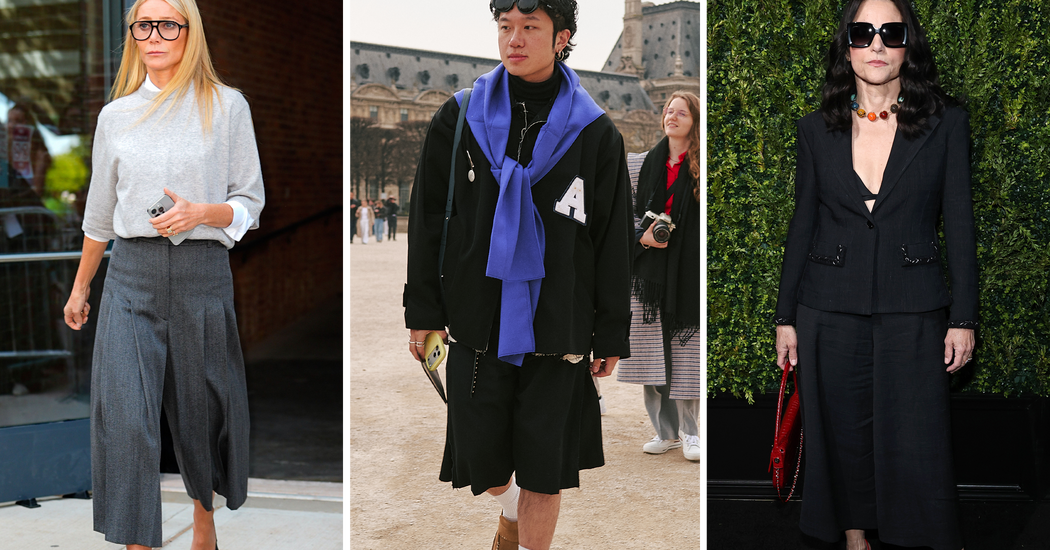
It was only two years ago when trends dictated that five-inch inseam shorts were four inches too long. Brands like Miu Miu and celebrities like Hailey Bieber and Olivia Rodrigo embraced micro shorts, a garment that barely covered the behind, and hot pants, which skipped past the thigh entirely.
Now shorts have grown long again. In fact, the trend-cycle pendulum has swung all the way back to an 1800s invention: the culotte.
The culotte is, historically and by definition, a trouser masquerading as a skirt. The style gained mainstream appeal in the late 1960s and throughout the ’70s, finding fans in Diana Ross, the model Twiggy and the fashion designer Marc Bohan, who designed a pair made from fur when he was at Christian Dior. Recently, retailers and brands have introduced silhouettes they describe as culottes, like the long Bermuda shorts from the Gap; Bottega Veneta’s divided A-line skirts; and a trouser whose hem is slowly inching up the leg, ending mid-calf, like the ones sold by Veronica Beard.
Between January and May, brands increased their inventory of culottes by over 30 percent compared to the same period last year, according to the retail intelligence firm Edited, which tracked the inventory of over 500 brands across 140 U.S. and U.K. retailers.
“Customers aren’t coming in specifically saying, ‘I need a pair of culottes,’ but when they see them and they try them on, we’re seeing that move to a sale very quickly,” said Jemma Cassidy, the chief product officer at Banana Republic.
Charlotte Van Gijzeghem, 29, is among many in her generation who are encountering culottes for the first time. She is drawn to the garment’s practicality, its function as a transition item between seasons and formal and casual events. Van Gijzeghem, who came to embrace the style last September, now owns six pairs.
“As a teacher, it’s not always easy to find, like, work-appropriate clothing,” Van Gijzeghem, who teaches at a high school in Dendermonde, Belgium, said. “I cycle to school, and skirts are always a hassle on a bike, but culottes make that so much easier.”
Sara Maggioni, the head of women’s wear at the trend-forecasting firm WGSN, said the resurgence of culottes boils down to three factors: the evolution of comfort-driven dressing meeting post-pandemic return-to-office mandates; rising temperatures as a result of climate change; and financial pressures that have consumers looking for versatile clothes.
Shoppers are concerned with what Maggioni calls “cost per wear” — the calculation customers make to justify a purchase by how often they will use it. “The consumer is buying less, they’re scrutinizing the purchases more,” she said.
“I buy a lot of stuff, but I’m quite conscious about what I buy, so that it works in my whole wardrobe,” Van Gijzeghem said. “I love when I can jump on a trend that actually works for my style, that I don’t have to throw it away after, like, the trends falls, because nothing fits with it.”
Wide-legged trousers have dominated the trend cycle in the last half-decade as retailers and shoppers have abandoned the slim and skinny fit. To refresh a silhouette that is now considered a staple in wardrobes, brands have introduced twisted jeans, barrel-leg pants and now, culottes. “I think the next evolution is playing with length rather than just adding more width or removing width,” said Cassidy.
Split-skirt culottes — not to be confused with a style of men’s breeches that share the same name — first gained popularity during the 19th and early 20th centuries and were favored by sportswomen for their practicality. They allowed women to sit astride on horseback and ride bicycles.
Culottes also presented like skirts, which was in accordance with the social mores of the time — women were rarely, if ever, able to wear trousers in public. In fact, Lili de Alvarez, the Spanish tennis player, caused an uproar in the staid tennis world when she wore a pair of white culottes by Elsa Schiaparelli to compete in Wimbledon in 1931.
“In Western fashion, the gender binary in clothing has been very much along the lines of ‘men have legs and get to wear trousers’ and ‘women wear skirts,’” said Hilary Davidson, a fashion historian and professor at the Fashion Institute of Technology. Culottes emerged at a time when women were gaining more independence, she added.
It wasn’t until the sexual revolution of the 1960s and ’70s that culottes — also referred to then as “gauchos” — and trousers in general, became widely acceptable for women to wear publicly. Women often wore culottes with blazers and Oxford shirts, or a cowl-neck sweater and knee-high boots. “What you’re seeing in that turn of the ’70s period, is a kind of new explosion of: What forms of trousers can we have in fashion?” said Davidson, adding, “and people are experimenting with it.”
Today’s culottes are appealing across demographics and have also been adopted by men. This is because of the prevalence of tighter fitting tops in both men’s and women’s wardrobes, which pair well with roomier bottoms, said Cassidy, the Banana Republic executive.
For Jeffrey Teneza II, 19, a student based in Pearl City, on Hawaii’s Oahu island, culottes have offered him a low-stakes way to experiment with his style, something he said he was unable to do at home for fear of being “shunned or shamed.” He has worn his pair of culottes at least twice a week since he purchased them from Uniqlo in May. He likes how “roomy and airy they can be,” he said.
The word “culottes,” however, may also be a way for retailers to hawk what may essentially be shorts that are a little longer than the ones their customers purchased last summer. According to Davidson, culottes have “an abundance of fabric” and “just being long does not make it a culotte.”
“It’s just become whatever the buzzword is,” said Davidson. Brands “sell to the buzzword.”

