
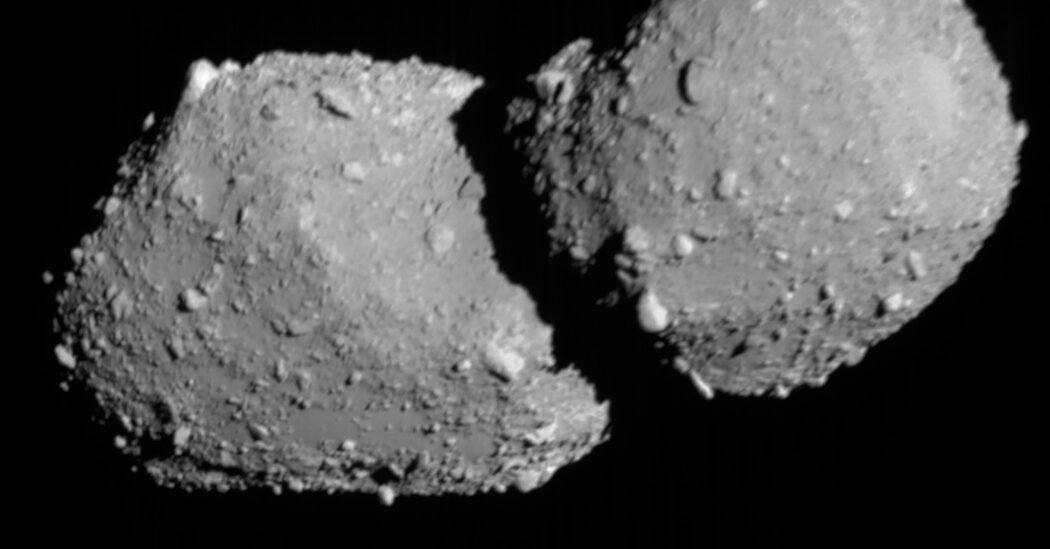
On Sunday, an uncrewed Japanese spacecraft screamed past an asteroid named Torifune at 11,000 miles per hour. And as it hurtled within 2,600 feet of its surface — extremely close, in space terms — it took a photograph. Before this, very little was known about Torifune, except that it was an intriguing speck hurtling through the solar system.
It turned out that it was not one speck, but two: Torifune is a pair of asteroids that have been incongruously glued together.
“Yeah, that’s weird,” said Andy Rivkin, a planetary scientist and planetary defense researcher at Johns Hopkins Applied Physics Laboratory in Laurel, Md.
Asteroids move through space at such extreme speeds that on the unusual occasions they meet one another, they cataclysmically break apart. Torifune is known as a contact binary, meaning it’s a pair of asteroids that have managed to get so close, in a surprisingly gradual and nonviolent way, that they have stuck together.
Contact binaries were once thought to be vanishingly rare, but in recent years astronomers have discovered several throughout our solar system. In 2019, as NASA’s interplanetary spacecraft New Horizons was venturing beyond Neptune, it captured images of a red-hued snowman named Arrokoth. And in 2023, while voyaging through the asteroid belt between Mars and Jupiter, NASA’s Lucy spacecraft found that the asteroid Dinkinesh had a smaller space rock orbiting it. This “moon,” named Selam, was two asteroids squished together.
Binaries come in several configurations: Occasionally, one asteroid orbits another, as our own moon pirouettes around Earth; sometimes, they are contact binaries, which is what happens when two asteroids hug and refuse to let go.
“There’re a few cool ideas about how they form,” said Agata Rożek, an astronomer at the University of Edinburgh. One is that a smaller asteroid, which orbits a larger one as its “moon,” has its orbit shrink gradually enough that the two of them eventually merge.
Another possibility is that two rocky fragments — both liberated by a momentous impact event on another asteroid long ago — end up moving so slowly relative to each other that they very gently collide. Torifune, the latest contact binary, is thought to have been created in a similar manner.
Hayabusa2, the Japan Aerospace Exploration Agency spacecraft that captured Torifune on camera, completed its primary mission in 2020, when it flew past Earth and dropped off a canister of material it lifted from the asteroid Ryugu.
Now it’s on an extended mission tied to planetary defense: How can Earth protect itself from killer asteroids?
“The successful flyby of Torifune is an excellent example of a rapid reconnaissance mission,” said Cristina Thomas, a planetary astronomer and planetary defense researcher at Northern Arizona University in Flagstaff. This involves a spacecraft zipping by an asteroid and quickly determining its size, shape, structure and composition — vital information for a spaceflight mission that hopes to deflect or vaporize it.
Torifune isn’t a danger. But Hayabusa2’s flyby of it demonstrates a new way to protect Earth from a future threat. “The technical, engineering, navigation and scientific expertise required to get up close and personal with space rocks is growing,” said Paul Byrne, a planetary scientist at Washington University in St. Louis.
Based on fuzzy telescopic data from Earth, Japan’s space agency thought Torifune looked like a somewhat lumpy, but solitary, asteroid. “Without a direct look with a spacecraft or radar, we cannot tell a brick from a peanut,” Dr. Rożek said.
“The result went far beyond my dream,” Yuichi Tsuda, the former project manager for Hayabusa2 and the deputy director general of the Institute of Space and Astronautical Science in Sagamihara, Japan, said.
But while the new discovery has delighted planetary scientists, those concerned with defending the planet have been left scratching their heads.
Back in 2022, NASA’s mission known as the Double Asteroid Redirection Test, or DART, slammed a robotic spacecraft into a (harmless) asteroid named Dimorphos to practice swatting a space rock away from Earth. It was a smashing success, but Dimorphos was a somewhat normal-looking asteroid.
If a two-lobed contact binary like Torifune were coming our way, deflecting it wouldn’t be as straightforward. “If targeting the center of the figure, like DART did, the spacecraft might go through the gap at the neck,” said Sabina Raducan, a researcher at the International Space Science Institute in Bern, Switzerland.
And if the spacecraft rammed one of the lobes, would it cause the entire asteroid to start wildly spinning about?
“Our intuition may not be a great guide here,” Dr. Rivkin said. In principle, thwacking a contact binary should deflect the entire object. But it’s worth double-checking this theory before Earth is genuinely imperiled. “People need to look at this in detail, and I have no doubt that somebody already is.”

