

Want to bookmark your favourite articles and stories to read or reference later? Start your Independent Membership today.
Already a member?
Log in
Some two-thirds of Americans can’t start their day without piping hot coffee in the morning – but may not realize that to-go cups could be quietly harming their health.
Now, Canadian researchers say they could have a fix that lets people enjoy their cuppa joe on the go.
While disposable cups made with a petroleum lining leach microplastics and hormone-disrupting chemicals called phthalates into your coffee, academics at the University of Waterloo have created a plant-based coating that could make the cups safer.
The coating was made using cellulose acetate, a plant-based plastic also known as a “bioplastic,” and reinforced with cellulose nanocrystals, which are other eco-friendly plastic particles that boost durability.
But unlike plastic-lined coffee cups, testing showed the new coating didn’t degrade after prolonged exposure to boiling water, food oil and a variety of chemicals that dissolve other substances.

“Learning how easily some plastic liners can shed particles was eye-opening,” said Dr. Shirley Tang, a chemistry professor at the university who led the team that developed the coating.
While microplastics were once considered relatively harmless within the body, what we know about the particles has changed.
For one, scientists and doctors have found them everywhere. They’re in our brains, hearts, sex organs and lungs.
Researchers have discovered that plastics could build up in our organs and kill animals that way over the last few decades. However, it was only last month that researchers discovered the plastics were chemically active and could cause harm to human health after they contact water.
“As plastic fragments into smaller and smaller particles, its surface area increases enormously. Then microplastics change the water that surrounds them, generating high-energy, reactive radicals (reactive oxygen species, ROS) that very likely contribute to biological damage that we see in animals and potentially in humans as a result of microplastic exposure,” Wei Min, a Columbia professor, said in a release announcing the findings.
More research is needed to understand the extent of the harm of these plastics, but changing the way we make our coffee cups could reduce risk.
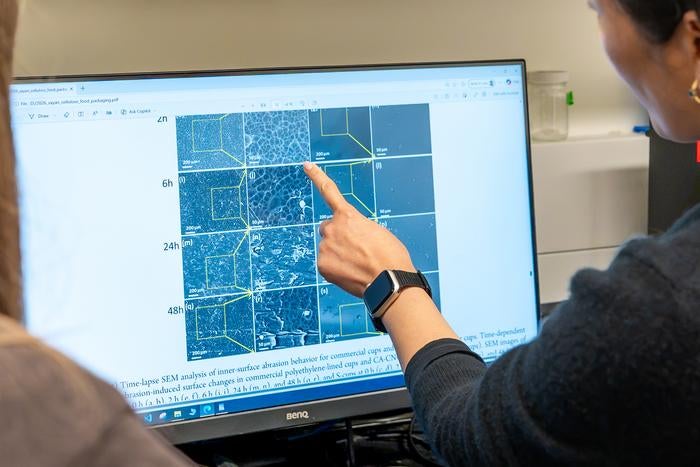
It could also help save us money, the researchers said.
Testing showed that the coating also maintained its protective properties when it was applied to lightweight paper, such as brown paper towels.
“That could reduce the amount of material required to manufacture cups while maintaining performance and lowering costs,” Dr. Sayan Ganguly, a research associate in Tang’s lab, said. “These savings could ultimately be passed on to the consumer.”
There’s also a major bonus for the planet. The bioplastic coating is biodegradable, meaning it can easily be broken down over time. Whereas fossil fuel-based coffee cups can last in the environment for centuries after they’re thrown away.
This could be applied to other materials in food packaging in the future, the university noted.


