
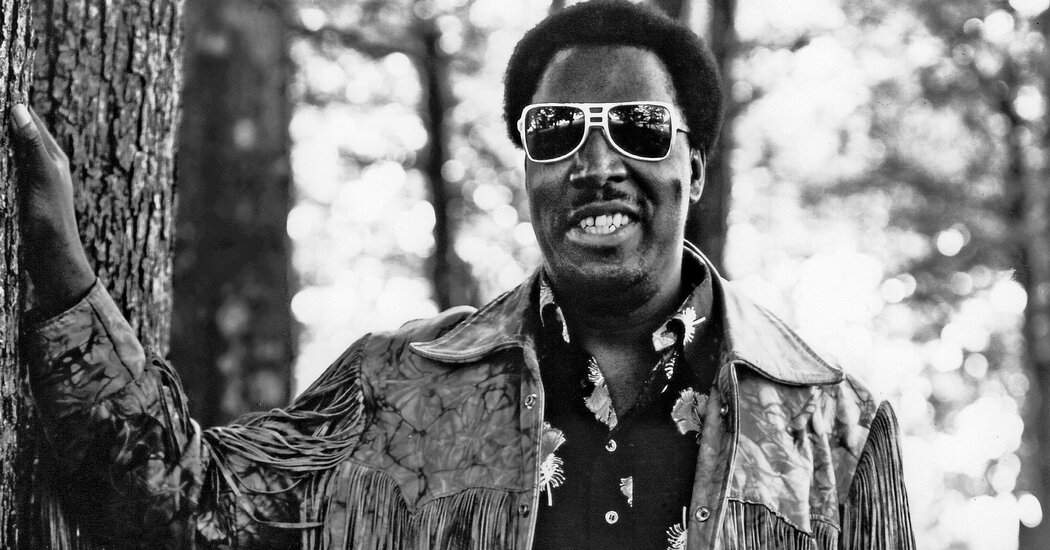
Clarence Carter, the Southern soul singer and guitarist who sang unabashedly of adultery and lust on hits of the late 1960s like “Slip Away” and “Back Door Santa,” died on Thursday. He was 90.
His death was confirmed by Rodney Hall, the president of FAME Studios in Muscle Shoals, Ala., where many of Mr. Carter’s hits were recorded. No further details were immediately available.
Blind from youth and distinguished by his deep, declamatory baritone and lecherous, full-throated laugh, Mr. Carter combined the sermonic fervor of a backwoods preacher and the bawdy humor of a juke joint.
His sensibilities are clear on the extended recitation that takes up much of “Making Love (At the Dark End of the Street),” his thorough reimagining of the soul singer James Carr’s 1967 hit “The Dark End of the Street,” written by Chips Moman and Dan Penn.
“They always talk about making love,” Mr. Carter begins, his stentorian drawl backed by gospel-steeped keyboards and horns. “Yeah, making love / But have you ever sit down to think about / Everything that’s got life in it likes to make love?”
Over the next three minutes, Mr. Carter ruminates on the sexual predilections of horses, cows, mosquitoes and people, his musings growing more urgent and outlandish with each successive digression. By the time he sings the record’s closing (and only) chorus, an anguished meditation on illicit love, he has delivered a performance that is as surreal as it is cathartic.
“Making Love” (1969) was the B-side of the funky “Snatching It Back,” which was recorded at FAME Studios and released by Atlantic Records. The chuckle that punctuates the record — and is also heard on the randy “Back Door Santa” (1968) — was modeled on that of a disc jockey in Montgomery, Ala., known as Mr. Lee.
“Patches,” sung from the perspective of a farmer’s struggling son, was his biggest hit. Though more pop than his typically blues-based performances, the song, originally recorded by the soul group Chairmen of the Board, reached No. 4 on the Billboard Hot 100 chart in 1970. Its spoken-word passages — as well as those on several of his other recordings — led him to be considered a precursor of rap.
“Long before they had what they call a rap, me and Isaac Hayes and Barry White were doing the same thing,” Mr. Carter said in an interview with The New York Times in 1998. “I listen to a lot of raps, and they wander on and on with no focus. When I talk in a song, I point in one direction and you know where I’m heading. It’s just a question of how I’m gonna get there.”
Numerous hip-hop artists, including Run-DMC and 2 Live Crew, have sampled Mr. Carter’s records. “Strokin’,” a salacious original from 1986, was featured in the 1996 remake of “The Nutty Professor” starring Eddie Murphy and in the 2011 thriller “Killer Joe” with Matthew McConaughey.
An out-of-left-field success, “Strokin’” revived Mr. Carter’s career at a point when his down-home approach no longer found favor with mainstream radio. Despite receiving little airplay because of its sexually explicit lyrics, the record sold more than 1.5 million copies and became a jukebox staple.
Clarence George Carter was born on Jan. 14, 1936, in Montgomery. His parents were sharecroppers.
Despite his blindness, Clarence taught himself to play blues-based guitar as a child. He later attended the Alabama School for the Blind in Talladega, where he learned to transcribe musical arrangements in Braille.
In 1960, after graduating with a bachelor’s degree in music from Alabama State College (a historically Black school that is now a university), he teamed up with the singer and piano player Calvin Scott, another blind musician, to form the duo Clarence & Calvin. The two men played regularly in clubs in Birmingham and released singles for independent record labels before signing with FAME in 1965, by that point billing themselves as the C&C Boys.
The duo had just recorded its first single with FAME when Mr. Scott was seriously injured in a car accident, forcing him to retire from performing. Mr. Carter remained under contract as both a recording artist and a session guitarist. His first solo single, “Tell Daddy,” was a minor hit in 1967. Etta James’s take on the song, “Tell Mama,” became a Top 40 hit later that year.
In 1968, Mr. Carter met the gospel singer Candi Staton and introduced her to Rick Hall, Rodney Hall’s father, who was then the owner of FAME. Ms. Staton went on to record more than a dozen R&B hits, including a remake of the Tammy Wynette classic “Stand by Your Man.”
Mr. Carter and Ms. Staton were married in 1970 and divorced three years later, after having a son, Clarence Carter Jr., also a performer. His union with Ms. Staton was the second of his five marriages, which all ended in divorce.
Complete information about his survivors was not immediately available.
Success came fairly late for Mr. Carter, who was already in his 30s when “Slip Away,” a groove-rich song about cheating, reached the Top 10 in 1968. He released dozens of albums over the next six decades and performed live, largely for blue-collar Black audiences, into his 80s.
“I’m determined to do what folks say I can’t, and it has to do with a lot of factors, especially when you’re blind,” he told The Times in 1998.
“I remember hearing a lady say to my mother one day when I was a kid, ‘I guess you’re going to have to take care of him the rest of your life,’” he added. “I never forgot that because I was determined that before the lady left this earth she’d know my mom wouldn’t have to take care of me.”
Charlotte Dulany contributed reporting.

