
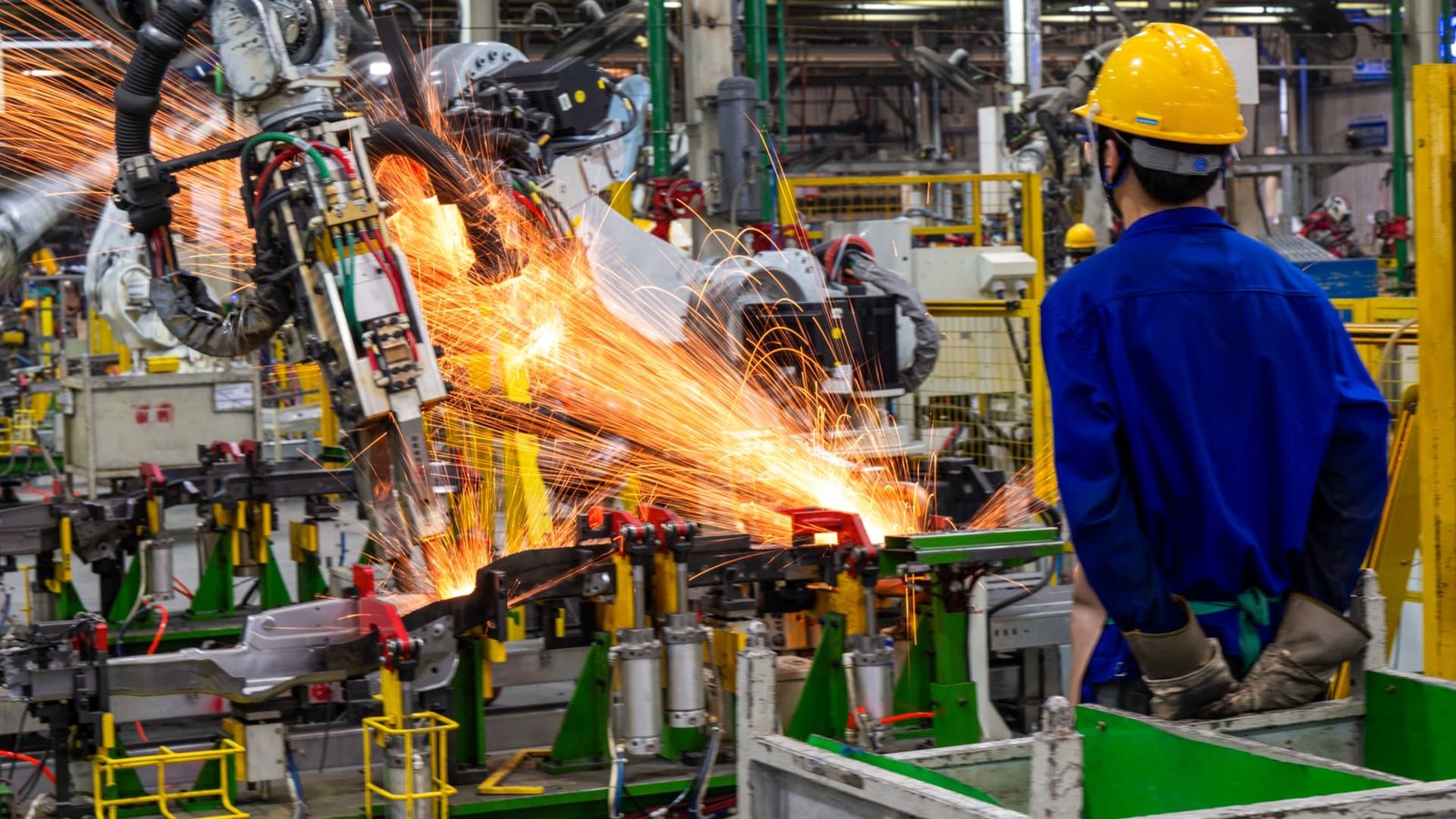
LIUZHOU, CHINA – JULY 25: Robotic arms assemble auto parts at the workshop of Guangxi Liuzhou Zhuotong Auto Parts Co., Ltd. on July 25, 2026 in Liuzhou, Guangxi Zhuang Autonomous Region of China.
He Huawen | Visual China Group | Getty Images
China’s factory activity unexpectedly contracted in July for the first time since February, as domestic orders slumped and typhoons disrupted production, while part of the front-loading momentum began to unwind, piling pressure on Beijing to boost domestic demand.
The official manufacturing purchasing managers’ index fell to 49.2 from 50.3 in June, National Bureau of Statistics data showed Friday, dropping below the 50-point threshold that separates expansion from contraction. Economists’ median forecast had pegged PMI at 50.
The gauge — the weakest since February — ended a four-month run at or above 50, a stretch propped up by exporters rushing shipments ahead of U.S. tariff increases.
The headline figure was dragged down by the new orders sub-index, which fell to 48.5, the lowest in 38 months, according to official data accessed via Wind.
“Domestic weakness appears largely to blame – while the export orders index softened a bit,” said Julian Evans-Pritchard, head of China economics at Capital Economics, who expects local governments to follow through on Beijing’s policy support pledges to prop up domestic demand.
The sub-index for factory-gate prices extended its decline after a brief war-driven energy spike earlier this year, signaling producer price weakness.
Weakness spread well beyond manufacturing. The construction PMI slumped to a record low of 47.0, the services gauge fell to its weakest since the initial Covid-19 lockdowns, and the composite PMI dropped to 49.3, the lowest since the pandemic ended in 2022, Wind data showed.
A statistics bureau spokesperson attributed part of the PMI weakness to a recent spate of typhoons that halted work on many projects.
Amid downbeat readings, indices tracking firms’ expectations for future output held up well across all the official PMIs in July, including an improvement in the construction sector. “Firms believe the latest deterioration in activity will prove short-lived, perhaps because they anticipate a stronger tailwind from fiscal policy over the rest of the year,” said Evans-Pritchard.
The print lands a day after the country’s top policymakers acknowledged “difficulties and challenges facing the economy” at its mid-year meeting, pledging to accelerate fiscal spending and roll out “incremental policies” to shore up growth in the second half.
China’s economy in the second quarter expanded 4.3% from a year earlier, the slowest pace in more than three years, missing the lower end of the full-year target of 4.5% to 5%.
Exports have been one of the economy’s few reliable growth engines this year — and that engine is now showing signs of strain. “U.S.-bound shipments fell outright for the first time in several months,” according to a survey conducted by China Beige Book.
The research firm found factory activity decelerated in July, with manufacturing posting the worst performance on employment as job growth deteriorated across all sectors surveyed from a year earlier.
That marks a sharp reversal from June, when shipments to the U.S. rose 14%, helping overall exports surge 27% — the fastest pace in nearly five years — as businesses frontloaded orders ahead of expected higher American tariffs later in the summer. Manufacturers had braced for additional levies from President Donald Trump’s Section 301 probes after the 10% broad-based duty expired on July 24.
Retail sales fell in July from both the prior month and a year earlier, China Beige Book found, with travel and restaurants seeing a sharp on-year downturn.
The disappointing data will likely sharpen expectations for easing, though the Politburo readout stopped short of concrete policy steps.
Chinese leaders see growth at risk of falling below target in the second half, as new-economy sectors such as AI fail to offset the slowdown in traditional industries, Eurasia Group analysts said in a note after Thursday’s meeting.
“Officials continue to prioritize risk containment over near-term growth,” Eurasia Group said, framing property, local government debt and smaller financial institutions as structural risks to manage over time rather than problems to solve quickly.
— CNBC’s Evelyn Cheng contributed to this report.
Correction: The story has been updated to reflect that PMI contracted for the first time since February.

