
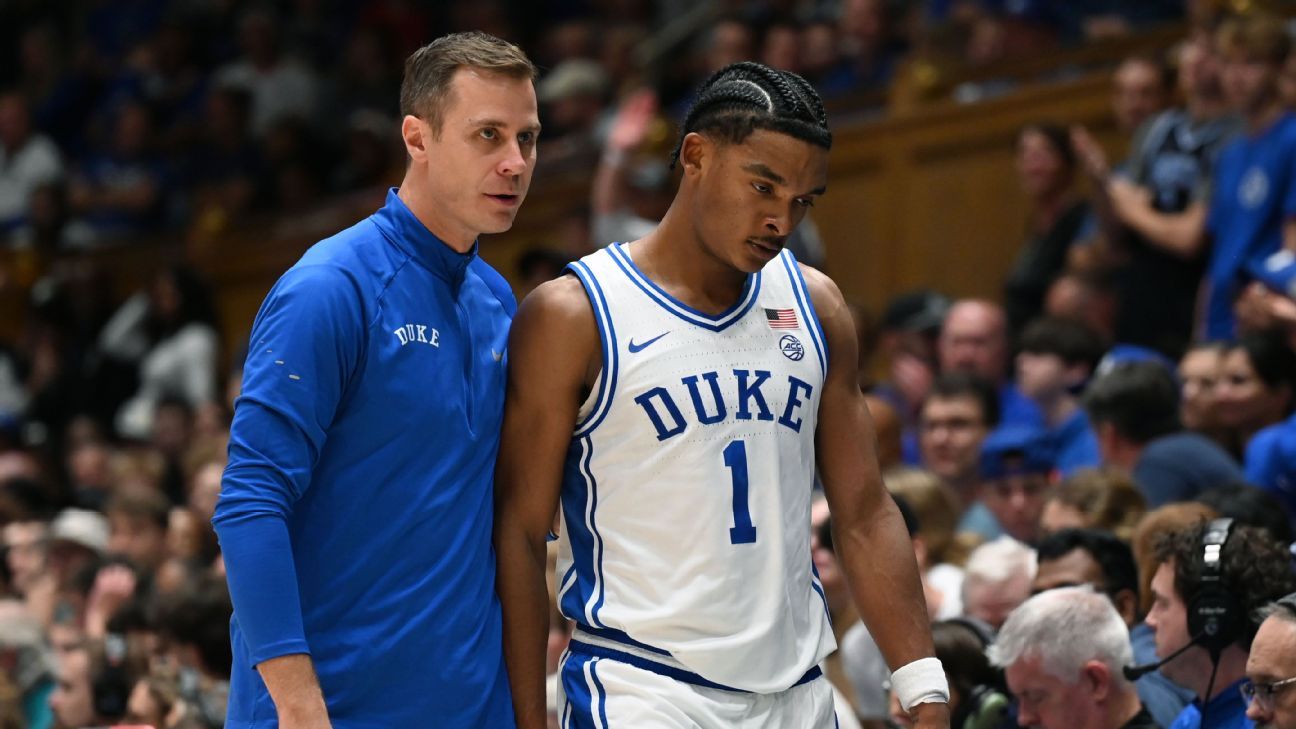
DURHAM, NORTH CAROLINA — Duke head coach Jon Scheyer woke up one midsummer morning and steeled himself.
“Today’s the day,” he told himself.
He knew it had to happen at some point in the offseason, and decided it was finally time: He was going to rewatch Duke’s Elite Eight loss to UConn for the first time.
It wasn’t a task circled on his to-do list, necessarily, but Scheyer knew rewatching that game had to be part of his usual offseason process.
“Losing sucks. And losing in a way you never think you’re going to lose sucks,” he told ESPN in September. “But how you got there, you can’t forget. You can’t diminish that stuff, either. I was very cautious. If I didn’t watch that game, I would’ve skipped steps.”
Scheyer entered his fifth season at Duke with the backdrop of two heartbreaking defeats to end each of the past two seasons: the Elite Eight loss to UConn on a 35-footer from Braylon Mullins — a game the Blue Devils had led by 19 — and a Final Four loss to Houston the year before in which they gave up a nine-point lead in the final two minutes.
There was a noticeable difference in the ways Scheyer handled each of those season-ending losses. He rewatched the Houston game “a million times” last offseason, he said, though he called it the harder loss to understand. That 2025 Cooper Flagg-led Duke team was playing its best basketball late in the season, rolling through the campaign with some of the best advanced metrics the sport has ever seen.
But the loss to UConn — on a buzzer-beating 35-footer after a turnover — produced a different feeling.
“All of a sudden, you go from one moment the plan is what we thought — we’re going to another Final Four, and I like our chances — and then the next moment, your season’s done,” Scheyer said. “I think that part of it was the hardest thing.”
Now, Scheyer is set to embark on a season that, on paper, looks dramatically different than the past few. There’s once again a highly touted recruiting class featuring a slew of future NBA players heading to Durham, but there’s no Flagg or Cameron Boozer, an ultra-productive one-of-one player around whom Scheyer can build his roster. Four players who started at least 11 games last season are back, a stark contrast to a 2025-26 campaign that featured zero returning starters from the year before.
“If we keep putting ourselves in that position, you’re going to tinker and learn,” Scheyer said. “And I love the fact this year we actually have guys on the floor that experienced what we went through [in those losses]. The year before, we didn’t. That’s a different thing. And so I’m as hungry as ever.”
FOR THE FIRST time since the 2023-24 season, Scheyer will not, in all likelihood, be coaching the best player in college basketball. Two seasons ago, Flagg was at the top of the roster, producing one of the best freshman seasons of all time en route to the Wooden Award and becoming the No. 1 pick in the NBA draft. When Flagg exited, Boozer entered. He arguably upstaged Flagg on a statistical basis, averaging 22.5 points, 10.2 rebounds and 4.1 assists and sweeping every player of the year award before being selected No. 3 in June’s draft.
This season, Duke is still bringing in the No. 2-ranked recruiting class in the country, led by Joaquim Boumtje Boumtje, a 7-foot-2 17-year-old who was named MVP at the Adidas NextGen EuroLeague finals in May and at the FIBA U17 Men’s World Cup over the summer. But the Blue Devils don’t have a clear-cut All-American for whom you can pencil in 20, 10 and five each game.
They welcome back senior guard Caleb Foster, junior big man Patrick Ngongba II, sophomore wing Dame Sarr and sophomore Cayden Boozer. Foster, Ngongba and Sarr were regular starters throughout last season, and Boozer started 11 games, including all seven ACC and NCAA tournament games. There’s also redshirt freshman Sebastian Wilkins, who looks poised to play a role, and incoming transfers John Blackwell from Wisconsin and Drew Scharnowski from Belmont.
“We may not know [who our go-to players are] for a little while,” Scheyer said. “I think part of the challenge and part of the exciting part is that it could be anybody on a given night, and we have multiple weapons, multiple ways to win. I think the thing for us is figuring out how to define roles with that as we’re growing individually. And that, to me, is going to be the toughest challenge.”
In his mind, the biggest test isn’t replacing the pure talent of Flagg, Cameron Boozer or Kon Knueppel, another star on the 2025 Final Four team. It’s replacing the consistency and baseline production those players provided.
“Cooper, Cam, Kon, they gave us such a high floor,” Scheyer said. “We got to find out where our high floor is. That’s why Pat’s stability is going to be huge for us. That’s why Blackwell is here. Cayden and Caleb, that’s what they should give us. Dame. We need to find that from those guys. That’s a challenge for them coming back. In their roles last year, they had the ability to figure themselves out a little bit, where this year, we need them to just be consistent with who they are.”
Scheyer hasn’t ignored the transfer portal in recent years, but it has been used more to plug gaps in the rotation rather than make wholesale changes to the roster. Two offseasons ago, Duke didn’t make any key additions from the portal. Before the season with Flagg, the Blue Devils added role players Sion James, Maliq Brown and Mason Gillis.
But with Cameron Boozer and Isaiah Evans leaving after last season, Scheyer knew he needed a big-time, needle-moving transfer and landed Blackwell, the best guard in the portal.
“When you lose such firepower, you have to replace that firepower somehow,” Scheyer said. “We felt like we had to get John. That’s the bottom line. We just felt like he had what we were missing. You feel pressure to get it done.”
“They jumped on it from the gun as soon as I got in the portal. They showed love from the start,” Blackwell said. “[Scheyer’s] pitch to me was basically, ‘We’re going to help you reach your goals.’ And that was the main thing for me. He just kept it real. He didn’t sugarcoat. He said, ‘We’re going to push you every single day,’ and that’s what it’s been.”
IN JUNE, SCHEYER had a chance to leave NIL, the recruiting trail and the transfer portal behind, while also reuniting with one of the greatest players in Duke history. Before the Dallas Mavericks hired Dusty May from reigning champion Michigan, they gauged Scheyer’s interest.
“I know I’m right where I’m supposed to be,” Scheyer said at Duke’s media day in September. “And not many people can get their dream job at 33 [years old], and I’m in this for the long haul with Duke.”
A day later, he admitted to ESPN that he considered the offer.
“The spring’s a hard time because you go from the best time of year in the tournament to the worst time. And so your emotions are all over the place,” Scheyer told ESPN. “It was surprising at first and you think about it, of course. But I was very clear-minded at the end of the day, and I would’ve not been able to live with myself not seeing this thing through. And I think whenever you have a potential, another opportunity or something like that, or you can think about a different spot, I think it allows you to either feel like you’re not in the right spot or it allows you to even feel stronger with where you’re at. And for me, I feel way stronger now than I ever have.”
The NBA’s interest in Scheyer is unlikely to wane. He’s part of a crop of young college coaches with the demeanor and tactical acumen to fit today’s NBA.
“If I’m thinking about that and I’m asking our players to be present, then who the hell am I?” Scheyer said. “And I don’t even think about that right now because I haven’t accomplished everything I’ve wanted to accomplish. And I may never accomplish everything I want to, like that’s kind of how I’m wired, but I’m not even close to feeling like the job is done and I’m ready for something new. Knowing the success we’ve had, I’m doubling down now on what we can do.”
Just because he retained much of his roster doesn’t mean Scheyer’s job has gotten easier, though. In some ways, he said, it’s harder with a large group of returnees because the success of the previous season’s team creates immediate expectations for the following campaign.
In Scheyer’s preseason practices, there was an emphasis on communication and talking louder on defense. During one late-September session, Scheyer had to yell, “You can’t make that pass!” twice in a minute after a pair of would-be turnovers. After too many possessions in a row ended with his team settling for a 3-pointer, Scheyer bemoaned the fact that his players had reverted to things they did before a summer of workouts.
“My message to them is that complicated things don’t get you beat. It’s the simple things,” Scheyer said. “If you’re experienced, you can’t skip over the steps you’ve learned. And if you’re young, you need to learn those habits you need to develop.”
“I feel like this year, we got to compete a lot during the summer,” Sarr said. “I feel like the group is there and I feel like we’re connected and that’s the most important thing. We were very connected last year, too. And I just think we’ll probably have a little different style of play because last year we had Cam and he was our guy, and this year, we are able to play a little faster and play a little different way. But I think the concept is always good basketball, just sacrifice for each other. So I think it’s going to be great.”
Associate head coach Chris Carrawell said it reminds him of the late 1990s Duke teams he played on under Mike Krzyzewski.
“The competition makes for great practices. Sometimes, guys are not going to be happy, but that’s why you have competitive practices,” Carrawell said. “Our practices, man, we’ve had some so far in the summertime and now in the fall, we’ve had some competitive practices. So, I think guys are going after each other. I think that makes for a really good team.”
SINCE THAT FIRST rewatch, Scheyer has reviewed the UConn loss more in-depth, taking notes and rewatching certain clips and segments from the game, which he has also shown to the players.
“I never want to put those clips on our guys. I never want to make it about where they have to feel like they have to make up for it,” Scheyer said. “But I showed them. I showed them stuff from the Houston game. I showed them stuff from past tournament games because I want them to understand what wins, and I also want them to understand what loses, that you never know can have you lose.”
He wasn’t the only one who needed to process the way the game ended, either. Cayden Boozer, whose turnover in the final seconds immediately led to the Mullins 3, has also viewed it as a learning experience.
“Obviously, it’s a tough moment,” Boozer said. “I think what was tougher for me was just the fact that we lost. I mean, obviously, but at the end of the day, players are going to make mistakes. I’m sure I’m going to turn the ball over at some point this year, too. But just understanding that moment, being able to learn from that and help our team win as much as I can, that’s important to me.”
For Scheyer, moving on from the way the past two seasons ended — as well as last-second losses to Texas Tech and North Carolina during the 2025-26 regular season — requires what he calls “facts over narratives.” Focusing on the facts, the Blue Devils were 11-3 in games decided by single digits last season. They overcame double-digit deficits six times, and they had a lead or were within one possession of the lead in the final minute of all 77 of their games over the past two seasons.
“Part of what makes a great competitor, to me, is you don’t take things lightly or you don’t let things go,” Scheyer said. “So that [UConn loss], I’m going to carry with me, but it’s really also not going to define me at the same time. And for our group, I want them not to feel like they’re making up for anything [from last season]. They have to continue to realize, ‘You’re not part of the three [losses], you’re not part of the 35 [wins], you’re 0-0.'”
The sour taste of the way the past two seasons ended is not going away, and he’s acutely aware of that fact. The final hurdle, the one where Duke pushes past the hump and reaches its first national championship game of the Scheyer era, will be the hardest.
“I believe in my soul that we’re going to win a national championship here soon,” Scheyer said. “But if you’re going to think about the times you’ve won, you got to be able to handle the tough moments. Unfortunately, you have to go through some s—, and I wish you didn’t. I wish that we’d be having a different conversation, but for me, you got to embrace it.
“Sometimes, it’s your day to take some s—. So, we’ll take some s—, and then I know it’s going to come back around.”


