
Bruce Springsteen has long wrestled with the anchor of New Jersey. But the artist who yearned to pull out of “a town full of losers” in the 1975 anthem “Thunder Road” has always managed to find his way back home.
Now, with the opening of the Bruce Springsteen Center for American Music, the reluctant-turned-exuberant ambassador of New Jersey is planting a flag of permanence in his home state. The 30,000-square-foot space — located on the campus of Monmouth University, just a mile from the Jersey Shore boardwalk — will offer visitors a deep exploration of American music when it opens June 13.
“It’s in New Jersey because I’m from here — I live here,” Springsteen, 76, said with a laugh in a backstage interview.
For those who might question why New Jersey should play host to a comprehensive collection of artifacts and materials pertaining to American music, he had a more definitive retort: “Why not!”
Housed in a $50 million building designed by CookFox Architects of New York, the center is a new frontier for an artist whose seven-decade career has included hundreds of songs, thousands of concerts, a Broadway show, an autobiography, a Hollywood biopic and a Presidential Medal of Freedom.
Given his cultural imprint, the center could easily have morphed into a monument to Springsteen. But that wasn’t what the Boss had in mind.
“Frank Sinatra’s tuxedo was pretty cool, you know?” he said, referring to a garment once worn by another son of New Jersey. The tuxedo is one of the hundreds of items on display, more than half of them related to artists other than Springsteen.
Indeed, just as the sound of the E Street draws from many American musical strands, so too does the center include the many genres unique to the nation.
“That’s kind of how I see myself,” Springsteen said. “I’m a small link in a big chain. I’m the guy that came along and kind of picked up the flag. That’s the way it works. You run with it for a while, and you pass it on to the next guy. I think the center reflects that.”
Having his name on the side of a building may have been new for him, but the opening festivities returned to him to his place of comfort — the stage.
On Thursday night, at the 4,100-seat arena on the Monmouth campus, Springsteen traded verses with Kenny Chesney on Woody Guthrie’s “This Land is Your Land,” marched down the aisles in a New Orleans-style second line with Trombone Shorty, and ripped through a punk anthem with Guthrie lyrics alongside the Dropkick Murphys.
On Friday, Springsteen channeled the spirit of Elvis Presley as he snarled through “Jailhouse Rock.” Then he took a seat to watch as Sheryl Crow crooned her way through Patsy Clines’s “I Fall to Pieces” and Mavis Staples offered a soulful interpretation of “The Weight” by the Band.
Jon Bon Jovi and the E Street guitarist Nils Lofgren pushed their amplifiers to the breaking point during their rendition of Neil Young’s “Rockin’ in the Free World.” Other artists who took the stage included Jackson Browne, Rosanne Cash, Public Enemy, Gary Clark Jr., Keb’ Mo’ and Valerie June.
Robert Santelli, the center’s founder and executive director, served as the emcee. The performances came shortly after a number of artists announced that they would not take part in this summer’s Freedom 250 event, a series of concerts organized by President Trump that is scheduled to take place on the National Mall in Washington.
“The way that Bob set up these two nights, which is taking you through the history of American music, with all these artists who have generously donated their time, is really what should have been happening nationally, and should have been happening on the Mall,” Springsteen said. “So it’s nice that it’s happening, period.”
Politics have been central to Springsteen’s music and concerts in the past year. Enraged by the actions of the Trump administration, including the dismantling of the U.S. Agency for International Development, he was pushed to the edge by the killings of two Americans by federal agents in Minneapolis.
“Alex Pretti died on a Saturday morning, and I get a call: ‘We’re going to Minneapolis,’” said Jon Landau, Springsteen’s longtime manager. “I said, ‘No, we’re not going today. Let’s wait.’ I said, ‘Why don’t you go write a song?’”
Within five hours, Springsteen sent along the lyrics to “Streets of Minneapolis.” He recorded it two days later.
The song, a blunt condemnation of the administration’s actions in Minneapolis, inspired Santelli and Eileen Chapman, the center’s director, to mount an exhibition on protest music. Called “Chimes of Freedom: Protest, Patriotism and the Power of Song,” it spans songs from “Yankee Doodle” to the civil rights and antiwar anthems of the 1960s, ending with “Streets of Minneapolis.”
“I’ve written a lot of music that has political implications, and what I would call critically patriotic, which is really my definition of a patriot,” Springsteen said.
Although “Streets of Minneapolis” stands as a rare musical rebuke to the current Trump administration, Springsteen believes the genre will continue.
“It’s there, it’s alive, it’s present, it’s living and it’s having its impact,” he said. “There’s always going to be something to protest in the U.S.A.”
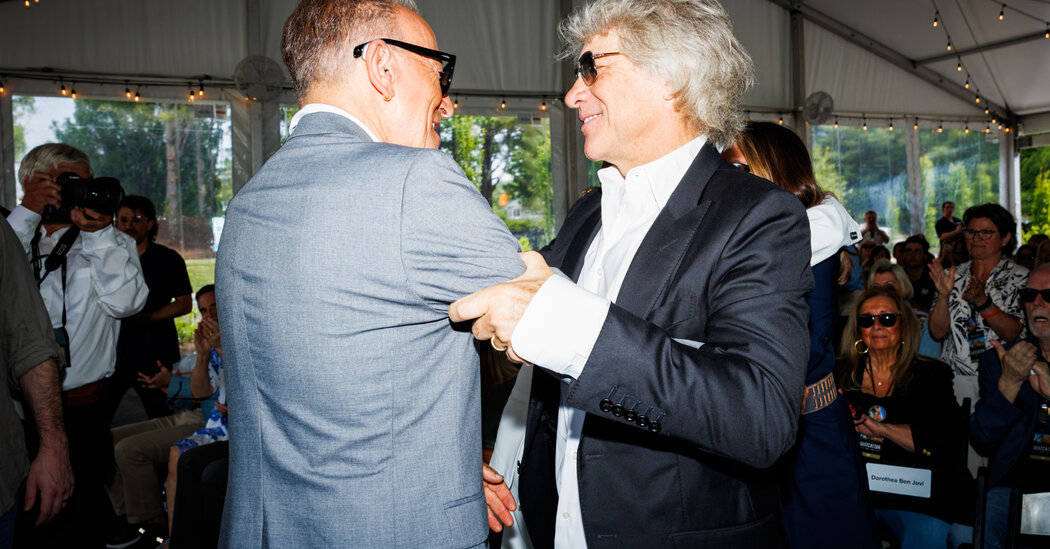
The performances ended with Bon Jovi joining Springsteen and the E Street guitarist Stevie Van Zandt for “I Don’t Want to Go Home,” an unofficial anthem of the Jersey Shore and its signature venue, the Stone Pony in Asbury Park. That was where Springsteen, Van Zandt, Southside Johnny and others used to play beer-soaked covers until sunrise.
Bon Jovi and Springsteen, two Jersey-born totems of American rock, are not often on the same stage together. Their performance (with added hype from Flavor Flav of Public Enemy) amounted to a proclamation of New Jersey’s vital place in music history while also demonstrating the chip-on-the-shoulder spirit that has animated American musical movements from soul to punk, from hip-hop to bar-band rock.
Discussing their set list before the show, Springsteen asked Bon Jovi about joining together for “Raise Your Hand,” a soul staple by Eddie Floyd.
“I was like, ‘Of course I know it, because I learned it down the Shore in the late ’70s,’” Bon Jovi said. “We could cut our teeth and learn about different styles of music and experiment. And with the success of Bruce and the Jukes, the kids like me could come down here and play original music.”
As Springsteen’s fame grew, the need for an archive became clear.
“For years, he was just sending boxes to his mom’s house,” Landau said.
Still, the Boss was hesitant.
“It seemed too auspicious,” Springsteen said. “Like, hey, do you really want your name on a building? Who knows what you might do?”
The idea of a permanent archive has bedeviled other stars of his ilk. Sir Paul McCartney only recently warmed to the idea of museum. Bob Dylan has reportedly never visited the Bob Dylan Center in Tulsa, Okla.
Opening an archive can also signal the end of career. But Springsteen is not done yet, having just wrapped a 20-date tour at sold-out arenas across the country with an expanded E Street lineup.
“It’s the best the band has ever sounded,” Landau said.
And, with the tour’s political message, Springsteen and Landau felt it was one of the most consequential in their decades-long history.
“The only thing I could compare it to was when we played East Berlin in 1988,” Landau said.
Springsteen warmed to the idea of an archive as he worked with Santelli, Landau, Chapman and Patrick F. Leahy, the president of Monmouth University. He agreed to go forward as long as it placed him within the context of the broader American catalog.
“I spent most of the time thinking about, how do I meet the expectations of telling the story of American music, because it is so big, so broad, so complex?” Santelli said. “I struggled with that for months, and eventually came up with the idea that we will give you snapshots of the great American genres, and snapshots of the great American musical themes, things that touched upon American culture and history.”
True to the Boss’s directive, the Springsteen-focused exhibition is booted up to the second floor. The first floor is dedicated to the many homegrown genres, as well as the themes of race, gender and American identity. Precious relics, like a guitar that once belonged to Johnny Cash, Louis Armstrong’s trumpet, a costume worn by Lady Gaga, the cape of George Clinton and, yes, Sinatra’s tuxedo, pop up around every corner.
Upstairs, there are Springsteen artifacts to excite all levels of Boss fan, from those who can hum the chorus to “Dancing in the Dark” to the die-hards who have walked down E Street in nearby Belmar. There’s the leather jacket from the cover of “Born to Run,” the red hat that dangled from a back pocket of Springsteen’s jeans on the cover of the 30-million-selling album “Born in the U.S.A.,” and even the original Gibson J-200 acoustic guitar and TEAC 144 Portastudio he used for the bare-bones “Nebraska.”
Visitors can try their hand at playing the famed producer Jimmy Iovine, adjusting mixing levels to “Born in the U.S.A.” There is also a drum set, complete with a video lesson from Max Weinberg on the song’s thunderous drum part (a humbling experience for most).
In addition to having a cultural center dedicated to his legacy, Springsteen has a vision for its future.
“As my own relevancy fades, I’ll be happy with the little glass cabinet, with the main business of whatever I did, and be surrounded by a bunch of other incredible musicians,” he said.
“So I would just like to see it really continue as an American music center,” he continued, “and just be a place that attracts young people who are looking for a sense of historical continuity, a sense of inspiration, a sense of how American music shapes culture, and how culture shapes politics. Just as a place that will expand, inspire, and educate your mind, your soul, and your heart.”

