
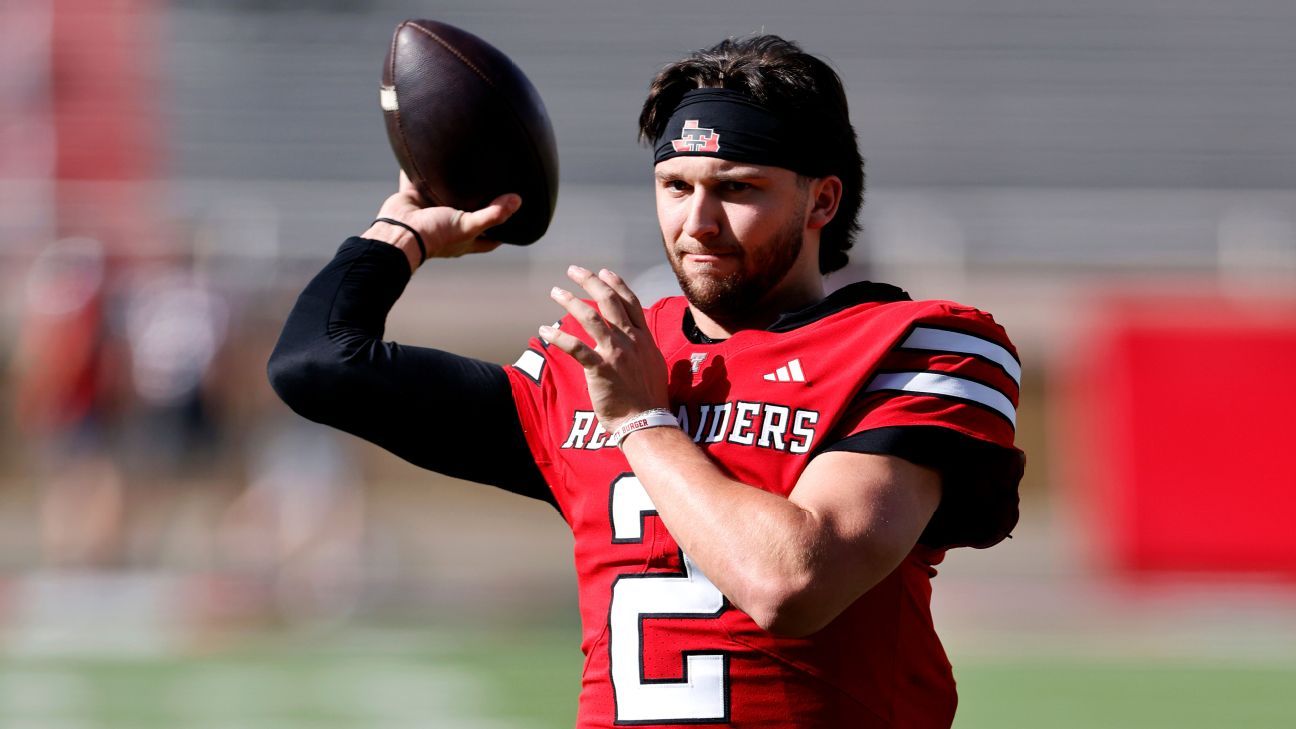
For the first time since 2019, the NFL supplemental draft is interesting! Texas Tech quarterback Brendan Sorsby has announced his intention to enter the supplemental draft, which will be held sometime in July once the league approves his application.
The supplemental draft allows all 32 teams to bid blindly against one another for the rights to a player. Any team wishing to add Sorsby must submit a bid for the round in which it would be willing to draft him. The team that submits the most valuable bid wins the rights to the player, but its pick in that specific round is forfeited in the upcoming 2027 NFL draft.
As such, NFL teams are now doing all of their due diligence on Sorsby. A much-larger-than-normal piece of that diligence will consider his serious sports gambling transgressions. But it’s still the job of scouts and coaches to watch the tape and grade his current play and NFL potential. League evaluators were excited to see Sorsby play another season at Texas Tech; even if he had declared for the 2026 draft, before the sports gambling was exposed, he was considered a high-ceiling prospect worthy of a solid pick.
I dove into the film to determine just how good Sorsby is right now and what sort of pick he’s worth based on his on-field ability. I also ranked my top five team fits for him based on his skill set and each offense’s needs and scheme. To be clear, this is a look at Sorsby’s football talent alone; it is not at all a reflection of the tough calculus many teams will do when the supplemental draft officially begins. Let’s begin with what he does well.
Jump to Sorsby’s …
Strengths | Weaknesses
Starter potential | Team fits | Value

What does Sorsby do well?
Sorsby has a live arm. Cincinnati’s offense featured a deep menu of run-pass options — 14.5% of Sorsby’s attempts were charted as RPOs, 28th in the country — and Sorsby cashed many of those throws by adjusting his arm angle without losing zip or accuracy. It’s impressive how quickly he can get into his throwing motion, and the ball pops off his hand without much effort. Cincinnati was able to attack vertically off RPO action because of his release speed and velocity.
Here’s a good example against Iowa State. Sorsby rides the fake for as long as he can, and when he finally pulls the ball to throw the glance, pressure is in his lap. But Sorsby does well to get his throwing platform set. His quick three-quarters release is fast enough and high enough to get the ball above the first level of the defense while still hitting his receiver with plenty of time before the safety can react. This is a quarterback with a good understanding of timing and spacing, and he has the creative arm angles necessary to fine-tune passes to the middle of the field.
— Good Clips (@MeshSitWheel) June 4, 2026
While much of Sorsby’s production came on one-read decisions, he showed poise when asked to get to secondary options post-snap. On this throw against Oklahoma State, the Bearcats want the same glance off the fake to the running back, but a squatting safety fills the throwing window.
Sorsby gets to the backside and considers the deep post from the slot receiver, but the safety has good leverage. He progresses further, to the deep stop route outside the far numbers. While he is a tad late on the release, he has enough velocity on the throw to beat the sinking linebacker and closing corner.
— Good Clips (@MeshSitWheel) June 4, 2026
While both of these throws are on a rope, Sorsby’s best balls aren’t when he needs to drive them; it’s when he gets to hang it up high. He gets easy distance on deep shots and consistently looked to capitalize on one-on-one opportunities. In fact, 17% of Sorsby’s throws were at least 20 air yards downfield (16th in the nation and significantly above any early-drafted quarterback from this year’s draft class).
Cincinnati offensive coordinator Brad Glenn cooked up just about every expression of vertical routes — slot fades, seams and wheels, switch verts, etc. — to give Sorsby the opportunity to throw shots in rhythm. Sorsby’s NFL offensive coordinator must be willing to do the same, and he would perform best on a team with speed at receiver.
Sorsby wants to push the ball, but he isn’t overly bold with holding it in the pocket. Telemetry Sports charted Sorsby with zero throwaways, zero intentional groundings and only seven sacks on 114 pressures last season. Some of that is the system, but the film backs it up: Sorsby has a good nose for when pressure’s brewing and understands the value of getting the ball out early or escaping the pocket fast. His overall sack rate of 1.8% was better than all but two quarterbacks in the FBS in 2025.
Listed as 6-foot-3 and 235 pounds, Sorsby has some serious scoot at his size. I would argue that on many of his scrambles, he’s out of the door a little early. Here against Nebraska, he has the quick out open against a linebacker with bad leverage. But he senses the seas parting upfield — again, he plays with great natural feel — and tucks without a second thought. When he’s gone, he’s gone. Sorsby has seriously impactful acceleration for a quarterback.
— Good Clips (@MeshSitWheel) June 4, 2026
In the open field, he eats up grass and consistently makes safeties miss with head fakes and sharp cuts. Sorsby hit 19.9 mph on a 41-yard scramble against TCU, per Telemetry Sports. The only quarterbacks to clear 20 mph in the NFL last season were Caleb Williams, Bo Nix, Justin Herbert, Justin Fields and Drake Maye (per NFL Next Gen Stats).
Because Sorsby is a legit threat as a ball carrier with the bulk to take on contact, the Bearcats used him in the designed running game. He averaged 5.8 yards per rush on the season (third among all quarterbacks) and had eight scores and 20 first downs on only 57 designed rushes. His athleticism warrants called runs in the NFL — perhaps not at a Lamar Jackson or Josh Allen rate, but on third downs and in the red zone for sure.
Where does Sorsby still need to work?
Because Sorsby is such a creative and natural thrower, he is unnecessarily flippant with his mechanics. He’ll throw flat-footed even when he has plenty of room to step into his delivery, and he’ll drop his arm slot into sidearm throws when it is not needed. He often makes throws more difficult than they need to be.
Take this third-and-4 against Baylor. Sorsby has a deep out-breaking route from the speedy Cyrus Allen running away from an off-cover safety — a great matchup. A little color flashes on the interior of the pocket, but there’s still plenty of room and time for Sorsby to throw this from a balanced platform and with good velocity. He has done it before. But he elects instead to lean back and lollipop this throw to the far sideline while fading away from the shot. Someone has been watching too much Jordan Love film.
— Good Clips (@MeshSitWheel) June 4, 2026
The pass is still completed. But watch Allen wait for the ball to arrive, meaning he can’t protect the catch point from the incoming safety. There was no need for this throw to end up like this.
The other major concern with haphazard delivery is haphazard accuracy. While Sorsby isn’t remarkably less accurate on his off-platform, wonky arm throws than he is on his crisp deliveries, he is generally inaccurate. He has not committed himself to one throwing motion with the robotic consistency that accurate NFL quarterbacks have, and as such, he produces a worrying grab bag of ball locations.
ESPN charted Sorsby with an off-target rate of 13.8% last season, 112th out of 133 qualifying quarterbacks. Only 75.3% of his passes were even catchable. Here’s how his accuracy numbers compare with recent quarterbacks taken on Days 1 and 2 of the draft.
Because Sorsby is so averse to taking sacks, and because the offensive menu of the Bearcats was fairly predictable, it was not hard for smart defenses to bait him into poor decisions. Against man blitzes, Sorsby loves to hang a deep floater out for his speedy receiver to track in space. But these bold attacks often become needless prayer balls. Against Arizona — whom he did burn with a couple of deep shots into blitzes — Sorsby has an open receiver immediately on third-and-7. His tight end, Joe Royer, gets to the flat. A safety is bearing down, but a quick throw would give Royer time to make the tackler miss in space.
Instead, Sorsby sees man coverage and holds his water in the pocket, looking for the deep corner route from Allen. It’s understandably greedy — Royer is nowhere close to the line to gain, and Allen is running a good route against Cover 1. But it’s a long-developing route, and Sorsby is forced to throw it well before Allen breaks. He hangs it inside given the pressure, and Arizona safety Dalton Johnson tracks it for the interception.
— Good Clips (@MeshSitWheel) June 4, 2026
That wasn’t the only time Arizona got him. Sorsby will also auto-throw first reads without checking his work. The Wildcats absolutely look like they’ll be in single-high for this seam/wheel combo that Sorsby loves so much, but Arizona is trying to trap this exact route combination. Sorsby sees the safety hanging on the hash and assumes the corner will get pulled with the seam, opening space for the wheel. He never confirms the coverage, though, and throws right into the teeth of two Arizona defenders, who are obviously expecting the throw.
— Good Clips (@MeshSitWheel) June 4, 2026
Both of these mistakes are easy to chalk up to the carelessness of youth. But Sorsby is a three-year starter who too often plays on autopilot. I admire his ability to generally avoid big negatives; he takes few sacks, and the two interceptions shown here were of his five total this past season. Still, he does not seem ready for an NFL-caliber offense facing NFL-caliber defenses. He is not accustomed to a deep playbook and gets got by post-snap coverage rotations too easily.
If forced to play early, his rate of negative plays would shoot up dramatically. It’s clear why another year of college ball would have benefited him. Now, the hope is he gets another year to sit.
So … is Sorsby an NFL starter?
He absolutely has the tools to be one. Watching Sorsby reminds me a ton of watching Malik Willis‘ (very limited) starting film over the past two years with Green Bay. Willis is a little shorter and stockier, but both QBs are explosive when they decide to tuck the ball and can rip off chunk gains as scramblers or designed runners.
Both also rely heavily on their first read opening up and will send a deep shot if given a fair look at it. But both can go through their progressions. It might be a tad slower than ideal, but they make up for that lethargy with good ball velocity. And while neither is particularly accurate, they are accurate enough.
Willis, of course, was a third-round pick as a developmental player. He didn’t find much purchase in Tennessee. But under Matt LaFleur in Green Bay, he was used as a dangerous wrinkle in the designed running game and was consistently given open downfield receivers with simple post-snap reads. On that play alone, he earned an unimpeded audition to be the full-time starter in Miami.
I can see a similar arc for Sorsby, especially given the odd constraints of the supplemental draft. Sorsby will join his NFL team months later than the average rookie, and most rookies aren’t up to speed by Week 1 anyway. Given how some quarterbacks rooms (Cardinals, Browns) are already loaded with potential starting options, the number of teams with roster room for Sorsby is limited — he’ll be fighting for a QB2 job, not a QB1 role. If Sorsby does see starts during the 2026 season, it likely means the campaign has not gone according to plan for his team.
If Sorsby comes along well enough behind the scenes, maybe he gets an audition for his team in 2027. And when he gets that audition, a clever playcaller should be able to draw a solid offense out of his explosiveness, nifty releases and downfield disposition. There’s a solid starter in here somewhere, but the unique circumstances of Sorsby’s entrance into the league make that player all the more difficult to develop.
Which teams are his best fits?
Sorsby is an absolute perfect fit for the 2023 Dolphins. In Mike McDaniel’s RPO-heavy system, Sorsby’s light feet and whip-like release would have been ideal for Tyreek Hill and Jaylen Waddle on all those little seams and glances that sat in the voids between coverages. He would have tossed so many moonshots for Hill to run under. And he could have gotten involved in the running game with De’Von Achane and Raheem Mostert. It would have been grand.
The 2023 Dolphins no longer exist. But that framework — vertical threats for Sorsby to take shots, a heavy dose of RPOs to keep the reads simple and a willingness to involve the QB in the designed running game — is the one we should track for Sorsby’s best offense fits in the league.
Of course, the measure of a team fit is more than the scheme. Some teams simply won’t touch Sorsby because of the gambling scandal. But the fits I’ve listed below are entirely about on-field skill sets.

In that Sorsby reminds me of Willis, I am unsurprisingly interested in his potential with LaFleur in Green Bay. The Packers’ current QB2 is Tyrod Taylor, whom they signed after the 2026 draft. I’d wager they wanted to snag a quarterback in that draft, but the board never fell their way. The QB3 is Kyle McCord, who doesn’t at all fit the mold of a Packers backup quarterback; they’ve typically prioritized athletes, such as Willis and Taylor, at that spot. Sorsby would likely beat out McCord for the QB3 role and be first in line for QB2 after Taylor’s one-year deal expires in 2027.

The Panthers are oddly thin at quarterback for June, as behind Bryce Young they have only Kenny Pickett, Will Grier and Haynes King. Much of what coach Dave Canales does for Young — getting the ball out of his hands fast with big one-on-one winners on the outside — would work for Sorsby. And Sorsby could contend with Pickett for the QB2 job while getting up to speed on the under-center aspect of Canales’ offense. But if Sorsby were forced into action, Canales has run plenty of shotgun RPOs to take advantage of Young’s fast release and natural footwork, and Sorsby brings much of the same.

Minnesota is secure at QB for 2026, as Kyler Murray is in town on a one-year deal to refurbish his career and right Kevin O’Connell’s sinking ship. If Murray is a successful veteran quarterback, the Vikings will be faced with the same question they answered last offseason, when they let Sam Darnold sign a deal with the Seahawks to give J.J. McCarthy the reins of the offense. With Sorsby in the building for all of 2026, O’Connell could get a long look at his potential as a QB1 challenger in 2027 should Murray play his way into a bigger deal elsewhere. While the Vikings’ offense isn’t a one-for-one fit for what Sorsby did in college, he saw some translatable concepts (especially rollouts).

As of today, the Colts don’t have a ton of room for Sorsby on their depth chart. But should they trade Anthony Richardson Sr., then QB2 will belong solely to second-year man Riley Leonard. Behind QB1 Daniel Jones off an Achilles injury, the Colts will need more firepower. Sorsby can easily take on the QB run chapters of Shane Steichen’s playbook, and Steichen has long been a successful RPOer. Sorsby might just bring the consistent deep ball that Steichen has been trying to find in Indianapolis for years as well. This is a fun pairing.

The 2026 starting quarterback job is up for grabs in Atlanta between incumbent Michael Penix Jr. and veteran minimum signee Tua Tagovailoa. New head coach Kevin Stefanski and new president of football Matt Ryan seem content to let the roster simmer for a year as they reshape the team in their image. Could one of Tagovailoa or Penix win the job for 2027? Sure! But it’s unlikely. By drafting Sorsby, the Falcons could give themselves an early look at a developmental challenger for that 2027 gig. Stefanski’s offense wants to get under center and boot the quarterback out. Sorsby did the second half of that quite a bit with Cincinnati, and Stefanski showed last season with Dillon Gabriel and Shedeur Sanders that he knows how to adjust the offense for popgun RPO passers.
0:49
Which teams should be interested in Brendan Sorsby?
What kind of pick would Sorsby be worth in a vacuum?
In the context of recent NFL drafts, in which players such as Penix, Nix and Ty Simpson were first-round picks, I would have expected Sorsby to go in the first round of the draft this past April. He’s far from a perfect prospect, and sitting a year would help him a ton. But he has the combination of size, arm talent, speed and feel that make a plus starter in the league. That potential gets drafted early, and coaches get paid big money to smooth out those rough edges.
Now, just because a quarterback would have gone Round 1 in a regular draft (with no off-field considerations) doesn’t mean he has a Round 1 grade. The QB-neediness of the league at large yanks these players into the first round. I personally put a second-round grade on Sorsby.
The earliest pick used in a supplemental draft this century was in the second round. Tony Hollings (2003), Ahmad Brooks (2006) and Josh Gordon (2012) were all second-round selections. The last first-round pick used was in 1992 on Dave Brown … a quarterback. Six quarterbacks have been selected in the supplemental draft, and all but Terrelle Pryor (2011) were selected with first-round picks (though the other five were mostly related to deadlines or academics, not off-field red flags).
No NFL team will wager a first on Sorsby — not with the excellent upcoming 2027 quarterback class, the expectations that come with being a first-round pick in the 21st century and the third rail of sports gambling ever present in our public spaces and league partnerships. I could see a second being wagered, but it would be surprising. If everything goes well for Sorsby in the predraft process, I would expect a third-round pick to be submitted. But that’s if he totally convinces a team that his gambling days are behind him.

