

A decade ago, ESPN published its first FC 100, ranking the world’s best players (and managers) in men’s soccer. Now here we are in 2026, 10 lists later, and so much has dramatically changed in the world of soccer.
Manchester City had yet to embark on their run of seven Premier League titles in eight seasons under Pep Guardiola. Lionel Messi and Cristiano Ronaldo were still at the very top of their games, going toe-to-toe in LaLiga for Barcelona and Real Madrid, respectively. And Germany were the reigning World Cup champions, having knocked off hosts Brazil on the way to winning it all in 2014.
The 2026 FC 100, position by position
Go to: Goalkeeper | Fullbacks | Center backs | Defensive/central midfielders | Attacking midfielders | Wingers | Center forwards
Go to: 2025 | 2024 | 2022-23 | 2021-22 | 2020 | 2019 | 2018 | 2017 | 2016

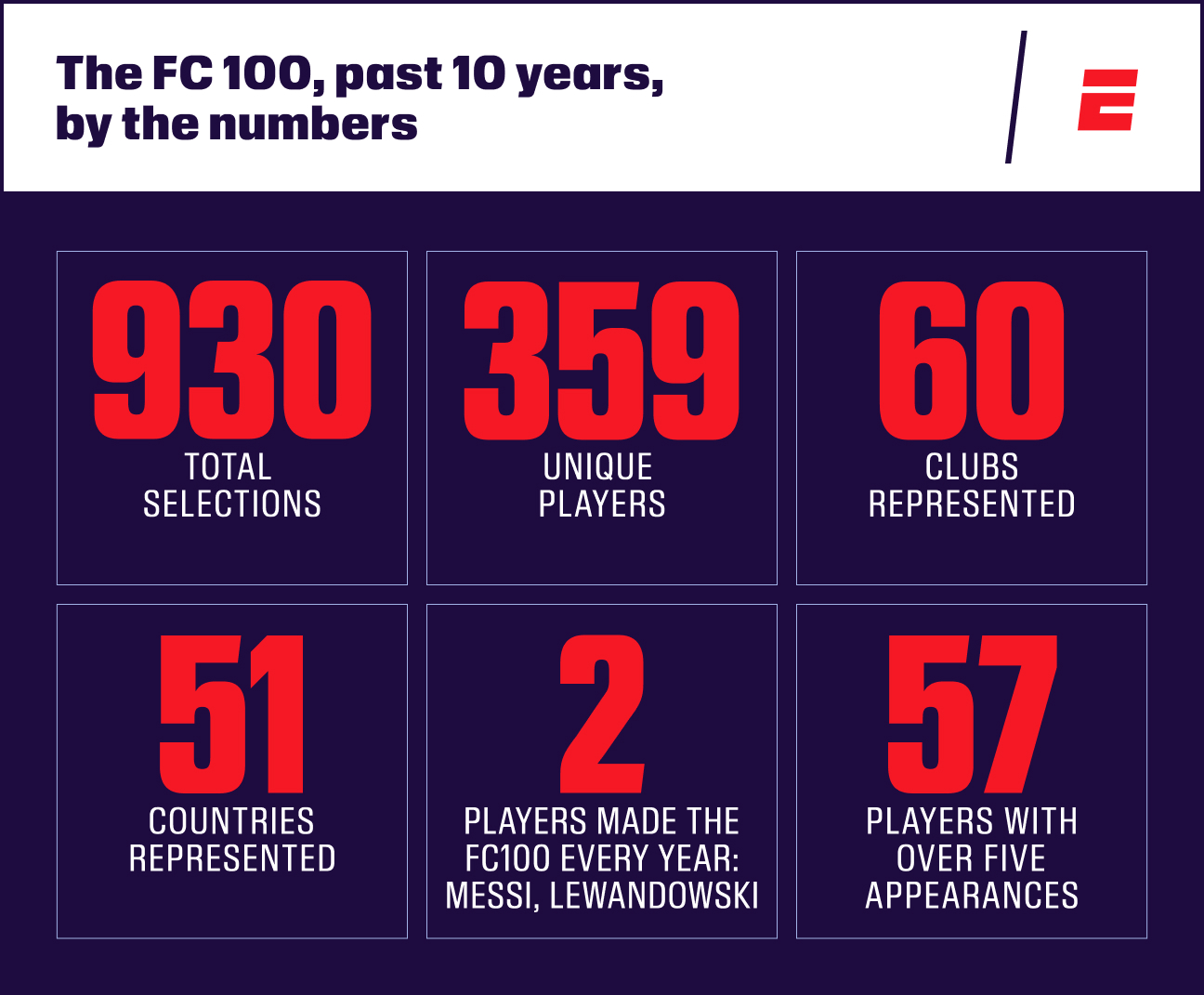
Of course, some things have stayed the same. Two stalwarts and icons of the game have impressively made the FC 100 all 10 years, a remarkable achievement. Take a bow, Messi and Robert Lewandowski — you’ve earned your place among soccer’s most legendary players.
For this special 10th anniversary edition of the FC 100, we decided it was only right to break down not just this year’s list, but all of them. Which clubs, countries and continents have seen their players dominate the rankings over the past decade? Who joins Messi and Lewandowski on the FC 100 all-time team with the most appearances?
Let’s answer those questions and pull out some of the other notable takeaways from 10 years of incredible players and moments.
New players in the FC 100
Nearly a third of the 2026 FC 100 was composed of players who have never before made the rankings, with some of them even shooting to the top of their respective lists.
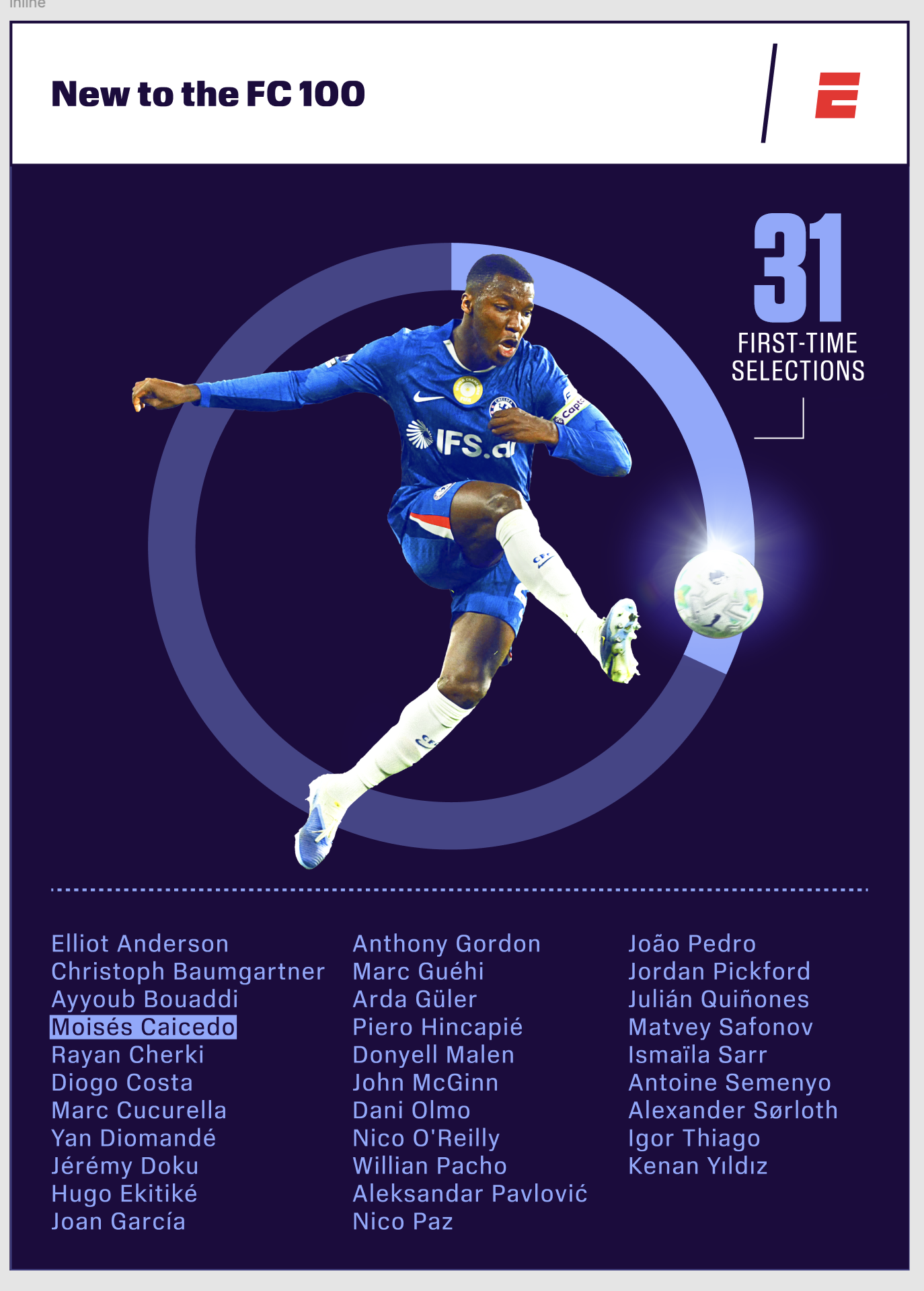
Dynamic playmaker Nico Paz broke into the FC 100 in a big way at age 21, debuting at No. 5 among attacking midfielders (sandwiched by No. 4 Rayan Cherki and No. 6 Martin Ødegaard, two Premier League stars). While he hardly figured into Argentina‘s plans in their run to the 2026 World Cup final, the Real Madrid academy product led Como to the best league season in their history, finishing fourth in Serie A. He’ll now have the chance to raise his profile even higher as Como compete on the UEFA Champions League stage.
Only a bit behind Paz in the attacking-midfielder rankings, Real Madrid’s Arda Güler (No. 9) stands out as a player to watch, though he’ll have to earn the confidence of new coach Jose Mourinho. As for the youngest debutant? That would be 18-year-old Ayyoub Bouaddi (No. 14 central midfielder), who impressed for Morocco at the World Cup and is slated for a big-money transfer — Manchester City are closing in on a deal for the Lille midfielder, sources told ESPN on Monday.
It wasn’t just young players who reached superstardom for the first time; 2025-26 featured a number of veterans enjoying a late-career renaissance. Matvei Safonov (No. 10 goalkeeper), Jordan Pickford (No. 9 goalkeeper) and John McGinn (No. 14 attacking midfielder) are among the players over 30 who made their first appearances.
Club breakdown
It’s no surprise that the two Champions League finalists, Paris Saint-Germain and Arsenal, top the club charts after their stellar seasons. PSG won that match in a penalty shootout to repeat as European champions, while Arsenal can still look proudly upon ending their 20-year Premier League title drought.
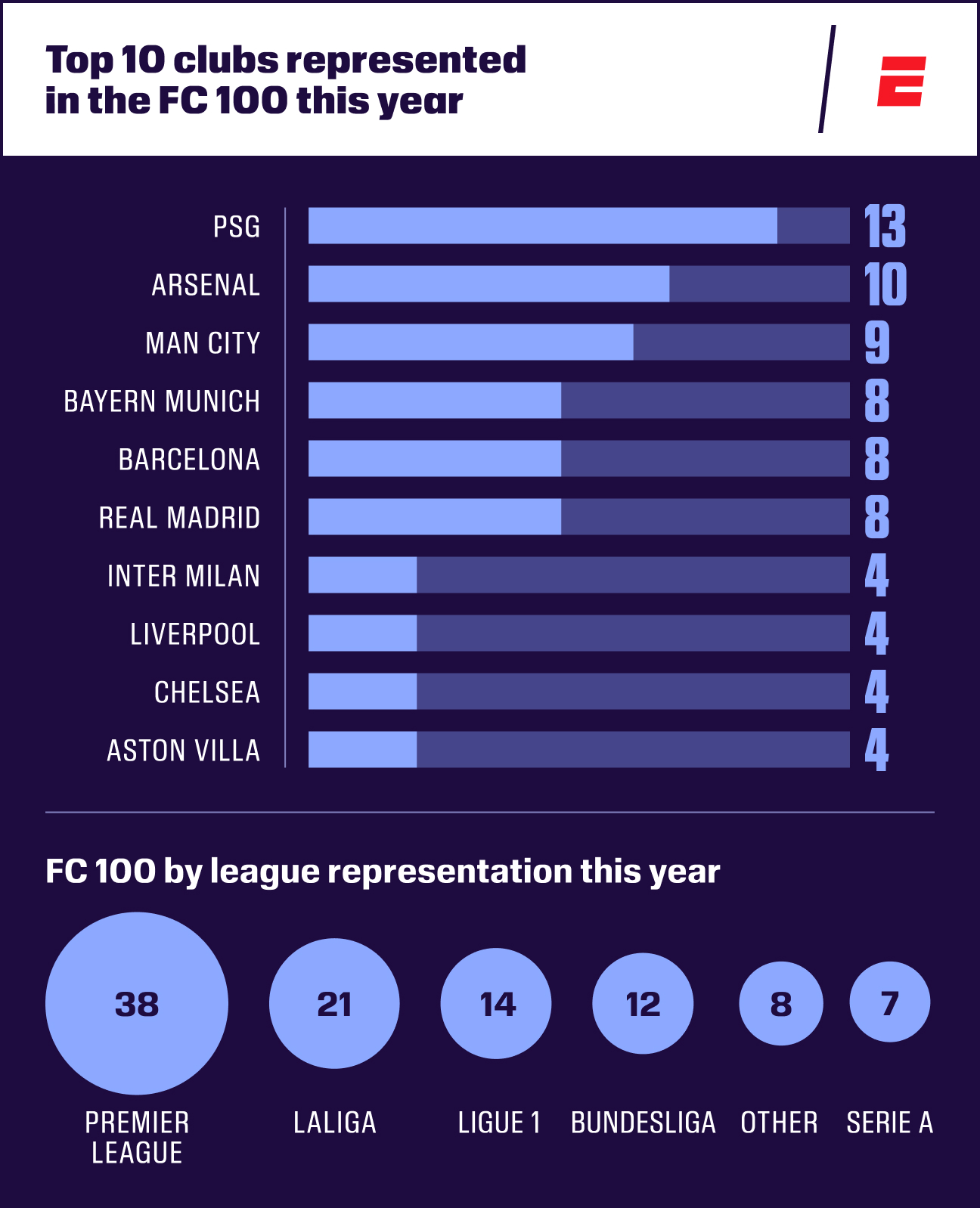
Remarkably, PSG claimed the top two spots in the full-back rankings. Nuno Mendes came in just behind No. 1 Achraf Hakimi, who was named the world’s best full back by our voters for the second consecutive year. Considering PSG also boasted Vitinha (No. 1 central midfielder), Ousmane Dembélé (No. 4 center forward), Khvicha Kvaratskhelia (No. 3 wide forward), Désiré Doué (No. 9 wide forward) and Willian Pacho (No. 2 center back) among their ranks, it’s no wonder they remained the best team in Europe.
Arsenal’s strength at the defensive end is evident from the list, getting top-notch contributions from David Raya (No. 1 goalkeeper), William Saliba (No. 1 center back) and Gabriel Magalhães (No. 3 center back). But reflecting the nature of their well-rounded squad, Declan Rice (No. 2 central midfielder), Bukayo Saka (No. 7 wide forward) and Ødegaard (No. 6 attacking midfielder) also received recognition for their performances.
But how does that compare with a decade’s worth of data?
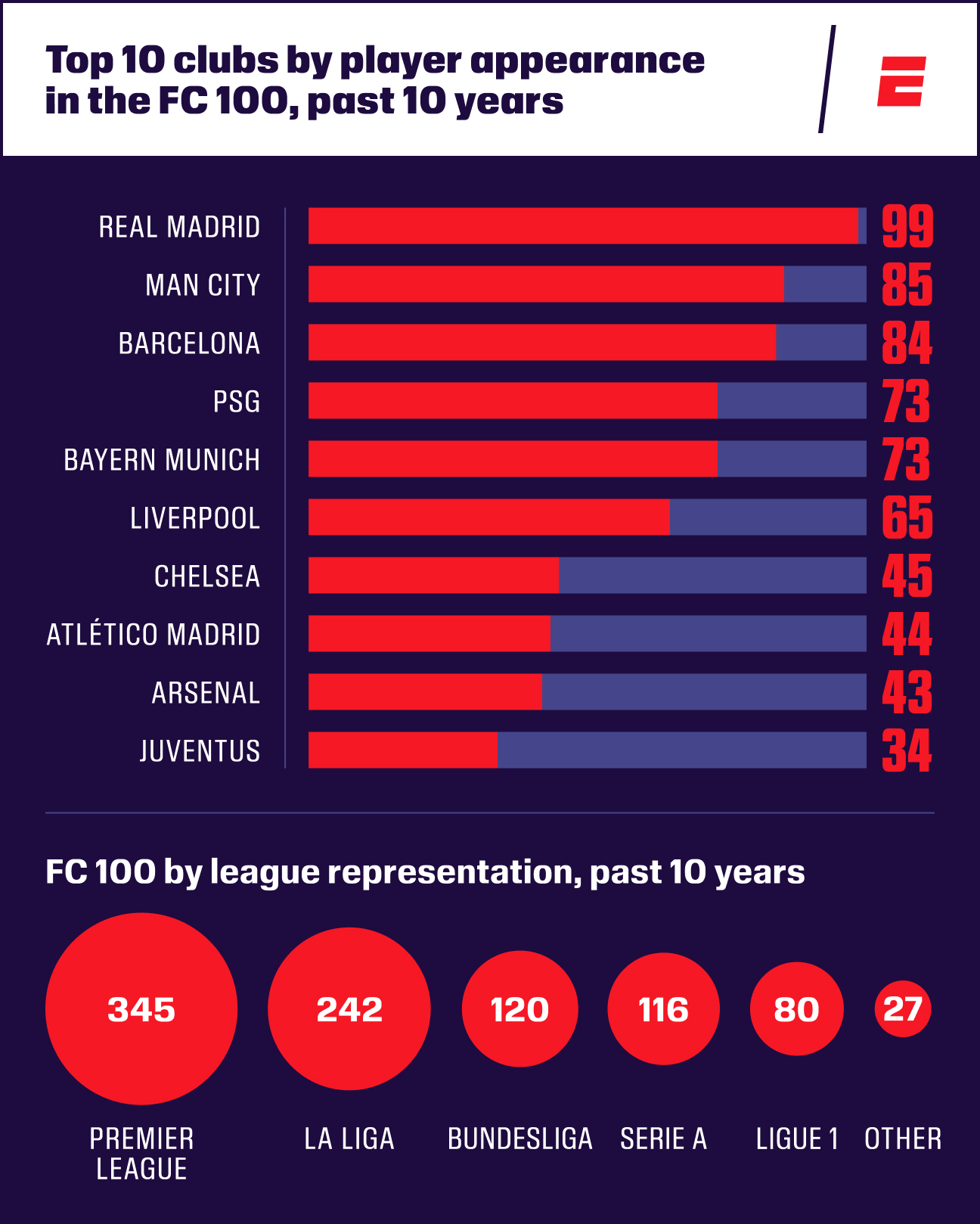
Here we see the result of Real Madrid’s former dominance in Europe — they won the Champions League five times in this voting span — and the later stages of their Galacticos transfer strategy that meant bringing in the very best and brightest stars from around the globe. Mainstays of the FC 100 for years include midfielders Luka Modric and Toni Kroos, center backs Sergio Ramos and Raphael Varane, full back Dani Carvajal and forwards Gareth Bale and Karim Benzema.
Ligue 1 drops down from third among leagues to fifth when looking at all 10 years. If you wanted to see the power that one dominant club (PSG) can have on its league’s FC 100 performance, this serves as the perfect example.
Country breakdown
France might have succumbed to Spain in the World Cup semifinals, but here in the land of the FC 100, it’s Kylian Mbappé & Co. on top in terms of best-represented countries.
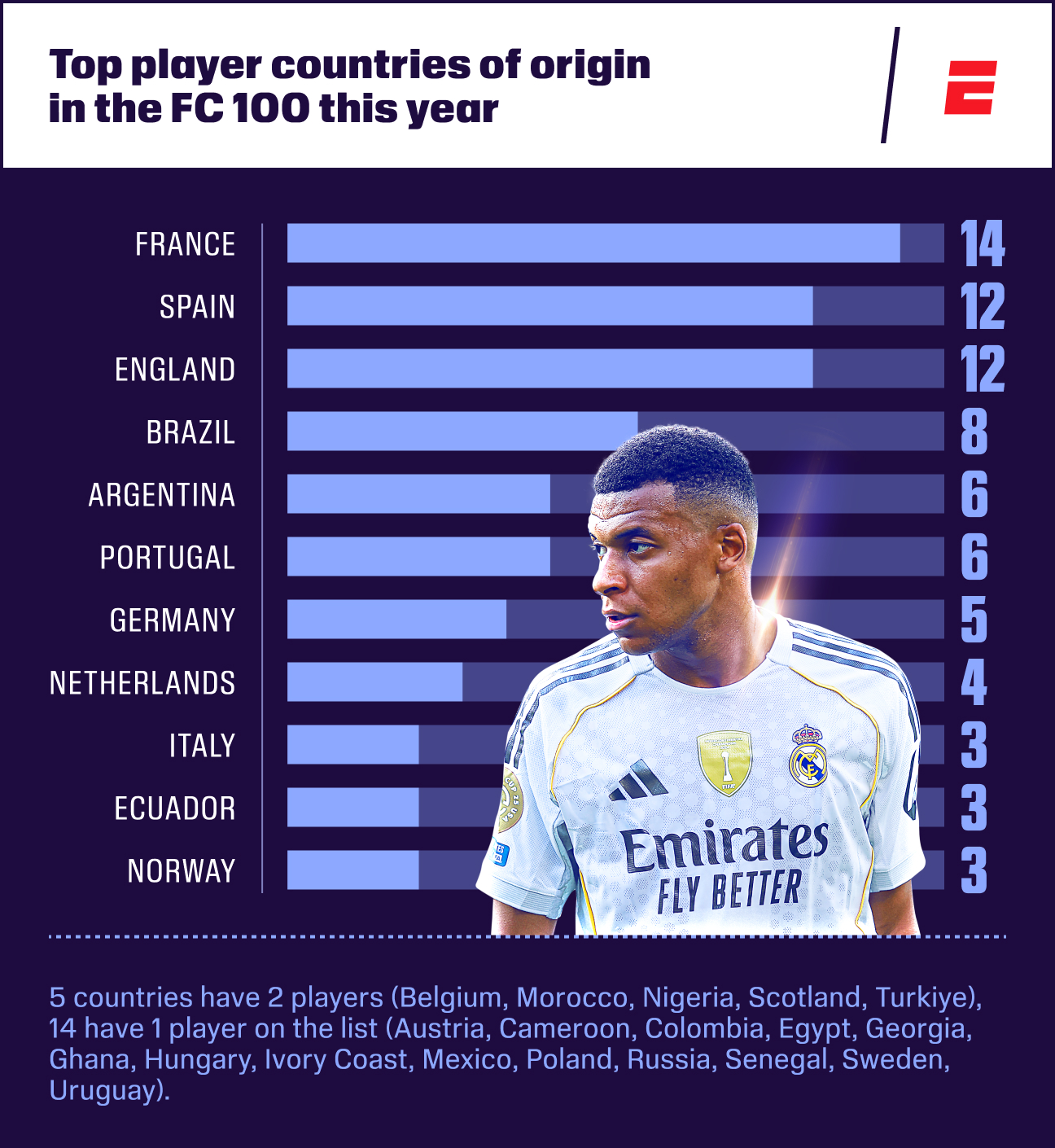
It captures the difference between the two nations’ squads: France are considered by many to have greater overall talent, but Spain’s cohesiveness, technical mastery and distinct possession-based identity make them even greater than the sum of their (world-class) parts.
And despite Brazil tumbling out of the 2026 World Cup earlier than they had hoped, losing 2-1 to Norway in the round of 16, they placed eight players in the FC 100. Sure, Argentina have a World Cup trophy in their cabinet, but you can bet they would trade that in a heartbeat to be ahead of their South American rivals in the rankings. (No, they would not, but we won’t take it too personally.)
Looking at the full decade, it’s a similar story at the top. Europe’s and South America’s giants dominate, with Germany supplanting Argentina in the top five.
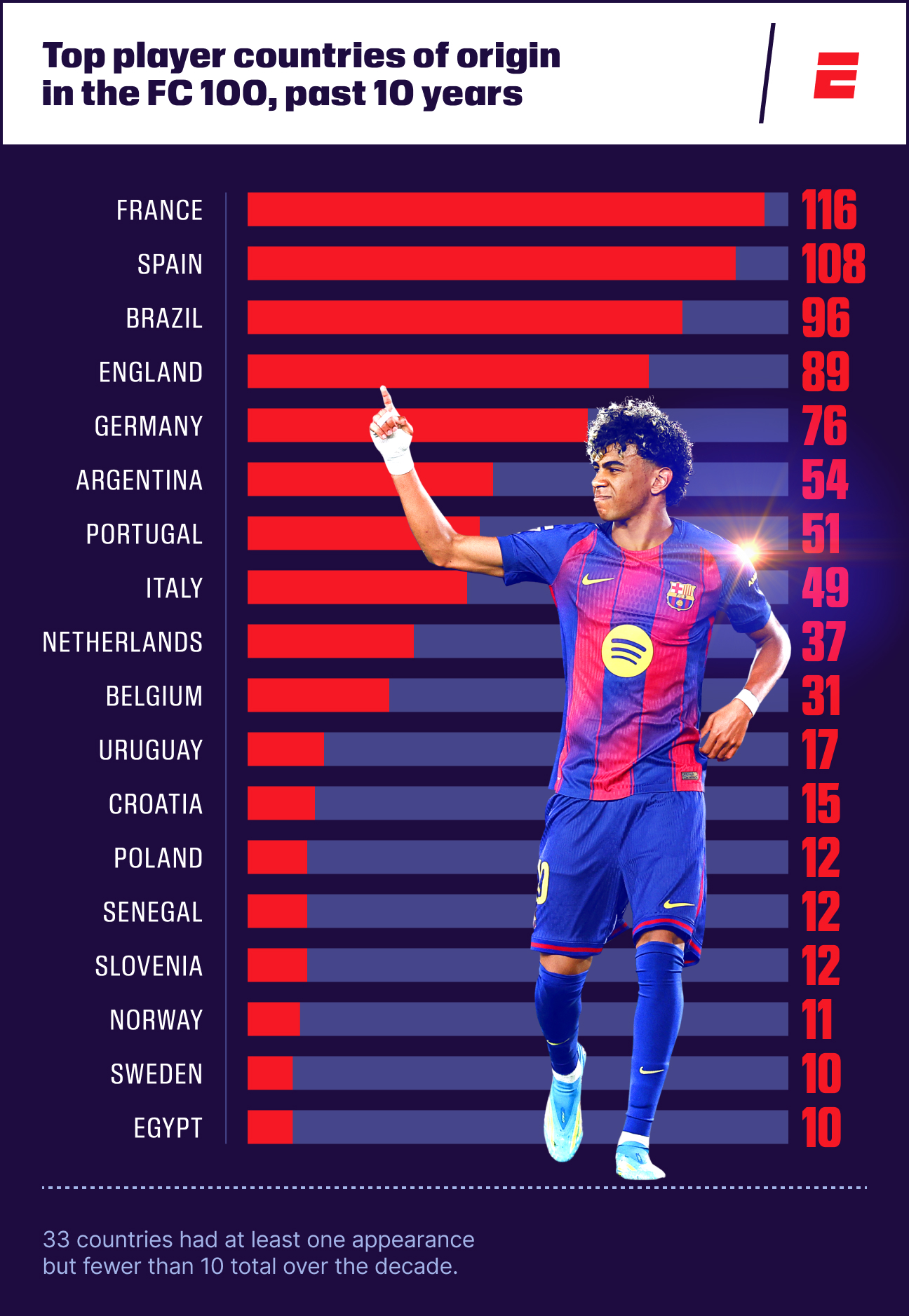
Senegal and Egypt deserve a shoutout for being the two non-European or South American nations whose players made at least 10 appearances. In Egypt’s case, much of the credit goes to a certain wide forward — we’ll get to him a bit later.
The all-time FC 100 XI
Now we’re getting to the good stuff. As mentioned before, Messi and Lewandowski are the two true titans of talent and longevity. But they are far from alone among players to earn ESPN FC plaudits for most of the past decade.
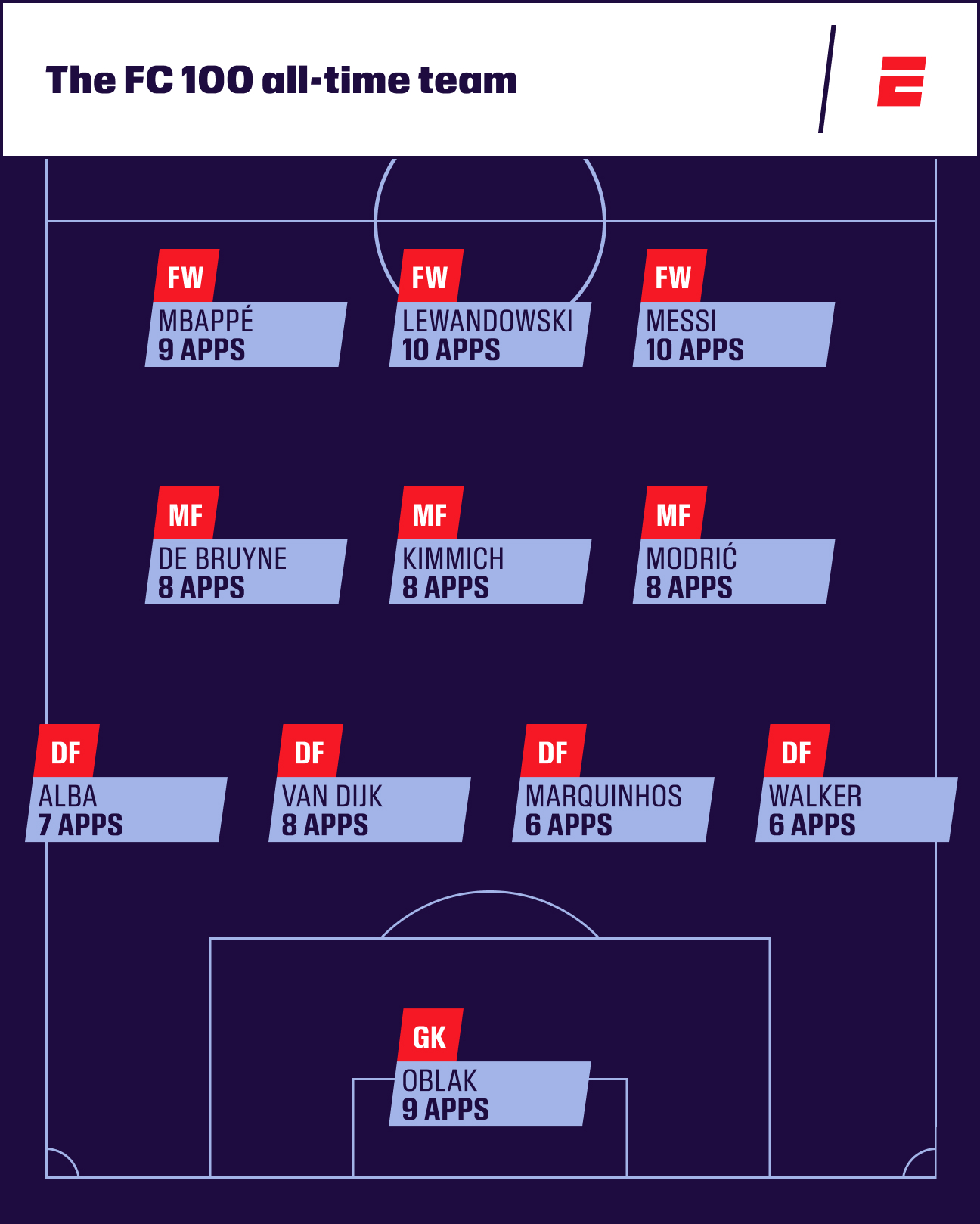
Mbappé (No. 2 center forward) and Jan Oblak narrowly missed out on joining that pair in the 10-appearances club — the latter failed to make just the 2026 list. But it’s an immense credit to both that they are looking up at merely the GOAT and the seventh-highest-scoring player in men’s soccer history. Mbappé keeps breaking new records left and right — at age 27, he already has the most career goals in World Cup history after scoring 10 this summer. And with Oblak’s consistency of both form and fitness for Atlético Madrid, who often trail Real and Barcelona in the LaLiga hierarchy, he has earned his place in the all-time XI.
Interestingly, defenders appear to have most variation out of all the position groups, as only Virgil van Dijk (No. 8 center back), holding down one of the center back spots, registered at least eight FC 100 appearances. Every other non-defender position is represented by a player with eight or more appearances. It goes to show that sustaining great performances on the back line (or reaping the rewards of being part of a great defense) can be a challenge at the sport’s highest level.
All-time appearances leaders
Here’s another way of looking at the best in the world over 10 full years: all of the players with at least seven FC 100 appearances to their names.
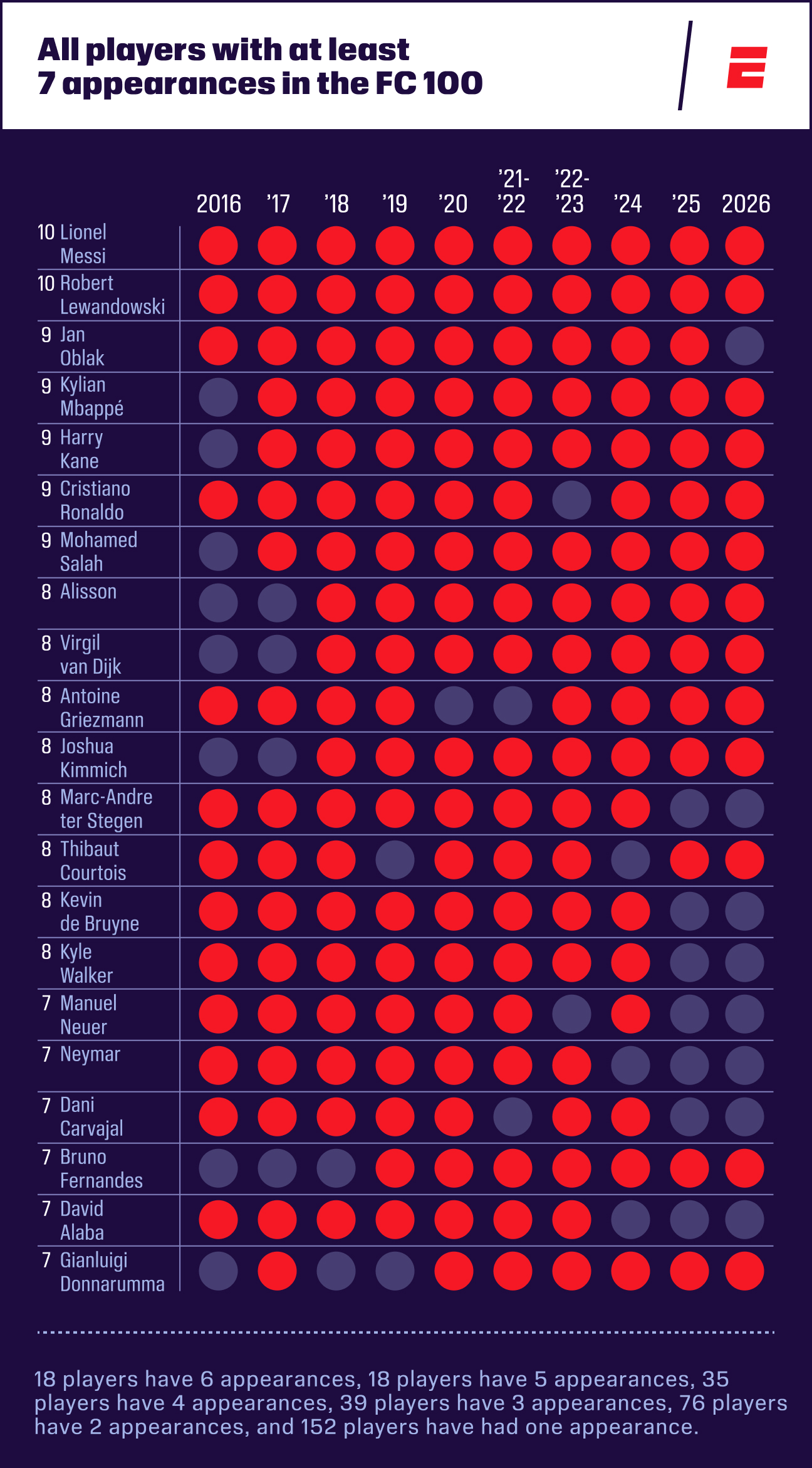
Blocked in the all-time XI at their position by Messi and Lewandowski, now is as good a time as ever to give flowers to Cristiano Ronaldo (No. 14 center forward), Harry Kane (No. 1 center forward) and Mohamed Salah (No. 17 wide forward).
Ronaldo needs no introduction at this point, of course. Save for missing the cut in 2022-23 after he tumbled out of favor with Man United, he continues to simply score goals, take names and hit “Siuuu” celebrations like no other. Kane had just begun his rise to superstardom in 2016, and even though he tallied 25 Premier League goals in the previous campaign, he hadn’t quite reached the level of household name that he did soon after.
How rivalries diverged
Some of the biggest grudge matches in the sport have also played out in the FC 100 voting, with supremacy being a fleeting concept in age-old battles to be the best. In the early years of the FC 100, the likes of Chelsea and Man United enjoyed a healthy competitive edge over Arsenal and Man City respectively, though that strength has indeed shifted in recent years.
Man City’s dominance in the Premier League — six top-flight titles in seven years — saw them come out comfortably above an underperforming United side, while Arsenal’s steady ascent has coincided with Chelsea’s chaos era. As the Blues continue to invest heavily in a squad of stars that often end up going out on loan, Arsenal have consolidated their power off the back of a first Premier League title in over 20 years, making the kind of summer signings that suggest they are serious about maintaining their place at the summit.
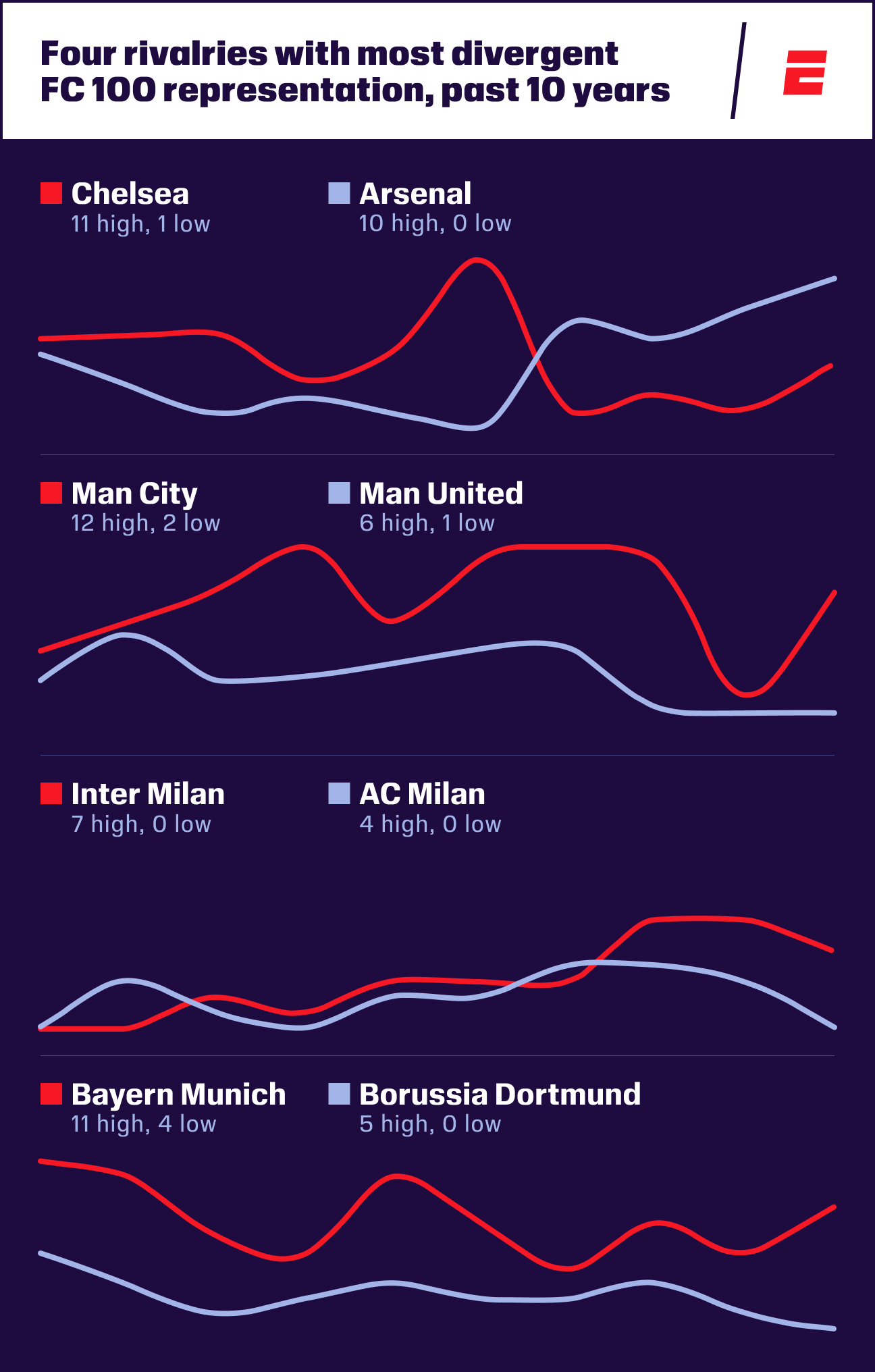
In Italy, the old guard of AC Milan has been replaced by a kind-of-older guard in Inter Milan, who rode on the coattails of a mature and motivated squad to win three Serie A titles since 2020, including 2025-26, and even rolled all the way to the 2024-25 UEFA Champions League final. Despite defeat to Paris Saint-Germain in that game, the Nerazzurri have increasingly had more members of the FC 100 in recognition of that power shift.
However, not all rivalries have seen transfers of power. Bayern Munich’s continued control of the German Bundesliga — winning nine of 10 titles since the FC 100 began — has kept them head and shoulders above their natural rivals, Borussia Dortmund.
Rise of African players
Last but most certainly not least, we’d be remiss not to mention one of the most notable trends of this entire project: African players are trending up the FC 100 leaderboards.
For most of the past decade, the number of African players in the FC 100 fluctuated between three and five, with one high point coming with six making the list in 2021-22. But we’ve now seen the continent break its record two years in a row, delivering seven top-100 players in 2025 before outdoing itself with nine in 2026.
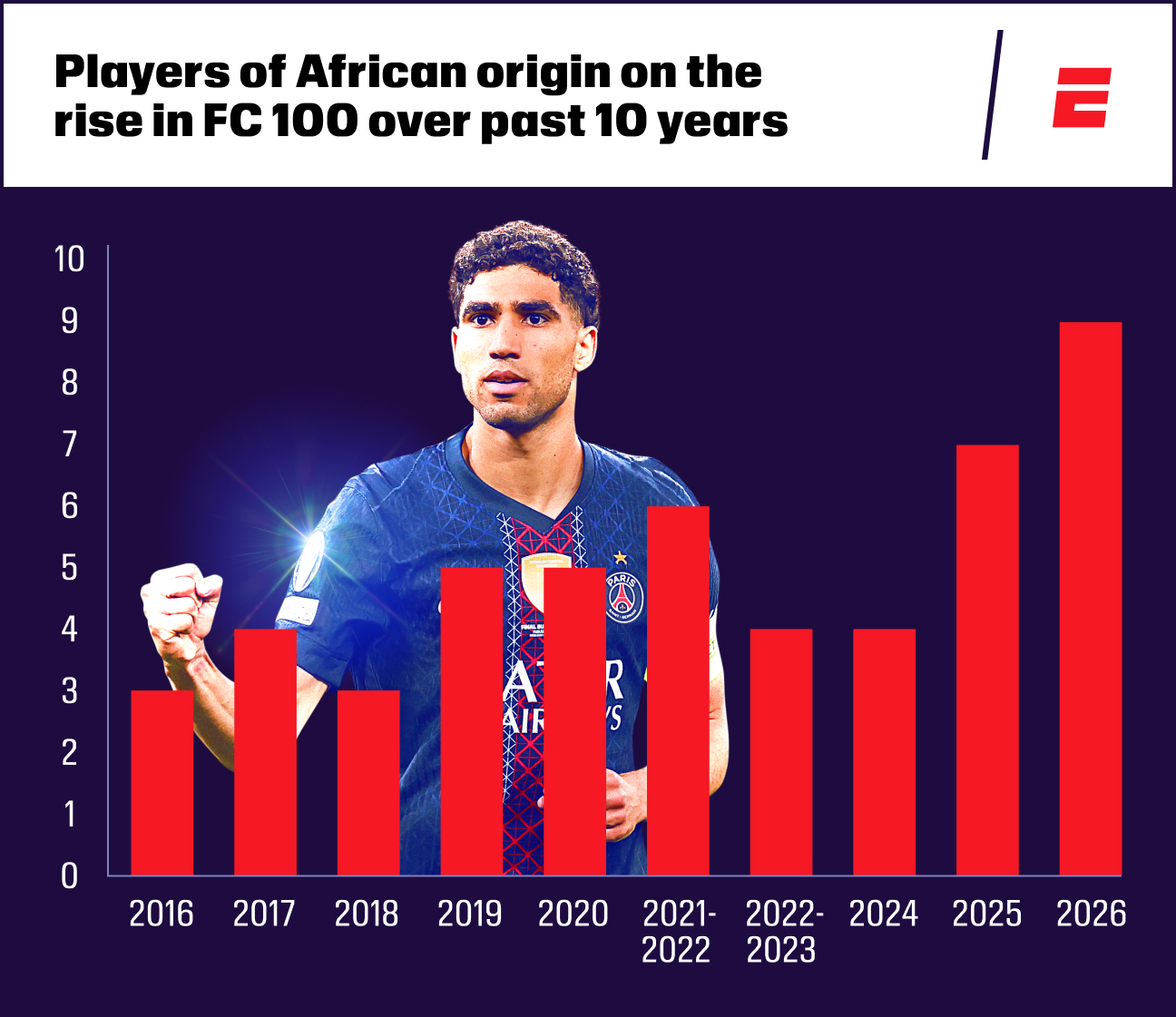
Six of those nine players are wide forwards — Salah (No. 17), Bryan Mbeumo (No. 16), Ademola Lookman (No. 13) and Antoine Semenyo (No. 11) among them. And with Hakimi (No. 1 full back) and 19-year-old Real Madrid arrival Yan Diomande (No. 19 wide forward) looking likely to be on the list for a very long time, the future of African soccer appears brighter than ever.

