
Saturday’s meeting with Japan was a kind of mid-term assessment for head coach Carlo Ancelotti after 18 months in charge of Brazil, but the 3-2 defeat has raised plenty of questions about the veteran Italian.
Ancelotti has another friendly of dubious importance against Singapore on Tuesday, then a long wait until the end of March for the next FIFA matchday — that is plenty of time for the media and the public in Brazil to dwell on the undeniable fact that his time in charge has been utterly underwhelming so far.
True, the Japan match was a friendly and he is experimenting with some players in some positions, but the basic problems have yet to be resolved: how to field two wingers and a coherent side with defensive solidity.
Ever the pragmatist, Ancelotti took the job having looked at Brazil’s resources and defining the team’s best characteristic as the pace and skill of the wide players. The best of Brazil under Ancelotti came exactly a year ago when they beat Senegal 2-0 in London, with a front four of Estêvão, Matheus Cunha, Vinícius Júnior and Rodrygo that did not overextend Casemiro and Bruno Guimarães in central midfield.
This front four became Ancelotti’s model. But it quickly became clear that it could not work in the heat — especially after the loss of both Rodrygo and Estevão to injury — when Brazil played a warm up game in Rio de Janeiro against Panama. With the team playing a 4-2-4 formation, the first half was a disaster.
Ancelotti was forced into a rethink, and from that point on an extra man was included in midfield. This gave the team more stability and they ran out 6-2 winners, but it did not make them world beaters. Ancelotti repeatedly said after the 2026 World Cup — when his side were shocked by Norway in the round of 16 — that the priority is to develop better midfielders. He is happy with the resources in most other positions, but in the center of the pitch the team can’t hope to compete with the likes of Spain.
In last month’s three-week international break, Brazil traveled to play two matches against Australia. In the first game, Ancelotti could not help turning the clock back and, with Estevao now fit, he had another look at the front four, fielding the Chelsea youngster alongside Endrick, Raphinha and Vinicius Junior.
It was a disaster; Brazil created next to nothing, and were slightly fortunate to salvage a 1-1 draw with the very last action of the game. And so it was back to a 4-3-3 formation for the second match against the Socceroos, and also for a 4-0 win over India.
Brazil’s best football came in the second half against Australia when Andrey Santos was introduced in the holding role on the hour and up Bruno Guimaraes and Danilo Santos to push forward, so this, with debutant André Luiz replacing the injured Danilo, was Ancelotti’s starting point for the game against Japan.
The problem, which was brutally exposed in the opening 20 minutes, was the Brazil’s high defensive line. Playing with a pair of wingers may open up the pitch, but that means the space is also there for the opposition.
In one of their characteristic dazzling 10-minute spells, Japan kept getting behind the Brazilian defensive line, either with well-worked triangles where the third man burst into space, or with a single pass. The deficiencies of Nottingham Forest center back Jair Cunha were exposed, and Brazil found themselves two goals down. And it could easily have been worse.
Brazil then became confused about where to press, but Japan are so often betterat chasing the game than defending a lead and Brazil came back into the match — though they owed their comeback much more to individual genius than from good collective play. For half an hour nothing went right for Vinicius Junior, then he played an inspired diagonal pass that put Estevao through on goal; Japan goalkeeper Zion Suzuki made the save, but was beaten when Vinicius turned and thumped home an unstoppable shot into the top corner.
In the second half, Vinicius did it again when he collected a short corner on the left, cut inside and fired home a shot so perfect that it went in off both posts. Brazil then nearly snatched the lead when Endrick, on for Raphinha, belted a surprise long-range shot off the bar.
All of these chances came from outside the area; all were the product of individual talent. But when Ancelotti arrived, the hope was that he would supply a collective context — compact and solid — which would give a platform for this type of talent, rather than relying on it to change the course of matches.
One of the aims of this match was to help Vinicius out of an early season slump, and that was objective completed, but another was to get the best out of Raphinha, and that was not. The Barcelona striker, in such scintillating club form, was made captain for the day, but Brazil’s midfield, as Ancelotti is well aware, is not Barcelona’s, and he was rarely brought into the action in places where he could make a difference.
As the game drifted towards the close, Brazil appeared the more likely winners, but Japan snatched a goal in stoppage time with their first real moment of danger since going 2-0 up, when Tatsuhiro Sakamoto latched on to a deflected shot to poke home.
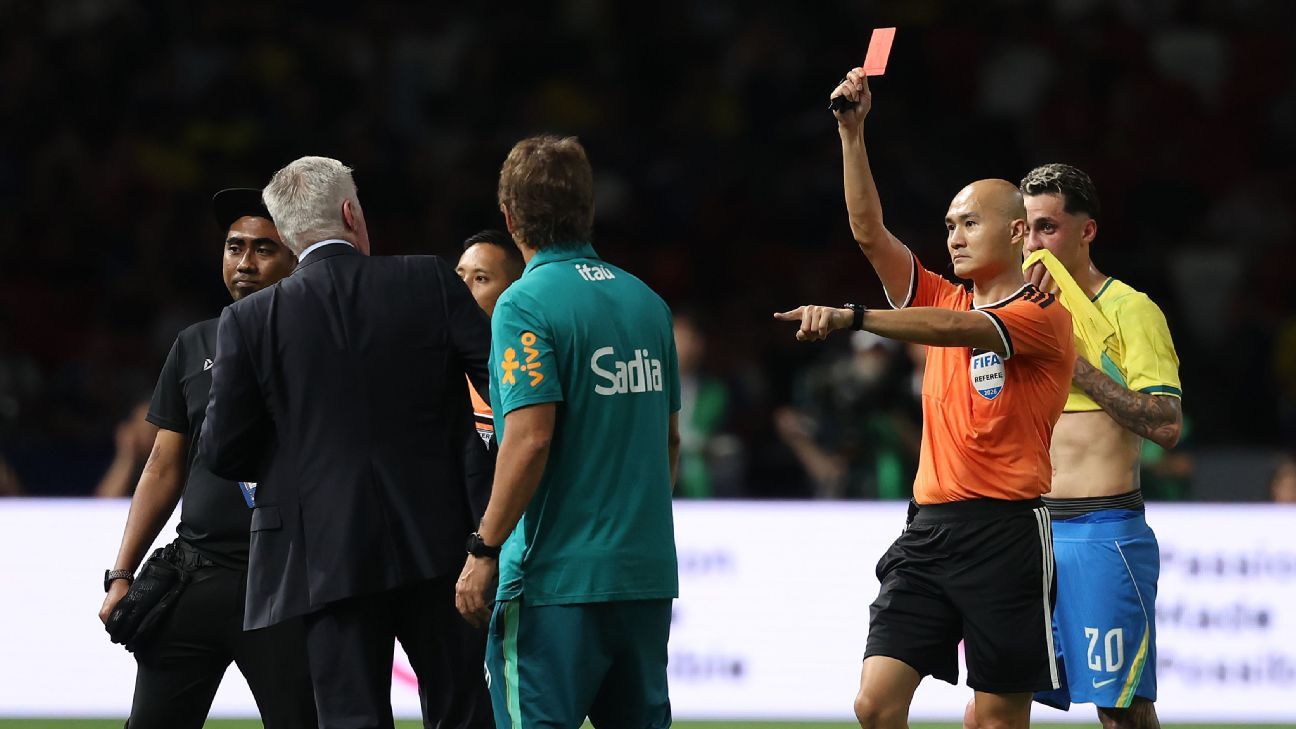
The move had started when João Gomes was caught in possession and Brazil screamed for a foul; many referees would have given on but the official from Singapore let play continue, retaining the criteria he had displayed throughout the match for both sides. Ancelotti, along with the already replaced Raphinha, complained so vociferously on the touchline that they were both sent off.
It was not a good look. Brazil’s big-name players can be obsessed with complaining at the referee, so they need a coach to calm them down. Not one who pours extra fuel on the fire.
Is Ancelotti’s red card proof that he is feeling the pressure? After another disappointing display, there is far more coming.


