
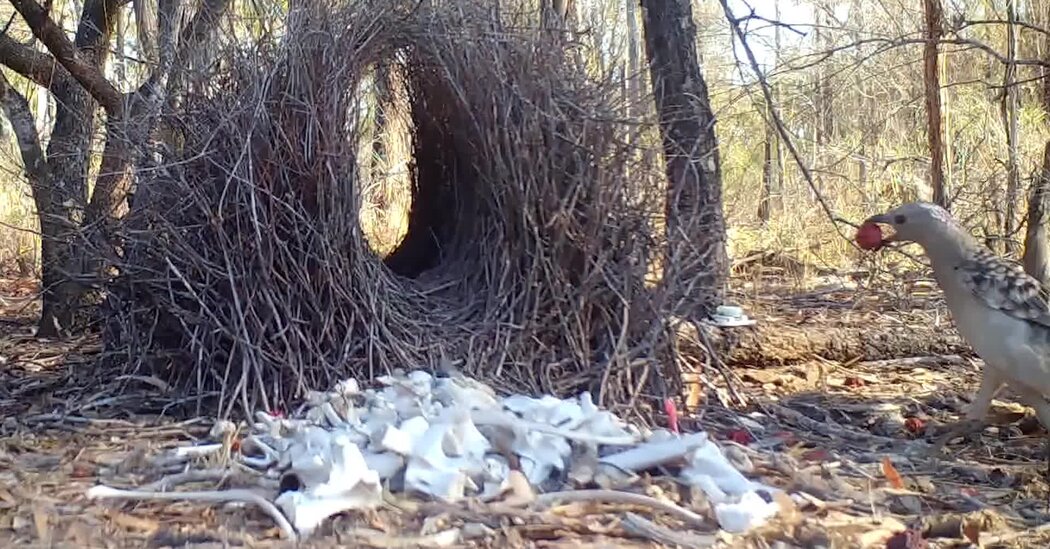
The great bowerbirds of northern Australia are well-known for their elaborate tunnels, known as bowers. Pieced together for months by the males, these bowers act as decadent thrones for females to sit in while they watch the males’ dramatic mating display of shakes, swerves and delicate offerings.
Male great bowerbirds spend most of the year building and meticulously decorating these posts with hundreds of brightly colored objects, all of which are intended to make them appear fierce and fashionable. In the forests where these birds evolved, bowers are usually decorated with flowers, leaves, bones, shells and grasses. But in the cities and towns these birds have come to inhabit, those humble materials seem to have fallen out of style.
A new study published in the journal Royal Society Open Science found that, compared with their country counterparts, great bowerbirds living in towns and cities style their bowers with larger, more colorful décor, most of it pilfered from humans. What’s more, the study found that the birds will choose artificial accouterments over natural ones when given the choice.
Caitlin Evans, a Ph.D. student from the University of Exeter, and her colleagues began photographing bowers in Queensland, Australia, in 2023. In total, they cataloged the décor from 61 bowers in great detail — some within the city limits of Townsville, Australia, and others on the outskirts of a rural cattle ranch. Among rural bowerbirds, green leaves, seeds and glass were the most common decorations. Green glass was popular among city birds, too, and red wire was all the rage. But such items were outshined by statement pieces, such as plastic packaging, homegrown hot peppers and cash.
The more they looked, the more weird objects they found, including mouth guards from a nearby football field and a pair of handcuffs. “One family told us that they have to keep the garage door shut, otherwise bowerbirds fly into the garage and steal their really nice nails and screws,” Ms. Evans added.
After analyzing their catalog of curios, the researchers found that the city slickers adorned their bowers with nearly five times as many ornaments as those living in the sticks. These extra items were also larger and bolder in color.
Ms. Evans and her colleagues don’t know yet whether female bowerbirds swoon more deeply over red hair scrunchies than over green grass, but they have found evidence that the males have a clear preference. During the study, the researchers presented a choice of natural and human-made items to male bowerbirds in urban and rural environments. In both the city and the country, the birds strongly favored the human-made items.
Why do male great bowerbirds seem to favor items from garbage bins and garages over those from farms and forests? Daniel Baldassarre, who studies the behavioral ecology of urban birds at SUNY Oswego and was not involved in the study, said that among bird species for which bright colors serve as signals, new, unnatural colors can be particularly attention-grabbing. “They get excited by things that pop,” he said.
Ms. Evans also suspects that the long shelf life of the plastic and metal objects plays a role in their popularity, because the males don’t have to find a replacement for them, as they would for a berry that loses its luster.
Although it’s possible that human trash is giving Australia’s male great bowerbirds some degree of energetic reprieve or luck with the ladies, Ms. Evans notes that these benefits may come with some unforeseen costs. Birds can, and often do, become entangled in plastic. “These risks are always present,” Ms. Evans said. “So it’s definitely something to be aware of.”

