
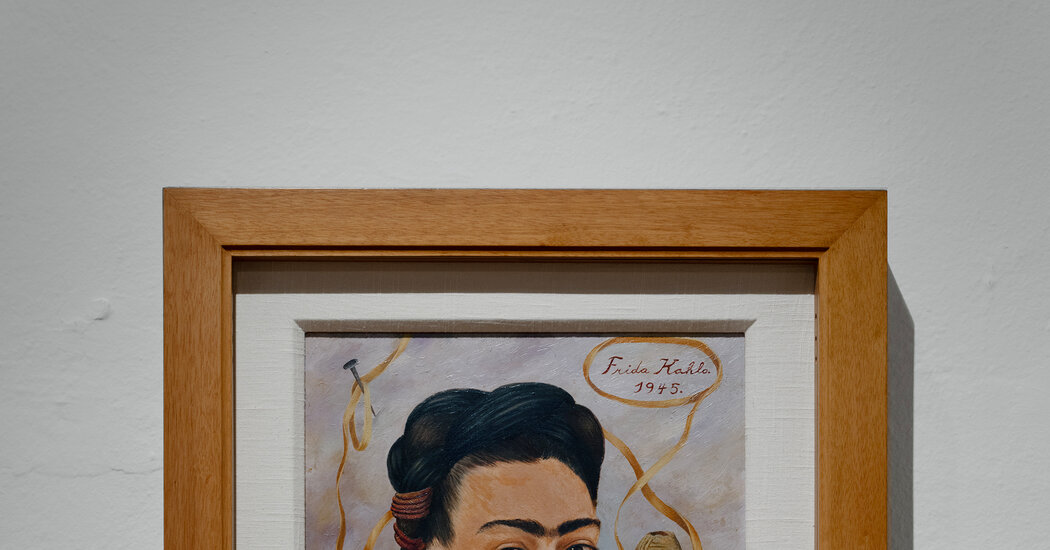
For six years, the heavy wooden doors of the Dolores Olmedo Museum in Mexico City remained closed to the public, its storied art collection hidden from view.
The museum, housed in a 16th-century hacienda, is home to 26 artworks by Frida Kahlo — said by experts to be the largest collection in the world — and nearly 140 pieces by Diego Rivera, including paintings, drawings and a fresco.
Set in lush gardens patrolled by peacocks and Mexican hairless dogs, the museum closed in 2020 during the coronavirus outbreak. It remained shuttered, with little explanation, long after the pandemic abated. Then on May 30, it reopened — in time, the management said, for the World Cup, which Mexico will co-host starting June 11.
The hacienda was once the home of the museum’s founder, a powerful, self-made businesswoman who modeled for Diego Rivera as a teenager and became his lifelong friend and patron. Olmedo established the museum in 1994 as a monument to Rivera, who died in 1957. She put the hacienda, the art and even her animals in a trust for Mexicans to enjoy.
As visitors wandered the galleries and gardens on opening day, Guadalupe Phillips Margáin and her sister, Dolores Phillips Margáin, Olmedo’s granddaughters and members of the committee that manages the trust, said that they had used the hiatus to rethink and renovate the museum.
The Phillips sisters said they wanted to emphasize their grandmother’s story and her relationship with Rivera. They said they also aimed to better showcase her collection, which includes three dozen artworks by Angelina Beloff (1879-1969), the Russian artist who was Diego Rivera’s first wife, and hundreds of pre-Hispanic artifacts and pieces of Mexican folk art.
“We tried to put her front and center,” Guadalupe Phillips said of her grandmother, speaking over the honk of peacocks on a shady patio. “We wouldn’t have any of this without her.”
Workers restored artworks and added museum-quality glass to frames, repaired walls, stripped out old carpets and unbricked huge windows. The museum made more space for Rivera’s artworks and hung them chronologically (Olmedo had arranged his work as she fancied, the sisters said). They also set aside a room for letters and documents that attest to the affection Olmedo and Rivera shared, which Olmedo described as intense but platonic.
In one, written a year before his death, Rivera suggests Olmedo buy about a dozen of his artworks from other collectors. He signs off “with all my love” and a sketch of a frog — a running joke about his froglike appearance.
The Museums Special Section
The museum also made more space for Kahlo’s art, which had previously been relegated to a long, low room that was once Olmedo’s walk-in closet. Olmedo bought the pieces in her collection at Rivera’s request after Kahlo died in 1954. She reportedly paid the equivalent of about $1600; in today’s market, the selection, which includes works such as “Self-Portrait With Monkey” (1945) in which Kahlo, her pet monkey and her dog fix their eyes on the viewer, along with “A Few Small Nips” (1935) and “Henry Ford Hospital” (1932), both painted in oil on metal, would be worth millions of dollars.
Luis Rius, a former director of the Diego Rivera and Frida Kahlo House Studio in Mexico City, said the collection is a kind of posthumous reconciliation between Olmedo and Kahlo. In life, he said, “their quarrels were really harsh,” adding that, with Rivera, “They made a very difficult triangle.”
Dolores Phillips dismissed the notion of any enmity, noting the women’s similarities: Cultured, nonconformist and born a year apart, they both married men who were significantly older. In an interview in 1993, however, Olmedo was direct. “I was never a friend of Frida Kahlo,” she said.
The new museum’s six-year closure riled intellectuals and residents of Xochimilco, the borough on the outskirts of Mexico City where the museum is based. So did a plan, announced by the museum in 2022, to move part of the collection to an amusement park in the center of Mexico City. The plan’s critics said it would violate the terms of the trust, which stipulates that the collection remain intact and at the hacienda. The moving plan was shelved earlier this year, said Guadalupe Phillips.
On opening day, a jubilant group of residents in traditional dress danced in the street as visitors filed into the museum.
“We are very happy,” said Juan González Romero, part of a group of Xochimilco residents, who had campaigned against the museum’s closure and the amusement park plan.
González, who toured the museum, said it had been well-restored. Still, he said, the improvements did not justify the six-year closure.
He added, “They deprived us of the museum for a long time.”
A tour of the hacienda begins in the generous annex where Olmedo lived after she turned the rest of the property into a museum. The rooms speak to a life of glamour, influence and collecting: walls covered with photos and portraits of Olmedo, including several nudes; a living room filled with carved ivory tusks, Chinese figurines and reclining Buddhas and hung with fanciful chandeliers composed of blue glass.
“If she hadn’t been a collector, she would have been a hoarder,” Guadalupe Phillips said.
The galleries remain a shrine to Rivera, with 98 pieces that span his career, from an early drawing that he made of his mother, Maria Barrientos, in 1896, when he was 10 years old, to a series of sunsets painted at Olmedo’s seaside house in Acapulco, shortly before his death in 1957. There are landscapes reminiscent of Cézanne and squat Russian children with sparkling blue eyes, whom Rivera painted after receiving cancer treatment in the Soviet Union in 1955, according to Rius.
Jorge Rios, a visitor who works in the fashion industry, said he was struck by some Cubist paintings by Rivera, who is mostly known for political murals and for paintings celebrating Indigenous people and members of the working class. Pieces like the 1915 oil painting, “El Rastro” and “Young Man With a Fountain Pen” (1917) showed that Rivera was an accomplished painter whose repertoire was wider than “Indigenous figures and calla lilies,” Rios said.
Guadalupe Phillips said that the museum wanted to promote Diego Rivera and lend his work to foreign shows more often. The museum frequently lends its Kahlos; their hopes for Rivera are more modest, Phillips said, adding, “It’s impossible to compete with Frida.”
Indeed, at the museum, which Olmedo dubbed “the maestro’s house,” Kahlo has gone from being a slightly-resented guest to a star attraction.
The museum has hung all 26 Kahlos in two rooms. One, said Dolores Phillips, shows intimate portraits of those close to her and the other, the psychological pain she suffered because of her injuries, ailments and romantic betrayals. At the far end of the second room is “The Broken Column,” a 1944 self-portrait in which a shattered pillar replaces her spine.
Dolores Phillips said the piece, hung alone on a black wall, was her pièce de resistance.
“This was her Mona Lisa,” she said.
Despite these artistic treasures, enticing visitors to Xochimilco is a challenge, said Phillips. Visitors already throng Kahlo’s foreign exhibitions and flock to three other pilgrimage sites in Mexico City, including the joint studio with Rivera, the blue Frida Kahlo Museum and the red Kahlo Museum Home, which opened last fall, and where Kahlo’s parents lived starting in 1930.
But fewer make the trek across the city’s hectic sprawl to see her art at the Olmedo Museum, Phillips said. The museum hoped to tie in with other local attractions, such as Xochimilco’s well-known pre-Hispanic canals, she said. Their goal is to boost the number of annual visitors from around 120,000 per year prepandemic to 300,000.
The Phillips sisters said options are needed to keep the museum financially viable. The original fund set up by their grandmother had diminished, they said, though they declined to share details. As part of their quest to sell more tickets, the sisters said that the committee was still mulling some kind of “extension” of the museum closer to the center of Mexico City.
Luis Cacho, former head of legal affairs for the Ministry of Culture, said anything but a temporary exhibition would break the terms of the trust. Speaking by telephone, he said there was no strict definition of temporary, but that an exhibition that lasted decades “obviously wasn’t the intention of Dolores Olmedo.”
Other plans for the museum included commissioning works by contemporary artists, Guadalupe Phillips said. In a nod to the World Cup, they had added a temporary exhibit by the Mexican photographer Santiago Arau focused on the Aztec-era game pelota and a series of tableaus in papier-mâché of soccer and fans. An exhibition of Mexican female artists, including works by Beloff, is planned for early 2027.
“We need to generate revenue,” said Guadalupe Phillips. “To generate interest, to keep it alive.”

