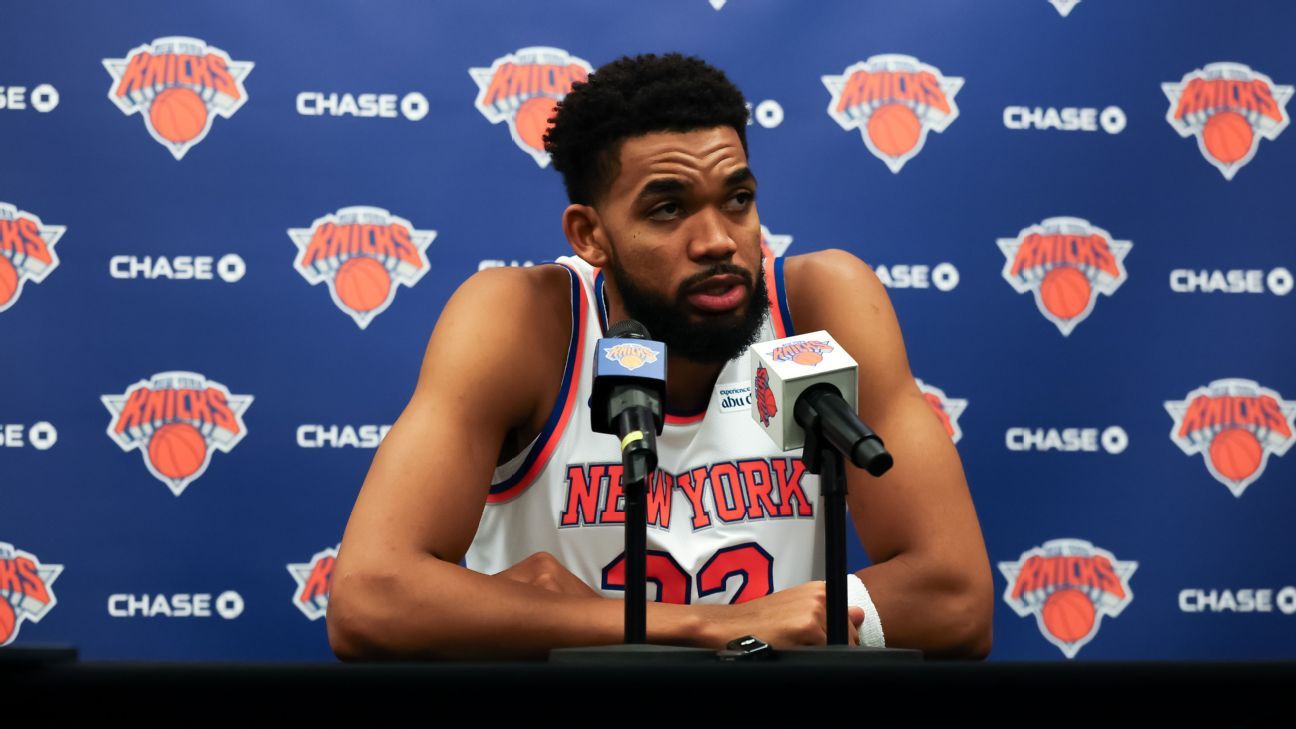
Karl-Anthony Towns has repeatedly stated his goal is a new deal to remain with the New York Knicks.
And since the NBA Finals concluded in June, Towns has been eligible for one: a four-year, $276 million contract extension that would keep him with the defending champs through the 2030-31 season. However, as sources told ESPN’s Shams Charania, the Knicks’ latest offer to Towns was a four-year deal worth approximately $200 million.
The reason: A max contract for the 30-year-old All-Star center would introduce major second apron concerns, a space Knicks owner James Dolan has shown no interest in occupying. Towns, for his part, says he is willing to meet somewhere in the middle.
“I want to do something that can keep the team together and work with the Knicks and also values me,” Towns said Monday. “None of those things have come close to happening.”
Will the Knicks enter opening night without getting a deal done? How hard should Towns push in negotiations? What options would be available next summer?
ESPN NBA insiders Ben Golliver, Zach Kram and Bobby Marks examine both sides of the Towns-Knicks contract talks — plus the deal our resident general manager would choose.
Breaking down Towns’ case for more money
Towns has every reason to push hard in these negotiations. Recent history suggests that teams basking in the championship afterglow almost always do what it takes to financially reward their core players.
Although Jalen Brunson and OG Anunoby outperformed Towns in the NBA Finals, the Knicks should view the 7-footer as an indispensable part of their title formula. Without Towns to space the floor, New York’s Brunson-led offense wouldn’t be as effective. Without Towns stepping up defensively against Victor Wembanyama — the San Antonio Spurs star was held well below his regular-season field goal and 3-point shooting percentages in the series — New York likely wouldn’t have waltzed to a five-game Finals victory. And without Towns, the Knicks would be stuck with Andre Drummond as their best remaining center.
That feels like a decent amount of leverage.
Towns inked a four-year, $220.4 million extension with the Minnesota Timberwolves in 2022 that covered his late 20s. While that deal looked questionable at the time, the Timberwolves were able to recoup solid value when they traded him to the Knicks in 2024, and he delivered a 2025 All-NBA selection before serving as a vital part of the 2026 title team. Towns’ availability in New York has also been excellent: He has appeared in 90% of the Knicks’ regular-season games and all their playoff games the past two seasons.
Philadelphia 76ers center Joel Embiid signed a three-year, $193 million extension in 2024 — an overly generous agreement that has aged poorly due to his repeated injuries. Towns doesn’t deserve to be in that ballpark because he’s not being paid to be New York’s franchise player. But Towns can argue that he is a more accomplished player than Miami Heat center Bam Adebayo (three-year, $166 million extension in 2024) and Cleveland Cavaliers big man Evan Mobley (five-year, $269 million extension in 2024). And at 30, Towns shouldn’t suffer major age-related decline until the latter stages of his next contract.
A four-year, $220 million extension would give Towns a higher AAV than Adebayo and Mobley and a significantly lower AAV than Nikola Jokic, Anthony Davis, Giannis Antetokounmpo and Embiid. Meeting at $220 million would also provide the Knicks with real savings under his four-year, $276 million maximum extension number. — Golliver
Breaking down New York’s case for a discount
Towns has the right to negotiate for every penny, and he should, after helping the Knicks win their first championship in 53 years. But New York’s reported four-year offer in the range of $200 million is in the right ballpark for a player of his age and skill set, even if it would represent a pay cut for Towns, whose previous four-year deal was for $220.4 million.
The former No. 1 pick is an excellent player, but he’s not in the top tier of NBA superstars.
Towns has three third-team All-NBA nods on his résumé, but no first- or second-team appearances, suggesting he never has been a top-10 player in the league. And that’s unlikely to change now that he is presumably at or past his individual peak. (Towns turns 31 next month.)
Moreover, Towns’ leap in the 2025-26 postseason came more as a role player than a max-level star. He ranked third on the Knicks in playoff points per game, behind Brunson and Anunoby, and his playoff usage rate was a near-average 20.6%. It’s difficult to pay a role player — even an elite role player with star upside — upward of $50 million per season in the current salary cap environment.
Coincidentally, the DARKO projection system estimates Towns was worth $52.8 million last season. Factoring in the rising cap on one hand and the typical aging curve on the other, four more years at a $50 million average seems about right. — Kram
Options if Towns enters 2026-27 without an extension
Towns not signing an extension by Oct. 19 would not mean the window has closed. Because he is technically in the final year of his contract, Towns is eligible to sign a four-year extension through June 30. A lack of an extension before the regular season, however, would leave Towns with five options next summer:
Pick up the $61 million player option for 2027-28, then sign a new long-term deal with New York starting in 2028-29.
Decline the option, then sign a new contract with New York at a salary lower than the $61 million option but with future guaranteed money.
Become a free agent. Teams with projected cap space include the Atlanta Hawks, Brooklyn Nets, Chicago Bulls, Golden State Warriors, LA Clippers, Memphis Grizzlies, Milwaukee Bucks and Sacramento Kings. No free agent has switched teams and signed for more than $49 million in the first season since Paul George‘s four-year, $212 million max contract with the Philadelphia 76ers in 2024.
Work on a sign-and-trade. Because the Knicks would be the sending team, they would be allowed to exceed the first apron (but not the second) in such a deal.
Pick up his player option and request a trade. — Marks
Towns’ best path: Opt in, then sign a new contract in 2027
In the scenarios listed above, declining the player option in favor of a new deal would result in Towns essentially signing for $140 million to $160 million in new money. However, picking up the option and then signing a four-year, $180 million extension that starts in 2028-29 would secure more guaranteed money.
And a $40 million cap hit in 2028-29 would accomplish Dolan’s goal to remain below the second apron — even after a max-level contract for Brunson and a new deal for Josh Hart. (Even with Towns’ $61 million, New York could still avoid the second apron next season if it declines the team option of Pacome Dadiet and likely renounces 2027 free agent Miles McBride.) — Marks