
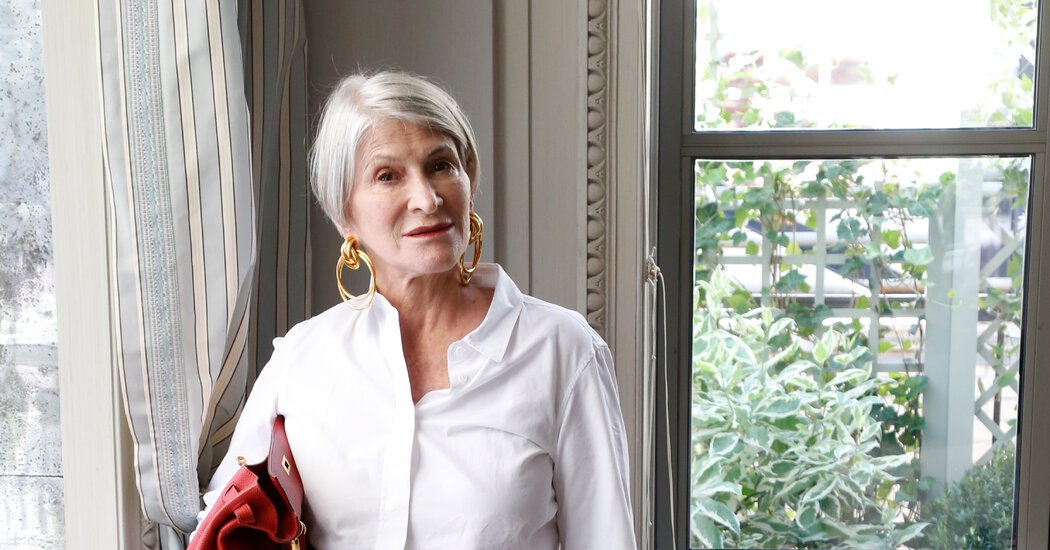
She became one of their staunchest supporters. Later, they designed her daughter’s wedding dress.
“Bobbi was an original thinker,” Yeohlee Teng, one of the many designers Ms. Queen championed, said in an interview. “She always spoke her mind. She was of that first generation of women that spoke up.”
Bridget Foley, Women’s Wear’s former executive editor, described Ms. Queen as “a unique mash-up of regal carriage, stalwart opinion, sharp wit and antithetical self-deprecation.”
Ms. Foley added: “We used to have this routine, when dissecting the relative merits of a dress. ‘Love it,’ one of us would start. And then, ‘Well, I’d love it if the sleeve were narrower.’ ‘Yes, and the neckline, straighter.’ ‘And the print, more subtle.’ ‘Yes, with a lean sleeve, straight neckline and quiet pattern, it would be fabulous.’ Bobbi would then cut off the conversation with, ‘If my grandmother had wheels, she’d be a streetcar.’”
Barbara Sela Queen was born on Feb. 22, 1942, in the Hollis neighborhood of Queens, and grew up in Lakewood, N.J. Her mother, Beatrice (Mallow) Queen, was a schoolteacher; her father, Alvin Queen, was an insurance broker.
She attended Boston University for a year and then transferred to the Tobé-Coburn School for Fashion Careers in Manhattan. After graduating, she worked as a buyer for Gimbels, the department store.
By the early 1970s, she was at Women’s Wear, working through all the fashion categories like the stations of the cross: She served, variously, as the evening-wear editor, the inner-wear (that would be underwear) editor, the ready-to-wear editor and the fur editor. These were hard-core beats, and Women’s Wear editors covered them as assiduously, and with the same granular expertise, as political reporters covering Congress.

