
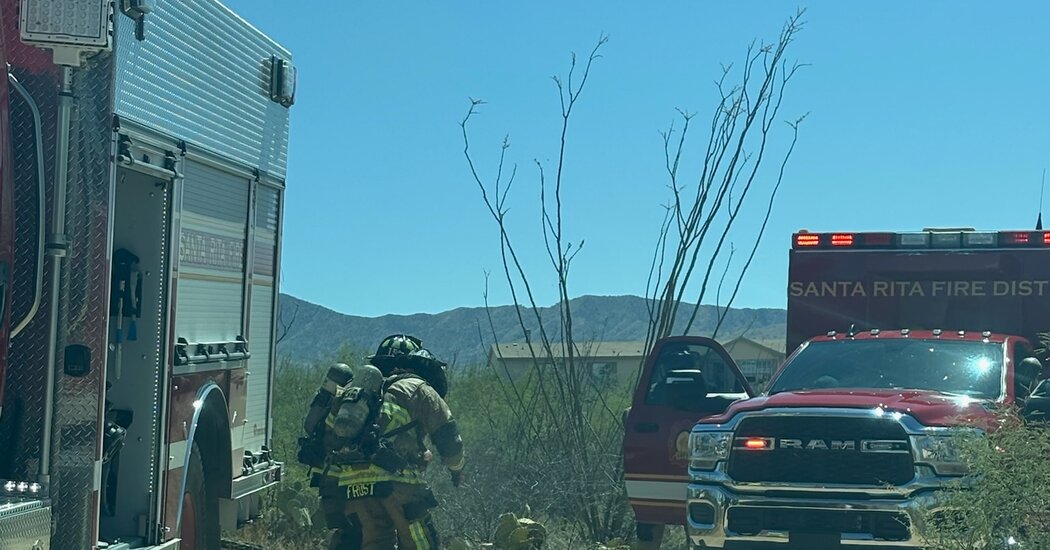
On a hot day in a remote area of southern Arizona last month, firefighters donned protective helmets and suits, sealed the openings around their wrists and ankles with duct tape, and cautiously approached a man lying face down on the ground.
A layer of stinging bees blanketed his body.
Spent stingers riddled the few patches of skin or clothing visible between the wriggling insects. As the bees clung to him, rescuers administered first aid and put the man, who had life-threatening injuries, on a helicopter to be flown to a hospital, the Santa Rita Fire District said.
“They were very aggressive bees,” Kyle Blecker, one of the medics, said in an interview. “They were still trying to attack us a football field away.”
The bee attack in the Sahuarita area, about 20 miles south of Tucson, was the latest in a series of similar episodes in May that were typical of the behavior of Africanized honey bees, which are highly aggressive and quick to defend themselves.
The episodes have generated news coverage in Arizona and calls for expert advice on how to respond during a mass stinging.
Or better yet, how to avoid one.
The swarm comes sooner.
Africanized honey bees, as they have come to be known, are a hybrid of African and European bee subspecies that entered the United States in the early 1990s. They have since become the most dominant feral bees in the southern United States, mostly in parts of Arizona, Texas, New Mexico and California. They are also found in Central and South America.
As winters grow warmer, bees are embarking earlier in the year in swarms, in which a queen and her protective workers leave their hive to scout for a place to establish a new one.
Swarmed, an online beekeepers’ network that tracks those patterns, said swarming has started an average of 17 days earlier this year in 56 regions of the United States.
Bees are generally not aggressive during a swarm, because they have no hive to protect, but the earlier onset of swarm season, and the bees’ increased roaming activity, means there is a greater chance of human encounters as they cling to urban infrastructure, such as water meters to balconies and garden fixtures.
“Our winters are much shorter right now and much warmer too,” said Shaku Nair, an entomologist in the University of Arizona’s extension office. “People need to be more aware of their surroundings and bee activity.”
A swarm can become aggressive if poked, sprayed or harassed, so Dr. Nair suggests leaving it alone. “People don’t understand it will move on in a couple of days,” she said.
When a swarm finds a suitable place to build a hive, it lasts for years and houses tens of thousands of bees. Innocent stimuli, such as a hiker, a lawn mower, a strange scent or a playful dog can stir the Africanized honey bees to sting, and to release a pheromone that signals peril and draws more bees to the fight.
It is a selfless battle. After discharging venom, their stingers break off and the bees die.
“They will give their lives, literally, to protect their hive,” Dr. Nair said.
If attacked, run. Find shelter.
On May 26, the man in southern Arizona was clearing garbage when a person in a tractor disturbed a hive, rousing a frenzy of stinging bees. The tractor operator, enclosed in the cab, was unharmed, News 4 Tucson reported.
The authorities did not release updates about the man’s condition, but there were no fatalities related to bee stings this year in Pima County, which includes Tucson, the county medical examiner’s office said in an emailed statement on Tuesday.
Monica King, president of the Southern Arizona Beekeepers Association, said the case demonstrated a crucial first response. “When they are set off, that’s when it gets really crazy,” she said of the bees. “People need to get into a shelter or home and get away from them.”
Ms. King, a third-generation beekeeper in the Tucson area, is often hired to remove hives. She recalled receiving a call from a woman who was “running around her car” trying to dislodge bees as they were stinging her. Ms. King told her to get in the vehicle — with the bees — to prevent more of them from joining.
Bees usually go for the eyes, ears, nose and mouth, she said. As a precaution, a landscaper or hiker should pack a mosquito net if they will be far from shelter.
“Throw the head net on first,” she said. “Then try to safely get away. It does not work if you stand still. Try to cover up and get distance between you and the bees.”
Liquid Benadryl or an EpiPen should be on hand to counteract allergies, she said.
While walking on trails near hives and swarms, people need “to turn and not go right past them,” Ms. King said.
If you’ve already upset them, run far and fast. Africanized honey bees have been known to defend up to 200 yards of territory, she said, a distance twice the length of a football field.
“Don’t ever trust a bee colony,” she said.
The water won’t save you.
When it comes to stinging bees, water is not shelter.
“One of the biggest misconceptions is, ‘If I am getting attacked by bees I am going to jump in my pool,’” said Aaron Lorti, an exterminator in Arizona for 19 years. “They are going to wait by the water and once you come up for air, they are stinging you.”
Swatting makes them more frenzied.
On May 25, in Lake Havasu, Ariz., Toni Chaffee, 63, a retired school district worker, let her 4-year-old Labrador retrievers, Daisy and Sky, out in the yard. When she checked on them, they were motionless and vomiting, covered with bees.
A mass of bees converged when she went outside. “All over me, from my head to my toes and all over my hair,” she said. “Like a gang of bees circling the area. My mom is spraying a can of poison, but we are getting bit, ears, eyes and legs.”
The women, who were vomiting themselves, dragged the dogs to the pool, thinking the water would repel the bees, “which we later found out was not smart,” she said.
There were bees “just laying on top of the pool,” she said. “We were told they just rest and they could have come back at us.”
Firefighters in full gear ushered everyone into the house and administered Benadryl. But the dogs could not be saved, she said.
A bee removal specialist, Alex Garcia, discovered a large hive in the yard, nestled under a fountain.
Weeks later, Ms. Chaffee still had sores on her face.
So you’ve been stung. Now what?
Covering your face is one of the most important steps if a mass of bees starts stinging you. A severe allergic reaction can rapidly cause death, said Dr. Jerry Snow, a medical toxicologist and emergency room doctor at Banner-University Medical Center Phoenix.
“If you are stung in your airway, or nose and mouth and the airway starts to swell, that will kill you,” he said.
In the United States, an average of 72 deaths per year are attributed to stings from hornets, wasps and bees, according to the Centers for Disease Control and Prevention, citing figures from 2011 through 2021.
Sting injuries include allergic reactions, muscle breakdowns, cardiovascular collapse and kidney and liver problems, Dr. Snow said. Stingers stuck in your body should be scraped off instead of plucked, which could squeeze in more venom, for which there is no antidote, Dr. Snow said.
Epinephrine or Benadryl is used as first aid but people should seek medical care. Thousands of stings can bring shock and send a person to intensive care. Some people may need temporary dialysis treatment.
“But most people,” Dr. Snow said, “have a meaningful recovery and are able to return to normal life.”

