
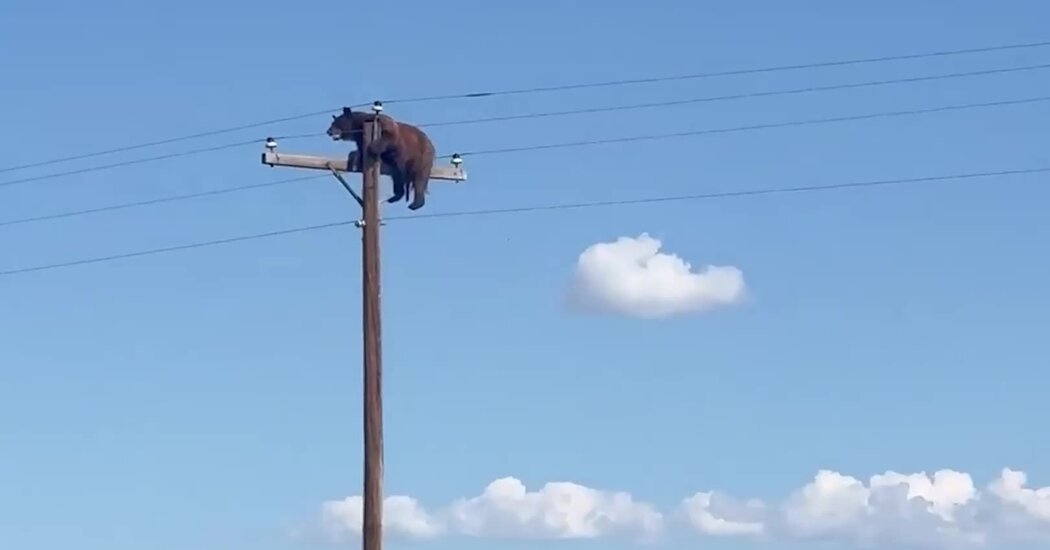
Shannon Mullens was with driving with her family on a desolate highway in rural New Mexico on Monday morning when they spotted a black bear on top of a utility pole. It was about 22 feet off the ground, panting heavily near wires that carry 7,200 volts.
Ms. Mullens recorded a video of the bear as her fiancé called 911. The dispatcher told them to leave the bear alone and added that there was nothing the authorities could do because it could it fall if they tried to tranquilize it or coax it down.
“It was shocking but also heartbreaking,” Ms. Mullens said in an interview on Thursday. “We just felt helpless. There was nothing we could do to help the guy out.”
By the time a utility crew and a sheriff’s deputy arrived at the pole east of Gladstone, an unincorporated community in northeast New Mexico, the bear had been electrocuted, Sheriff Curtis Skaggs of Union County, N.M., said in an interview. Its body was on the ground.
“The best thing we could have done is move people back and give it some breathing room and maybe we wouldn’t have had this unfortunate situation,” he said.
Video footage of the stranded bear, which circulated widely this week, highlighted the danger wild animals face when they come into contact with high-voltage power lines and other utility infrastructure. Scientists said that problem could become more persistent with accelerated land development and climate change.
Jon Holst, a wildlife expert with Western Resource Advocates, a nonprofit that fights climate change, said bears have been moving into more areas of the West this year, in part because the extremely dry winter deprived them of the foods they eat in their usual habitats.
“As climate change causes these sorts of extreme events to happen more, it’s going to become more common, which is unfortunate,” he said. “Bears are going into areas where they don’t normally go.”
David Spradlin, the chief executive of Springer Electric Cooperative, which owns the utility pole that the bear ascended, said the animal might have been spooked by a car along nearby Highway 56.
“I wouldn’t say it’s common, but it does happen,” Mr. Springer said. He added that with drought conditions, “we are seeing them more and more in areas where we’ve never really had issues with them.”
In addition to seeking shelter from threats, bears are attracted to the creosote and tar that some utility poles are soaked in, said Tom Smith, a professor of wildlife sciences at Brigham Young University who has studied the animals for 32 years. Black bears are also exploratory by nature and are expert climbers, he said.
Bears that climb poles usually come down on their own, Mr. Springer said. He recalled one time when one of his crews left bacon at the base of a pole to coax one particularly recalcitrant bear to the ground.
Late last year, a lineman in Arizona went up in a cherry picker and used a rod to gently prod a bear down from a utility pole.
In the episode near Gladstone this week, the bear might have been scared to climb down because people had gathered around it take photos and videos, according to the New Mexico Department of Wildlife, which responded to calls about the bear.
Although people had been instructed to leave the animal alone, “some members of the public continued to stop next to the power pole to film and take pictures of the bear, so the bear remained at the top of the pole,” the department said in a statement.
If animals touch two wires simultaneously, they can be electrocuted, so small birds are usually unharmed, said James Dwyer, a wildlife biologist at EDM International, a consulting firm that works with electric companies. Larger animals like hawks and bears are at greater risk, he said.
Ms. Mullens, who was traveling home to Oklahoma when she saw the bear, said her family drove away before it fell. But she was still haunted by the encounter.
“Even after I got home, I could not get that bear out of my head,” she said. “And hearing that the bear didn’t make it was heartbreaking.”
Kitty Bennett contributed research.

