
Every generation gets the horror films it deserves.
In the 1950s, “Invasion of the Body Snatchers” pulsed with postwar fears about Communist infiltration. Vietnam-era distrust of American institutions haunts 1970s classics like “The Texas Chain Saw Massacre” and “The Exorcist.” The slasher films of the 1980s — made popular by suburban, latchkey Gen X-ers — typically feature absent parents, or monstrous ones. And mid-aughts “torture porn” like the “Saw” series can be read in the context of Guantánamo Bay and the Abu Ghraib scandal.
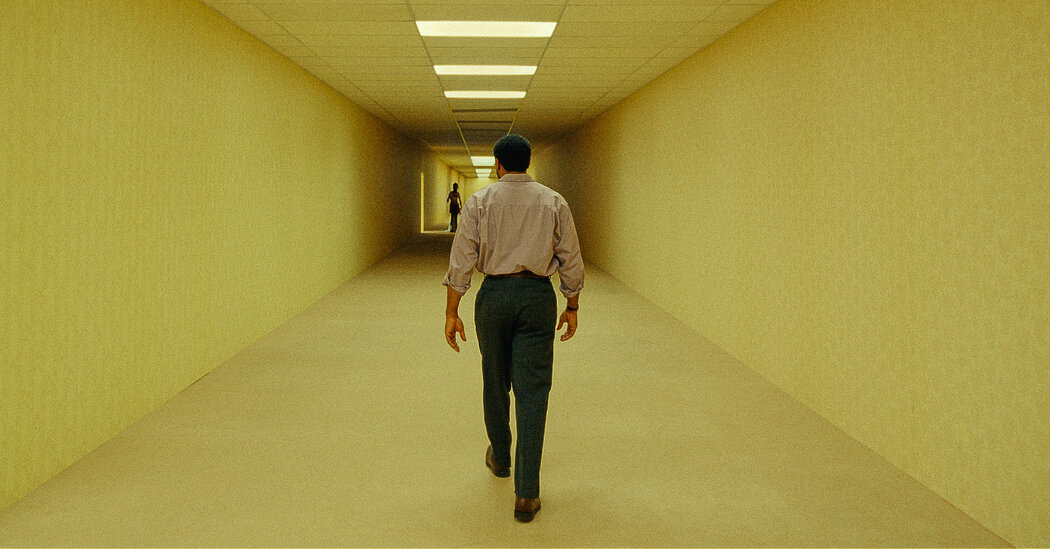
“Backrooms,” a new film about a frustrated architect turned furniture salesman who discovers an eerie dimension of (mostly) empty rooms, provides a glimpse of a Gen Z nightmare: being stuck inside an endless and mutating alternate reality. A frightening vision of a slopified, gameified, distorted universe with no boundaries between the personal and professional, “Backrooms” tracks a generation’s deep unease with life lived online. (Some spoilers ahead.)
The movie is a Gen Z sensation. It grossed $81 million domestically in its opening weekend. About 86 percent of the audience was under 35, according to PostTrak, a film industry research service. Forty-four percent was under 21.
So why are zoomers so drawn to it?
It’s partly a matter of representation. At 20, the film’s director, Kane Parsons, is a child of the internet, with a style forged by digital media and video games.
Brendan Reynolds, a 26-year-old who works for the New York Public Library, said that he recognized a film made by someone with a common generational experience.
“It’s the first movie I’ve seen directed by someone who grew up with vaporwave,” said Reynolds, referring to an online music microgenre from the early 2010s.
In 2022, using common graphics software, Parsons, who was anonymous at the time, turned an unsettling meme image of an early-aughts office into a short video. “The Backrooms (Found Footage)” was such a hit — as of this week, it’s been viewed more than 80 million times — that A24, the stylish production house that has defined a certain kind of glossy indie filmmaking in the 2020s, hired him to direct a feature-length version.
Much of the discussion about “Backrooms” has focused on its exciting novelty: as a path forward for Hollywood to get young audiences in seats; as a new pipeline for stories that bubble up from internet subcultures; and for its disquieting sensibility, which is something like the big-screen debut for the Gen Z preoccupation with uncanny physical spaces. (It’s a generation that grew up scaring itself with digital images of circa-Y2K landscapes — abandoned shopping malls, for instance.)
But it’s not the first movie based on a meme. It’s not even the first movie based on a creepy meme (though the less said about “Slender Man,” the 2018 film about the digital urban legend, the better).
And the myth of the labyrinth is one of the most enduring in Western civilization, from Knossos to Florence, all the way through to Borges and the hedge maze of Kubrick’s “The Shining.” So-called liminal spaces, surreally depopulated man-made expanses, have been a feature of horror and science fiction throughout their history.
Yet the labyrinth in Parsons’s movie seems to be calling to a new generation, for new reasons.
“Horror films always take the shape of the world in which they are made and they channel the particular anxieties and traumas of that era and that context,” said Adam Lowenstein, director of the Horror Studies Center at the University of Pittsburgh.
In Parsons’s film, Clark stumbles through a portal to the backrooms underneath his furniture store. The weird, looping combinations of office space he finds there suggest a kind of demented learning algorithm. Some Gen Z-ers read the film as a commentary on A.I. and the profusion of uncanny online slop.
“I think people are feeling very lost these days,” said Sydney Andrews, a 23-year-old production designer in New York who saw, and loved, “Backrooms.” “Our generation is really freaked out about A.I.”
Parsons has called A.I. “genuinely harmful,” adding that if he could, he would “make generative A.I. disappear forever.”
But he says the most important inspiration for his work is a video game, Portal 2, and that some of his first digital creations were in Minecraft. In “Backrooms,” a person enters the liminal zone by “clipping,” gamer-speak for passing through a solid wall.
From there, the maddening repetition in “Backrooms” resembles “procedural generation,” a technique that allows video game designers to feed digital elements — walls, floors, monsters — into an algorithm that then generates a much larger world. It’s a way of building scale cheaply, sometimes criticized for its mindlessly repetitive quality.
It’s easy to imagine why the idea of being stuck inside a proliferating maze would haunt a Gen Z audience. After all, these young people spent formative years trapped indoors during the pandemic, largely experiencing the outside world through thick layers of digital mediation.
Some developed a growing sense that the algorithms that seemed to provide infinite choices were in fact leading them down narrow paths.
“You could be watching any of a billion videos, but the actually available choices are determined by something you can’t name or point at,” said Aidan Walker, a 27-year-old internet culture researcher and writer. “It feels tyrannical, even if in the moment you have freedom.”
Even before the pandemic, younger generations had a tendency to apply a gameified, digital filter to the real world. “Pokémon Go,” the mobile game that peaked in popularity in 2016, encouraged children to view the real world as an endless playground animated by their phone.
Today, TikTokers try “speedruns” through Scientology buildings — essentially, attempts to turn labyrinthine, off-limit spaces into video game levels. Gen Z influencers ride Jet Skis to Little Saint James, better known as “Epstein Island,” to make content about the “Temple,” a supposedly haunted structure there. “N.P.C.,” a video game term for non-player character, has been prodded into the popular lexicon by Gen Z-ers.
Altogether, it’s a vision of life as an epic game created by a hidden hand, full of Easter eggs, played with a smart device.
In the hands of many zoomers, smartphones have become tools to re-enchant the world, to imbue the built environment with the magical properties of a scary story.
Of course, for much of Gen Z, the real world is a scary story, one with a hostile job market, administered by a distant gerontocracy, with doom on the horizon.
“You turn your head up from the phone, but you can’t get a job, can’t get a house,” said Walker, the internet culture researcher. “There’s this sense of constricting opportunity. ‘IRL’ is a labyrinth you’re lost in.”
And while digital life may provide forms of distraction, digital work — online content creation being the most obvious example — is a Darwinian battleground that demands total dedication and sometimes the only job prospect Gen Z can imagine.
“It’s a generation where work itself is a very disconcerting and disturbing and frightening prospect,” Lowenstein, the University of Pittsburgh professor, said.
In “Backrooms,” work and home are hopelessly intertwined. Clark, the film’s protagonist, played by the Gen X actor Chiwetel Ejiofor, sleeps in a bed on the showroom floor. The backrooms themselves resemble offices, but they are full of home décor, patio furniture and dirty laundry.
And the film’s vision of young people at work is nightmarish. While Clark at least has professional dreams, however unfulfilled, his two young employees — who are depicted as incompetent and stoned — seem to have no dreams at all.
Clark offers the pair gig work, first as content producers, and then as assistants in his quest to explore the backrooms. (Without going into detail, the two should have asked for hazard pay.) They’re simply the only bodies on hand.
Adding a layer of meta-commentary, Parsons’s astonishing success story has been braided into the marketing of the film itself. James Francis, a professor of English at Texas A&M University who specializes in horror movies, pointed out that Parsons has been a bigger part of the publicity push around the movie than either of the film’s Oscar-nominated stars (Ejiofor and Renate Reinsve).
One way of seeing Parsons’s ascension from anonymous content creator to star Hollywood director is an escape from the labyrinth of digital work into the real world. (Consider: While the backrooms of Parsons’s viral short were entirely computer-generated, for the movie, A24 sprang for a real, 30,000-square-foot set.)
“Those thresholds and backrooms are about that cultural center, about wishing I could go through a doorway and change my life,” Francis said. “There is a fear and anxiety at the idea of living an algorithmic life instead of an individual one.”
“Backrooms” ends on an ambiguous note, with one main character’s fate unresolved. It’s unclear whether the person is still inside the maze or back out in the real world. More frighteningly, it’s unclear whether that even matters.

