
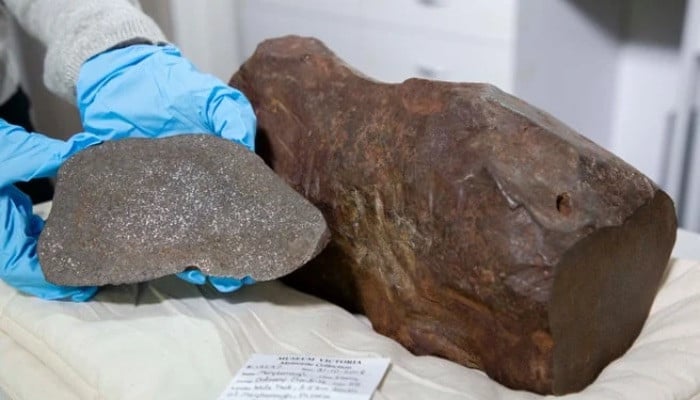
A routine gold prospecting trip in Victoria, Australia, led to an extraordinary scientific discovery when David Hole unearthed a 17-kilogram reddish rock in Maryborough Regional Park in May 2015.
What Hole initially hoped was a gold-bearing specimen has since been confirmed as a 4.6-billion-year-old meteorite.
Hole tried everything to crack open the unusually dense rock, including a rock saw, an angle grinder, a drill, acid, and even a sledgehammer, but all attempts failed.
He eventually brought the specimen to the Melbourne Museum in 2018, where geologists Dermot Henry and Bill Birch identified it as an H5 ordinary chondrite.
“It had this sculpted, dimpled look to it,” Henry said, explaining that the surface features formed as the meteorite melted and was sculpted by Earth’s atmosphere during its descent. Birch noted that the rock’s density was a key clue: “If you saw a rock on Earth like this, and you picked it up, it shouldn’t be that heavy.”
Analysis published in the Proceedings of the Royal Society of Victoria in July 2019 revealed iron-nickel alloys including kamacite, taenite, and tetrataenite, along with troilite.
The specimen also contains chondrules (tiny spherical silicate formations up to one millimetre) that originated in the early solar system. Carbon-14 dating indicates the meteorites landed on Earth less than 1,000 years ago.
Carbon-14 dating indicates the meteorites landed on Earth less than 1,000 years ago, though no impact crater has been found.
According to researchers, the rock formed in the asteroid belt between the planets Mars and Jupiter. The Maryborough meteorite is the 17th meteorite in Victoria and the third H5 chondrite from the same place. Speaking about the rareness of finding something like that in view of the area’s past, Henry said, “This is only the 17th meteorite ever found in Victoria, where there are thousands of gold nuggets found.”
The chances of finding the rock were quite astronomical, said Henry.


