Soccer tactics are like fashion: Trends come and go each season, and previously outdated ideas get reused with new twists.
Every position on the pitch has changed one time or another. We have seen touchline-hugging wingers turn into inside forwards. Attacking midfielders dominated games, then faded into obscurity. Even goalkeepers evolved into outfield players on occasion.
Each new idea is spurred by the changing cast of players at top clubs, such as the wingers who can dribble better than before, or the defenders who are more comfortable with the ball at their feet.
The 2026-27 season has brought further evolutions, meaning women’s soccer again looks different than it ever has before.
Here are three major trends across women’s football in Europe this season.
Putting the most athletic players at wing back
For the last decade, the full back role has presented coaches with an opportunity unlike any other to get innovative. Traditional fullbacks who defended as part of a back four have long been replaced by more attacking-minded wing backs. Players like Chelsea‘s Katie McCabe and OL Lyonnes‘ Selma Bacha became creative hubs for their teams, providing a wide outlet and delivering piercing crosses.
Those newer, attack-oriented roles also developed into inverted roles — full backs would come inside to add an extra player into central midfield and make it easier for their team to keep possession.
This season, though, the position has evolved once again, this time with exceedingly athletic players who can cover the length of the touchline at pace.
This new breed of wing back can perform many different duties: While carrying all the same defensive responsibilities, they’re also tasked with making incisive runs beyond an opposition’s defence, as well as overlapping (or underlapping) those ahead of them when attacks are less direct.
One of the biggest innovations of these new athletic wing backs is their ball-carrying abilities. Against low blocks — when a team sits deep and soaks up pressure — having a full back who can dribble forward and take players on can be a major advantage.
One of the best examples has been OL Lyonnes’ use of Jule Brand at wing back this season. The Germany international has been used on both flanks as Lyonnes’ attacking outlet. Her ability to exploit large spaces with darting runs, to receive the ball in her stride, and to then create chances is exceptional. She leads the assists charts in the French top flight this season (9), six more than the next best player.
Credit: Canal+
Brand has elite athleticism and wins 50-50 tackles more often than not, qualities which were put to good use by Germany at the Women’s European Championship in 2025. Since then, Lyonnes boss Jonatan Giraldez has followed suit at club level, meaning his side has essentially added an extra player in attack while knowing Brand can recover defensively if needed.
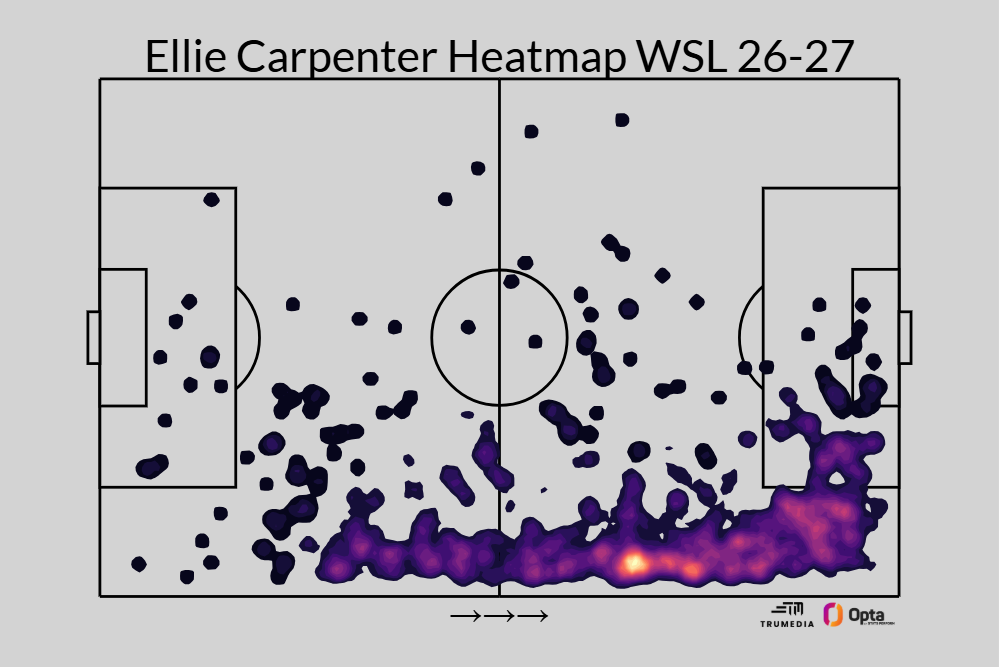
Brand isn’t the only athletic wing back starring this season, though. Sonia Bompastor’s Chelsea have also tweaked their usage of Ellie Carpenter on the right flank. The speedy Australia international has been a frequent sight in the opposition box from her wing-back role.
Carpenter is one of two full backs, alongside Tottenham Hotspur‘s Julie Blakstad, in the WSL’s top six players for opposition penalty area entries and touches.
Credit: Opta Graphics / TruMedia
In Spain, Real Madrid have been using Eva Navarro, a right winger by trade, as their right back since last season. Defending champions Barcelona have extended their successful experiment with Netherlands winger Esmee Brugts at left back and have used midfielder Sydney Schertenleib at right back this season.
The common denominator between all of these players is their athleticism to gallop up and down the flanks.
Teams are harnessing the two-way impact of their most athletic stars by placing them in full back positions. This allows teams to have more numbers in attack and the ability to recover from precarious situations in transition.
Starting attacks with a temporary back three
Any tactical change in one part of the pitch brings a knock-on impact elsewhere.
By tasking wing backs to attack higher up the pitch, teams then have to find a solution to fill the space they leave behind. The most common solution? A makeshift back three.
Teams are still starting with four players in defence, but they now rely on the other wing back to cover centrally and make a back three, or even have a central midfielder drop deeper to allow both wing backs to move forward.
The three shape brings benefits in attack, as well as defence. When building possession from the back, the numerical advantage of three central defensive players makes it easier to move the ball around or carry it up the field, with an attacking full back or two providing an outlet out wide.
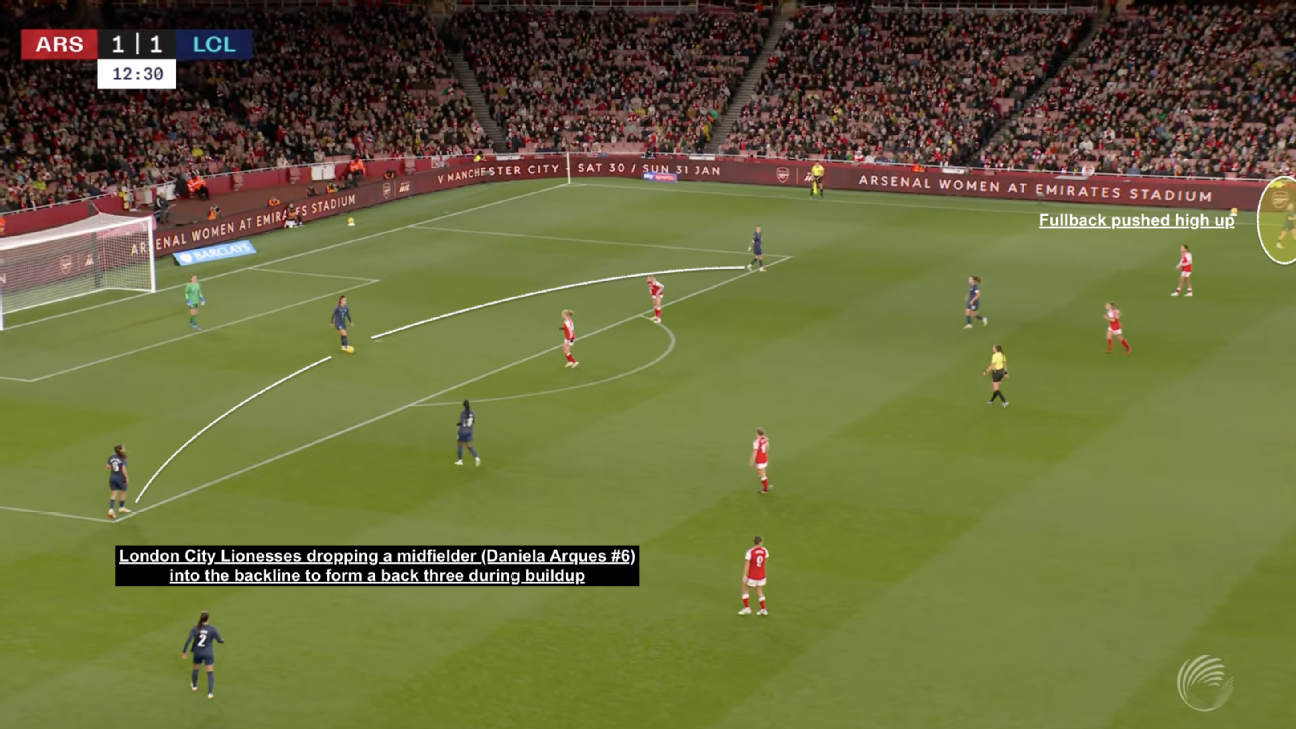
Perhaps the biggest proponents of this are the London City Lionesses. The WSL club, who are enjoying their best season yet amid a summer influx of veteran stars, have consistently used a back three to build possession.
Credit: WSL
London City manager Eder Maestre has often tasked a midfielder with dropping into their backline to complete the trio and play through an opposition press.
The same thing can be seen elsewhere, too.
In the recent Frauen-Bundesliga clash between heavyweights Wolfsburg and Bayern Munich, both teams used a back three during the buildup phase despite starting with four at the back. While Bayern used one of their midfielders to drop in between the center backs, Wolfsburg utilized their right back to complete the set.
Manchester United, Arsenal, Real Madrid and Barcelona have also all used a temporary back three to much the same effect.
It’s worth mentioning some teams do the same thing but keep a permanent back three. Chelsea, for example, have converted England fullback Lucy Bronze into a central defender and made her part of a trio of center backs that allow their wide players the freedom to push up.
Aston Villa‘s improvement since manager Brian Sorensen took over in September is also rooted in a return to a permanent back three formation. With three center backs, the team are able to play a slightly more direct style and free their quick wide players more effectively, leading to improved results.
Reimagining the No. 10 role
The traditional No. 10 is back in fashion. For years, the role featured an attack-minded midfielder fill the space between an opposition’s defence and midfield was often redundant. That job was instead shared between midfielders and attackers, rather than the role of a single player.
Now, some teams have used that role again, albeit in a different way than before.
To explain this phenomenon, we need to talk about strikers. The No. 9 position has itself changed, with center forwards taking fewer touches inside the opposition penalty box and instead dropping deeper in a bid to draw defenders with them.
Replacing the penalty box threat of strikers are central midfielders, even those who have previously played deeper roles. Those central players must now make runs into the box, create chances and score goals. Their end-product now resembles that of a traditional No. 10, but in a more expanded role.
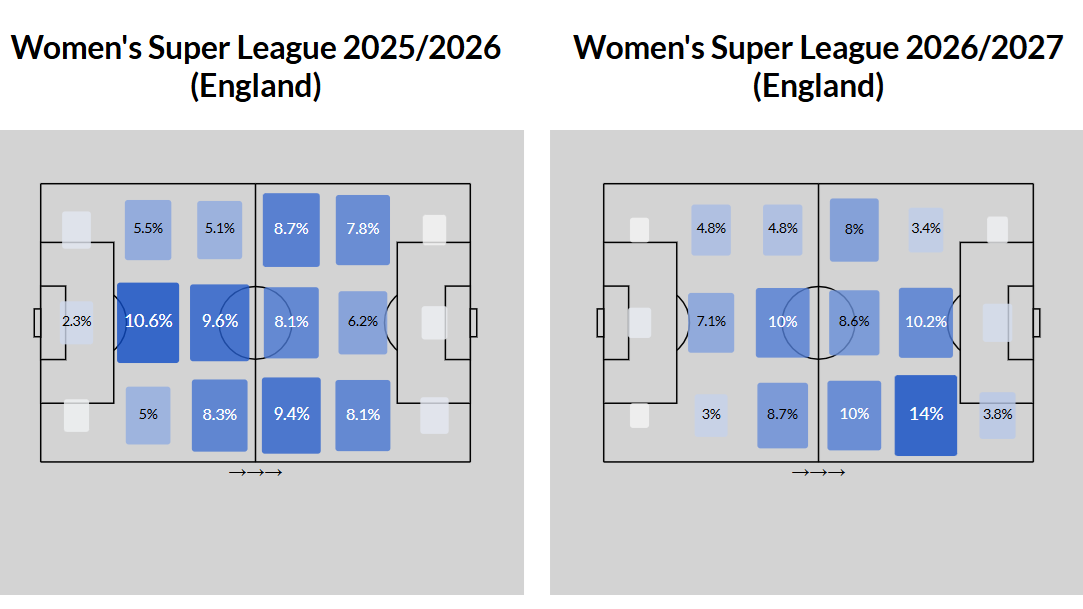
Take Chelsea’s Keira Walsh as an example. The 29-year-old midfielder has been seen consistently taking up positions around the edge of the box this season and has already registered six goal involvements (two goals and four assists) — a career-best return at this stage of the season.
Credit: TruMedia
Walsh’s other metrics paint a similar picture. According to Opta Analyst, the Chelsea midfielder is putting out her career-best numbers for shots, chances created and touches in the opposition box per 90. Bompastor has turned a midfielder who previously tended to sit deep and dictate play into someone who provides an exciting end-product.
Yet, Walsh is not alone. Arsenal’s usage of Frida Maanum or Manchester United’s deployment of Zigiotti Olme both share a common denominator. Olme, for example, is getting fewer touches on average but averaging one more touch per 90 inside the opposition box, and her goal tally (four) is already one off her return for all of last season.
In Serie A, Roma‘s Manuela Giugliano has been spearheading this charge, too. The Italy midfielder leads the league in both goals (9) and assists (5) this season. She is averaging fewer touches per 90 (52 in 2026-27 and 59 in 2025-26), but her shots, touches in the box, and chance creation metrics are all up on a per-90 basis. Her influence around the 18-yard-box is palpable this season as she is constantly involved in the thick of things.
Credit: ZDF Sportstudio
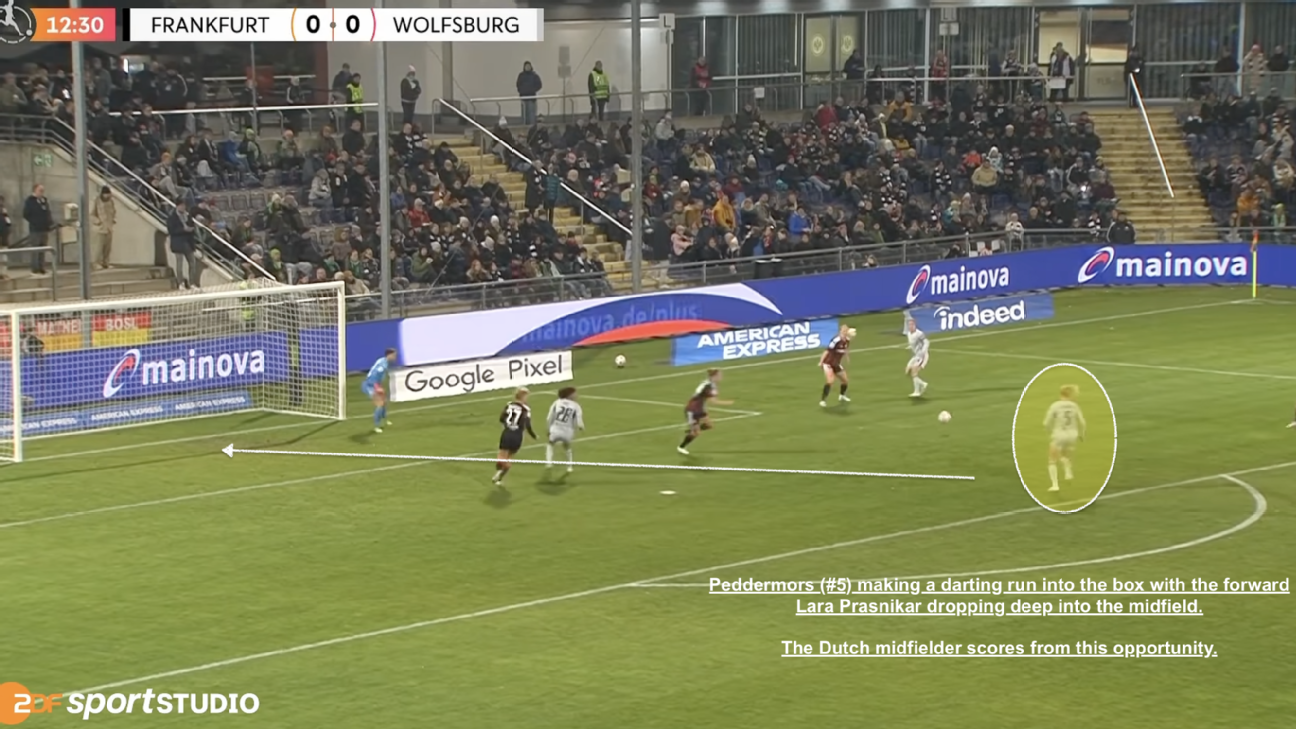
In Germany, Wolfsburg’s Ella Peddermors is another excellent example. The midfielder is averaging twice as many shots and chances created this season compared to last. In fact, she is leading the charts for goals in the Frauen-Bundesliga and has been directly involved in almost half of Wolfsburg’s goals.
Similar impacts are being made by Real Madrid’s Arianna Caruso, Liverpool‘s Natalia Ramos and Tottenham Hotspur’s Signe Gaupset.
Change is a constant in soccer tactics, and each season brings new opportunities for teams to make small adjustments in order to reap big rewards. Teams adapt, players evolve, and the cycle continues.