
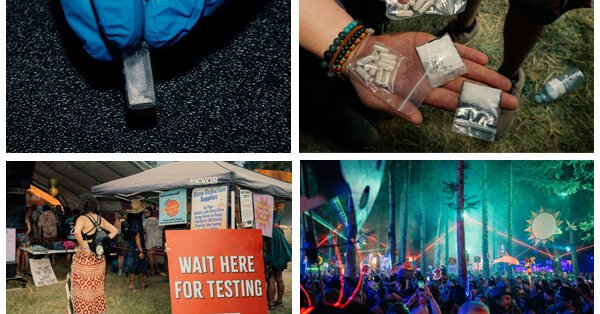
One morning in late July, Justin and two friends from Seattle crossed the border into British Columbia in a small R.V., on their way to one of the more unusual raves in the world.
As the friends set up camp among the 23,500 other visitors to the Shambhala Music Festival, they were approached by someone offering “party favors” — drugs. Soon they received a menu of illicit substances and their prices via an encrypted messaging app.
The three of them — and several other friends — decided to purchase LSD, ketamine and MDMA. The total cost was $400.
(The Times agreed to identify the festivalgoers by first name only so they could speak openly about their drug use.)
Buying and using drugs is not unusual at music festivals. It’s commonplace — and risky, given that drugs can be cut with dangerous substances or differ from what sellers claim they are. What distinguishes Shambhala is that anyone can test the drugs they’ve just bought, and get advice on how to reduce the risk of using them, at a sophisticated on-site drug lab.
Shambhala’s approach is one answer to a question at the heart of an intensifying health crisis: What should be done about a drug supply that is more contaminated, potent and unpredictable than ever?
The free drug testing service is sanctioned by the festival and the government. Last year, about 7 percent of the 4,592 samples tested at Shambhala contained something unexpected. That suggested the drugs at the festival were far less contaminated than those on the streets, though they still carried risks: Fentanyl was detected, but rarely, along with other dangerous combinations of substances.
The stakes can be high. Hundreds of people at Shambhala each year need medical attention for drug-related problems. And in 27 years, there have been four deaths, festival officials said; two were ruled drug-related, including a cocaine overdose in 2024.
Illegal drugs are getting more dangerous. The rise of lab-made drugs has allowed illicit chemists to introduce hundreds of new compounds, flooding streets and festivals with new products and risks.
The shift helps explain an overdose crisis that, in the United States, kills more Americans each year than died in the whole of the Vietnam War, with Canada experiencing similar public health effects. Fentanyl is one major reason, but a broad transition to cheap synthetic drugs has amplified the problem.
One approach favors tougher law enforcement. Another, practiced at Shambhala, emphasizes harm reduction: accepting the dangerous realities of drug use, and trying to reduce the risks.
The festival code of conduct prohibits illegal substances, but the organizers say they know people will use drugs anyway. Neil MacLeod, the festival’s chief executive officer, said he saw no contradiction there. “Harm reduction isn’t about approving of drug use,” he said, “it’s about making sure people can get help when they need it.”
Justin put it in more practical terms. “If we’re going to do them,” he said of the drugs, “I want to be certain of what they are.”
The Realities of Raves and Drugs
Drug testing of varying kinds has been part of music festivals for years, but few have open and extensive operations like Shambhala — and even fewer, if any, in the United States.
One reason is a 2003 law, the Illicit Drug Anti-Proliferation Act, known as the RAVE Act, which can penalize operators of music festivals for knowingly allowing drug use.
The threat of liability forces festivals to “pretend there are no drugs,” said Tammy Anderson, a rave culture expert and professor in the University of Delaware’s Department of Sociology and Criminal Justice.
More broadly, the Trump administration has turned away from harm reduction. In April, the Substance Abuse and Mental Health Services Administration said it would stop funding needle exchanges and test strips to detect fentanyl in drugs, among other programs. The agency called the move a “clear shift away from harm reduction and practices that facilitate illicit drug use.”
Public health experts criticized the policy, saying that drug users are safer when they have more information.
Drug testing made Shambhala safer, too, Dr. Anderson said, though she added that it didn’t eliminate risk.
“I would not want my 21-year-old or 22-year-old to go into a setting like that,” she said. But, hypothetically, she added, “Which one do I want him to go to? Probably Shambhala” — because of the safety precautions.
Shambhala’s harm reduction efforts go well beyond testing. It has a 12-bed field hospital, run by an emergency room doctor and staffed by 30 physicians; roaming teams of harm reduction counselors; and an area called the Sanctuary, with 50 hammocks and mattresses for people having bad drug trips or suffering from exhaustion.
Even with these precautions, 600 to 800 serious medical issues occur each year at Shambhala, many related to drugs, including cases involving decreased consciousness, agitation, psychosis and the occasional seizure, said the festival’s medical director, Dr. Brendan Munn, an anesthesiologist in Ontario.
Other festivals have medical challenges, too. Data is limited, but one paper on music festivals in the United Kingdom found 32 possible drug-related deaths between 2017 and 2023. Other research suggests that deaths at such festivals are often attributable not to drugs but to traumatic events, such as trampling.
The Festival Begins
Thursday, 4 p.m.
Justin and his friend Bryce, both tech professionals in their late 20s, stood in line at the drug-testing building. Like many at the festival, they said they were occasional recreational drug users, not in the habit, outside raves, of ingesting psychedelics.
A table near the front offered male and female condoms, syringes for accurate drug dosing and clean straws for sniffing powders. Signs urged consent for any sexual activity and warned against combining certain drugs.
The lab was run by ANKORS, a regional nonprofit focused on harm reduction. At Shambhala, it received financial and scientific support from Interior Health, a British Columbia health authority.
The province wasn’t encouraging illegal drug use, said Antoine Marcheterre, the drug-checking lead for Interior Health and a co-manager of the ANKORS testing service. In fact, in January, after a political backlash, British Columbia ended a three-year pilot project that had decriminalized drug use and the possession of small amounts of some illicit drugs. But legal exemptions for drug testing remain.
Mr. Marcheterre said he knows some people oppose harm reduction, including drug testing. “They’ll say, ‘Let’s not spend the money. People should not use drugs,’” he said. “But that’s not the reality of things. We’d rather help people than say, ‘You’re on your own.’”
Justin said that he and his friends go to several festivals a year in the United States and sometimes use drugs. In those cases, he said, they might bring drugs bought from a trusted source and test them using less sophisticated at-home testing kits.
“Every festival has people taking drugs, but people just have to be way more discreet,” he said. Shambhala, he added, was an outlier only in terms of how open it was.
He and Bryce had reached the front of the line.
Their drugs all tested as expected.
To ANKORS, the counseling that followed was as important as the testing itself. These conversations focused on the drugs’ risks and effects, along with safety tips such as staying hydrated. But the counselors don’t tell people not to take drugs.
Justin and Bryce told the technician they hadn’t previously tried ketamine and didn’t want to overdo it. She cautioned them to take it slowly.
“That first bump might take a while” to kick in, she said, adding: “The next will come quicker. Be careful to not lose track of the bumps you do. Sometimes, ketamine messes with your memory.”
Thursday, 6 p.m.
A mile away, at the north end of the festival, the simple house of the farming family that started Shambhala sits atop a bluff. In 1998, Rick and Sue Bundschuh, formerly apple farmers who bought the land to raise cattle, learned that their 16-year-old son, Jimmy, was attending raves.
In the days before smartphones, they said, young people would write the locations of secret parties on chicken eggs and then leave them for their friends.
“Kids were partying in the bush,” said Ms. Bundschuh, now 76. “No first aid, no security, starting fires.” So the family decided to host Jimmy and others on their property.
“It just made sense to have a place where they could, you know, not have a lot of rules but some checks and balances,” she recalled. That first year, around 500 people attended.
When ANKORS got involved, in the early 2000s, the family was thrilled. Drug testers feared arrest, and ANKORS initially ran a discreet operation with much less sophisticated equipment. But as the opioid crisis intensified over the past decade, and drug-related deaths became more common, the operation gradually moved into the open.
On the bluff that evening, Mr. Bundschuh, 77, sipped a pilsner and looked across the pop-up village of tents and R.V.s sprawled across the property, amazed at how much the festival had grown. With help from his parents, Jimmy had built it into a multimillion-dollar family business, now charging 620 Canadian dollars, or about $440, for general admission.
What did he think about all the drugs on his ranch? “It’s nothing I’d ever use,” Mr. Bundschuh said, though lately he’s been taking a few puffs of marijuana to help him sleep. But, he added, prohibition seemed futile. “A place like this, it’s totally impossible to stop it.”
“There’s been opposition,” he said. “You know, people say, ‘Oh, you’re encouraging the use of that stuff.’”
The family has drawn a harder line on alcohol, insisting that the festival not allow it; booze added danger, they said, particularly when combined with drugs, and aggressive behavior they thought made young women in particular uncomfortable.
Thursday, 7:30 p.m.
That evening, a problem arose at the testing center.
A festivalgoer had brought in four translucent capsules filled with white powder. He told the technician that he thought they contained 2C-B, a synthetic psychedelic and stimulant that can cause euphoria. The test found something else: 25B-NBOH, which Mr. Marcheterre described as “a very potent psychedelic” — and possibly deadly.
Adding to Mr. Marcheterre’s concern, the person who brought in the capsules said he had bought them at the festival, meaning more could be circulating.
The testing service contacted Shambhala organizers, who discussed the issue at their nightly public safety meeting. By 9:35 p.m., an alert had gone out through the widely used Shambhala app, warning of a “very dangerous substance.”
This was an extreme case, Mr. Marcheterre said; he couldn’t remember the last warning like it. But, he added, “It’s a textbook example of what our service can do.” Word also went out to the medical staff and security, just as the party was taking off.
Thursday, 10 p.m.
Bass thumped and light shows erupted on three major stages: the Pagoda, the Living Room and the Amp. Crowds danced joyfully.
Justin and his friends decided not to use any of the drugs they’d bought earlier. Instead, they eased into things with cannabis gummies and pot they’d legally purchased.
On Friday, Justin and his friends would take LSD. He described it as “a body high, not a head high,” and said that when he closed his eyes, he could see fractals of light. He and his friends were back at camp and asleep by 7:30 a.m. On Saturday night, they used the ketamine; on Sunday night, the MDMA. They said they had a great time.
The Morning After
On Saturday at 11 a.m., just outside the medical tent, Dawson, a 24-year-old from Calgary who works in the oil fields, hobbled on a bandaged left foot.
His injury was drug-related. Several hours earlier, he said, at 5 a.m., he had returned to his campsite after dancing to Dr. Fresch at the Pagoda stage and using ketamine all night. His friends went to sleep, but Dawson could not, so he took some more ketamine to try to come down.
“It turns out I was on a mission,” Dawson said. “I convinced myself that I was in a video game and climbed on a trailer and sprinted across the roof.”
He tried to jump to the next trailer, but he fell short. His foot caught on the edge, leaving him with a six-inch-long cut. The skin around the wound was so dusty and dry, he said, that it couldn’t be stitched, so he’d have to wait until he got home for more care.
Dawson said he doesn’t use drugs often in his regular life, but acknowledged that he’d taken more than ketamine that night: LSD and MDMA, and “I smoked weed, but that doesn’t really count,” he said. He didn’t get his drugs tested because he thought he could trust the friend who gave them to him. Asked whether he knew what was really in them, he said, “I guess not.”
As he stood in front of the medical tent, he said he’d not be coming back to Shambhala. Then he reconsidered and said he’d at least take a few years off. “I need to work on my self-control,” he said. “I am not strong enough to handle my substances in a place that gives you this much free range.”

