
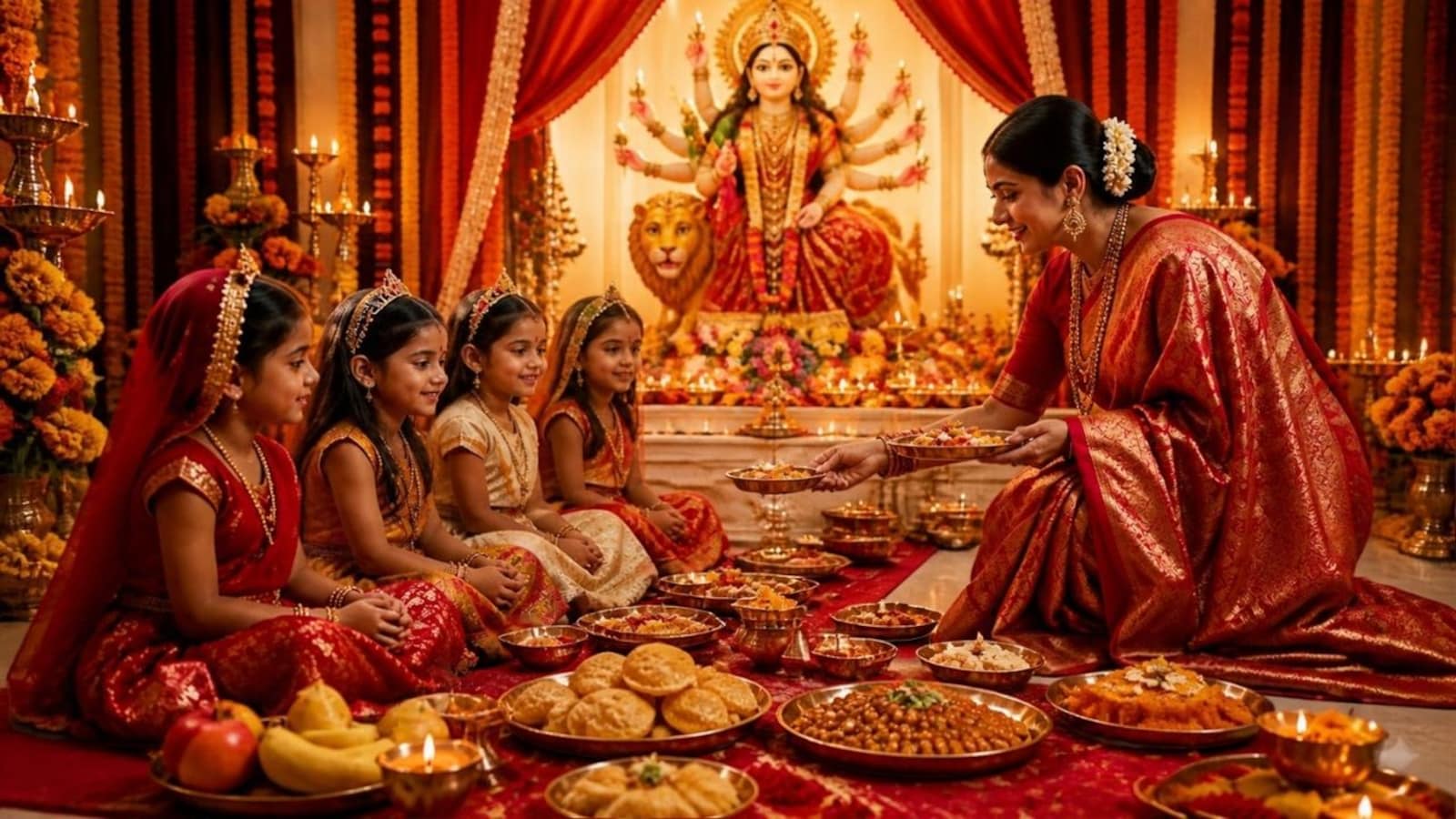
In Hindu culture, little girls are considered little goddesses, representatives of the Devi, powerful, supreme, and kind. It is to honour the Devi that we observe Navratri, and what better way to culminate the nine-day festival than to treat little girls as nothing short of goddesses? They are welcomed into homes with love, their feet are washed, and they are served prasad as families seek their blessings. This is Kanjak, or Kanya Pujan, observed on Ashtami or Navami.
For a young girl, Kanjak puja is quite a grand occasion, much like her birthday. Today, she is a princess, and she is going to make the most of this special day, just as many of us once did.
As I help myself to another serving of Maa’s delicious halwa, puri and chole, I am transported back to my six-year-old self – excited about her new outfit, establishing an efficient plate-changing system with her dadi, and ticking off neighbourhood houses with her best friend.
Even as an adult, sitting for the kanjak puja makes you feel like a little girl once again.Photo Credit: Author
Knowing I could not be the only one missing this VIP treatment, I spoke to other women about their childhood memories. What followed was a treasure trove of stories that come alive every year when the aroma of halwa, puri and chole fills our homes.
For Mallika, 27, Ashtami was all about being pampered by the aunties in her neighbourhood.
“The excitement began a day before, when they would come to meet my mom in the evening and remind her to send me to their homes for Kanjak puja.”
The anticipation extended to the outfit, too. “Every year, I used to get a new hand-me-down lehenga from my sister, and I was super excited. I would wake up super early the next day and get dolled up in my lehenga with matching bangles,” she recalls.
Food was another highlight, although Mallika admits that she hardly ate at home on the occasion.
“There was one aunty who was the best cook, and she would prepare a lavish spread. I used to love eating at her place,” she says. Another neighbour would insist that the girls stay for at least an hour.
“We used to go to her place towards the end, for a long lunch, and sit around all comfortable while she cooked and treated us.”
The day eventually came when Mallika had to say goodbye to her Kanjak days. “I was 12 when my mom said, ‘You are too old now to go for Kanjak,’ and I was actually heartbroken,” she recalls.
Also Read:8 Childhood Food Habits And Memories We Would Want To Live Again!
For Reena, 55, the ritual now involves preparing delicious halwa, puri and chole for the little girls she welcomes into her home. Yet, while she cooks for them, she finds herself thinking about her own childhood, when she would visit different homes, sample their halwa and puri, and decide whose preparation was the best.
The food is only one part of what makes these memories so special. The small monetary gifts that girls received along with the prasad remain just as memorable.
“I was a jewellery buff, so every year, without fail, I would count all the money I received and go and buy a beautiful piece of jewellery that very evening,” Reena recalls.
Collecting money was, indeed, one of the most exciting parts of the day for many girls. Vretti, 33, remembers eagerly counting her earnings at the end of the day and using the money to splurge on herself throughout the month.
“I loved that feeling of independence, that it was my money, and I would only use that, even if I had to buy a packet of chips. It was liberating,” she says.
For Vretti, the anticipation of the halwa-puri prasad was just as memorable.
“I don’t think I ever ate this combination at any other time, but I would crave it all morning on the day of Kanjak,” she says. “I remember we used to get beautifully dressed and then quickly go and invite all nine Kanjaks into our homes. We would get done with the puja so that we could finally eat that delicious prasad.”
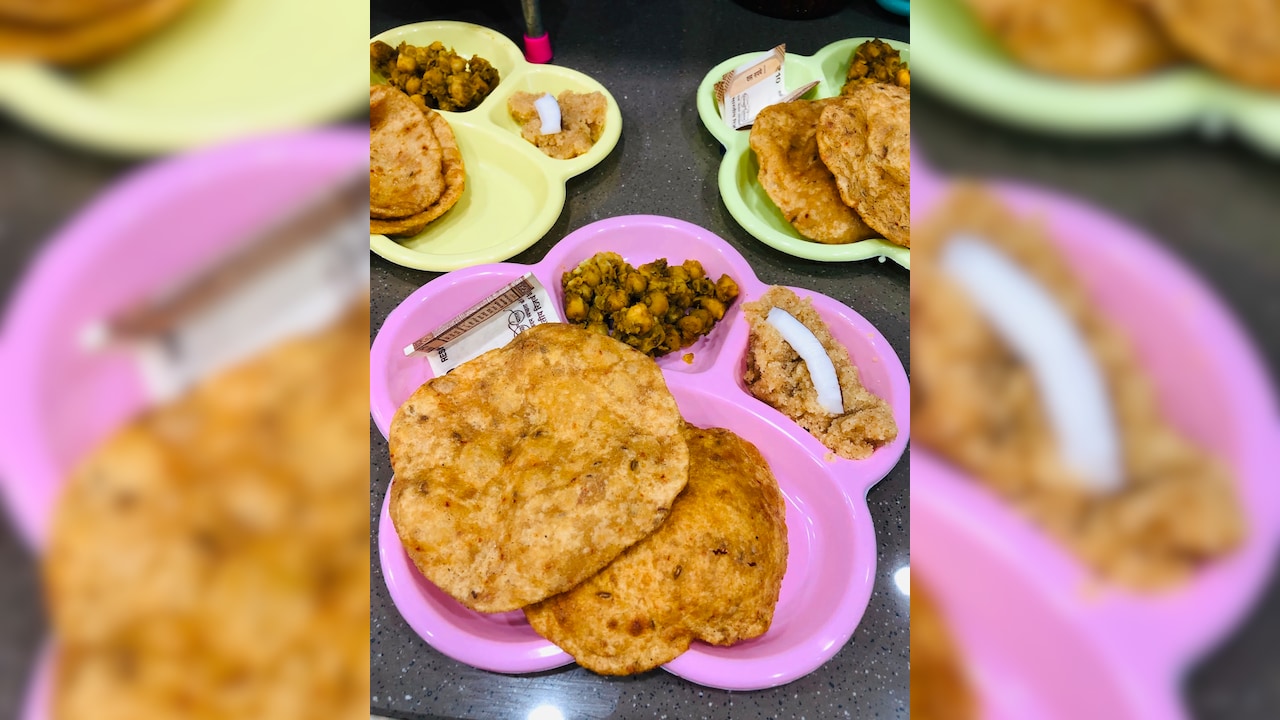
The halwa, puri, chole carry a taste of nostalgia. Photo Credit: Author
However, the excitement that once surrounded the ritual seems to be fading in some neighbourhoods.
“I don’t think I see the chirpy groups of little girls going from one house to another any more,” Vretti observes.
She believes changing family structures and neighbourhood dynamics could be contributing to this shift.
“Earlier, the joint-family concept was more prevalent. You could invite at least three or four kids from one house, and they would come running. Now, couples usually have one child, and kids nowadays are also not playing or engaging enough with their neighbours. Some people don’t even know the name of their neighbour’s child. So, it would definitely be awkward to invite them, or for the child to go to someone else’s house. For us, it came naturally because we were all so familiar with each other.”
Also Read: Why ‘Nani Ke Ghar Ka Khaana’ Is So Delicious and Will Always Be
Interestingly, traditions such as garba, dandiya and pandal-hopping continue to bring people together during the festive season, with social media adding to their visibility. Getting dressed up, taking hundreds of pictures, sharing a few online and enjoying the festivities have become part of the experience for many.
Kanjak, however, is rooted in something more intimate: the warmth of being welcomed into a neighbour’s home, the excitement to get special treatment for being a girl, and the bonds that once brought entire neighbourhoods together.
It is not a tradition that can be recreated simply by turning it into an event or encouraging participation online. Its charm lies in the relationships that make it possible. As families and neighbourhoods change, keeping that spirit alive may require a little more effort, but it also begins with something simple: making a child feel loved, included and special.
Perhaps that is what many of us miss most about those Ashtami and Navami mornings. Not just the halwa, puri and chole, but the feeling of being a little goddess for a day.


