
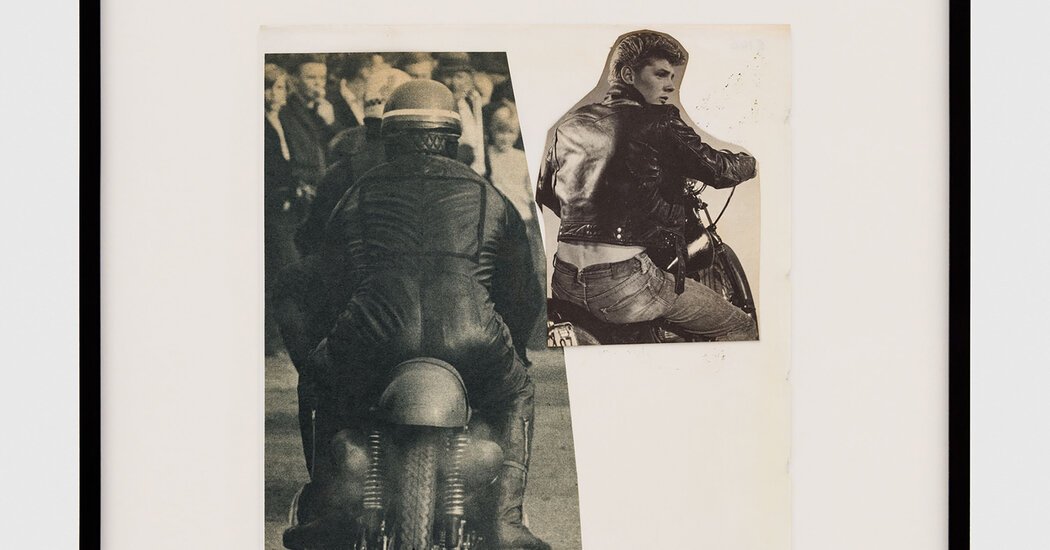
This week in Newly Reviewed, Carolina Miranda covers three shows in Los Angeles: a group exhibit with Tom of Finland at the center, Betye Saar’s “wearable art” and Esther Pearl Watson’s spaceships.
Mid-Wilshire, Los Angeles
‘Tom’s Stretch’
Through Aug. 22. David Kordansky Gallery, 5130 West Edgewood Place; 323-935-3030, davidkordanskygallery.com.
In an interview last month, Representative Becca Balint, Democrat of Vermont, likened Defense Secretary Pete Hegseth’s exaggerated notions of masculinity to the virile men drawn by Tom of Finland, the artist known for producing erotic illustrations of square-jawed leather men and chiseled farm boys.
Born Touko Laaksonen in Finland in 1920, the artist is regularly mentioned as a key precursor to the biker aesthetics of the experimental film “Scorpio Rising” by Kenneth Anger and the macho-man looks of the Village People. This may, however, be the first time he has been invoked in relation to the president’s cabinet.
Thirty-four years after his death, Tom of Finland remains a touchstone. And “Tom’s Stretch” articulates his relevance to visual art. The exhibition puts his drawings, watercolors and collages in conversation with works by more than 70 mostly contemporary artists exploring themes like sexuality, fetish and extreme physiques.
On display are pieces by Laaksonen’s contemporaries, like the California photographer Bob Mizer, whose beefcake magazine, Physique Pictorial, was the artist’s springboard to fame. But also included are unlikely acolytes, like the conceptual artist Mike Kelley, who once invited Laaksonen to lecture at the California Institute of the Arts. A sequence of paintings by Kelley, “Lobed” (2008-09), depicts a series of biological forms, including a pair of penises facing off.
The sex, naturally, is abundant. Graphite pieces by the Los Angeles painter Joey Strella show corporate mascots in flagrante delicto. And eroticism permeates even the abstractions, such as the seductive, bondage-inspired paintings by Tiona Nekkia McClodden, made with black leather and jute rope.
It is a playful, uninhibited gathering — just right for a steamy summer. It’s also a winking statement of affirmation in the face of the homophobic and anti-trans vitriol that has wended into civic discourse these days.
Hancock Park, Los Angeles
‘Let’s Get It On: The Wearable Art of Betye Saar’
Through Aug. 22. Roberts Projects, 442 South La Brea Avenue; 323-549-0223, robertsprojects.com.
Betye Saar, the Los Angeles artist renowned for attacking racist tropes in her assemblages, died late last month, just days before she would have turned 100. “Let’s Get It On” takes viewers to the beginnings of her artistic trajectory.
The show gathers more than 200 objects that orbit around a three-year period beginning in the late 1960s, when Saar was a costume designer for the Inner City Cultural Center, a Black-led multicultural performance space established in the wake of six days of intense racial unrest in Watts in 1965.
At the time, Saar was transitioning from her early experiments in fine art printmaking to the assemblages for which she would ultimately become known. Parallel to that, she was designing clothes, theatrical costumes and jewelry, as well as album covers for the jazz musician Bennie Maupin.
Shows of ephemera can feel like a clutter, but the smart installation here pairs Saar’s colorful sketches with plenty of photographs and large-scale reproductions that give a sense of how the artist’s work materialized onstage. For a production of “West Side Story,” she devised mod, contemporary ensembles in psychedelic hues. Her concept drawings for a staging of “Antigone” fused medieval and modern silhouettes for a futuristic look that would have been right at home on the set of “Star Trek.”
Altogether, the work reveals an artist wielding pattern and texture in formidable ways, as she did with the sleek “cheetah dress” she crafted for herself in 1968. Its fuzzy, animal print fabric imbues a simple A-line shift with sizzling sensuality.
Saar has been rightfully remembered for how her work grappled with troubled histories. But this exhibition is a window into more lighthearted moments. Whether posing in her fanciful handmade ensembles at a Renaissance fair or dancing seductively in a walk-on role, for Saar, life was art and art was life.
Downtown Los Angeles
Esther Pearl Watson
Through Aug. 21. Vielmetter Los Angeles, 1700 South Santa Fe Avenue; 213-623-3280, vielmetter.com.
In Esther Pearl Watson’s paintings, a flying saucer frequently hovers in the sky — over fields and freeways, above parked cars and strip malls.
The ships are symbolic of her late father, Gene Watson, an engineer who spent his life trying to build a functioning spaceship. His obsession led to a peripatetic childhood for the artist, since neither neighbors nor landlords took kindly to Gene turning their property into an intergalactic garage as parental duties were shunted and bills left unpaid.
In “Celestial Road Trip,” the flying saucer motif reappears. Painted in a naïve style, these bright canvases function as a diary of sorts. In the past, Watson created scenes chronicling Southern California wildfires and the pandemic. The new work draws inspiration from her new home in Joshua Tree, where she moved last year.
The brilliant color palette and crude figures convey innocence, but Watson’s work can be deeply mordant. One painting depicts a spaceship crushing an unwary onlooker, while another shows angels clutching Reese’s candy as they encircle a pink U.F.O. — inspired by an episode in which Watson’s father became so obsessed with his spaceship that his children took to subsisting on peanut butter cups.
But the paintings also reveal an artist enchanted by her new home. In “A Visit I Will Never Forget” (2026), a coyote trots through a blooming desert. And the show’s title work, “Celestial Road Trip” (2026), shows a woman on horseback admiring a spaceship against a lustrous sky rendered in blue, pink and purple. It is hopeful, contemplative and beautifully bittersweet.
See the July gallery shows here.

