
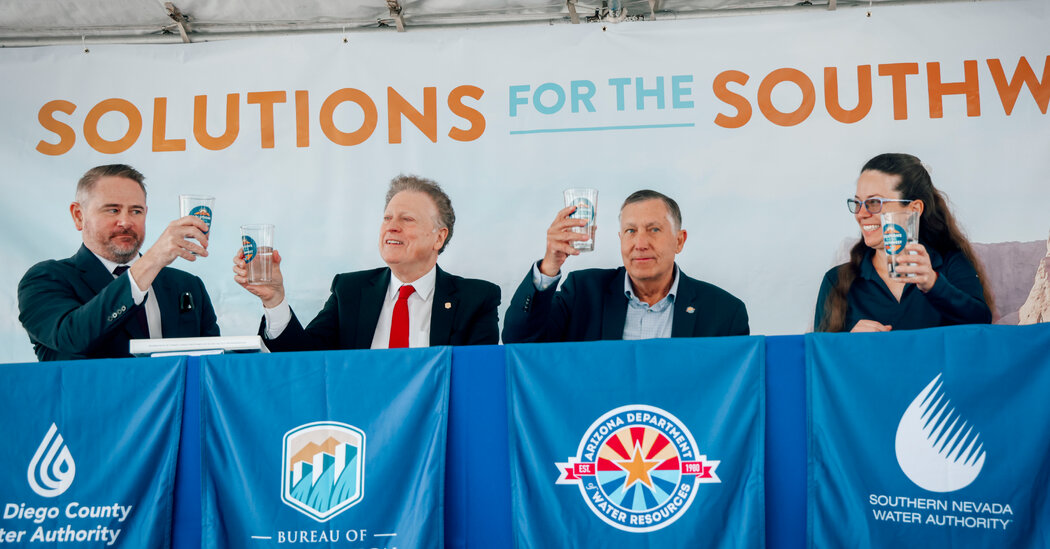
San Diego could sell some of its rights to Colorado River water to Arizona and Nevada under a deal struck Wednesday that could help parched inland states fill a widening gap between water supply and demand.
The San Diego County Water Authority now has a water surplus thanks to a desalination plant the utility opened a decade ago after facing shortages of its own. Water wouldn’t physically move inland, but the utility wouldn’t draw as much from the river as it’s entitled to.
The deal is the first large-scale water trade between states with claims on the Colorado River — which officials said was urgently needed in light of shortages that are threatening a system of reservoirs and dams that provides water to 40 million people and 5.5 million acres of farmland across the West. Before Wednesday, the complex set of laws and court rulings that govern the use of the river’s water included no legal or practical mechanism for such swaps.
“The urgency is real,” said Scott Cameron, acting director of the Bureau of Reclamation, the federal agency that oversees water supplies and infrastructure in the West and is also a party to the agreement. “Today we are signing a short document that represents a potential great leap forward for the water security of the people of the Southwest.”
The utility and the desert states still need to iron out details over how much water San Diego County can spare, and how much Arizona and Nevada will have to pay for it. That will require lawyers to pore over more than a century of legal precedent, and water managers to negotiate even as the already scarce water supply dwindles.
“I think with the momentum we have and the situation on the river, it has to happen now — it can’t take more than a year,” said Dan Denham, the San Diego utility’s general manager. “Hydrology is not going to wait for us.”
The Colorado basin is facing its most dire outlook in decades of drought after a winter with the smallest mountain snowpack ever observed, which melted rapidly this spring. Flows into Lake Powell, one of two huge reservoirs along the Colorado, are forecast to be 13 percent of normal this year.
Across the Southwest, some towns are warning residents they could soon run out of water, but in many communities, rationing has been patchy despite grim forecasts.
The seven states that rely on Colorado River water — California, Arizona, Nevada, New Mexico, Utah, Colorado and Wyoming — are struggling to agree on how to share the pain of water use cuts after failing to reach a deal by a Feb. 14 deadline imposed by the Bureau of Reclamation. A new federal plan for the watershed’s future is expected in July, Mr. Cameron said.
A second consecutive dry winter could send water levels in Lake Powell and Lake Mead next year to their lowest readings since the reservoirs, the nation’s largest, were first filled to capacity in the 1980s, according to a paper scientists published Monday. That could wipe out usable water storage and risk damage to dam and hydroelectric infrastructure.
The prospect is heightening urgency for creative solutions such as desalination and wastewater recycling. New water recycling projects are underway in Utah, Arizona and Southern California — including one in the Los Angeles area that received $12 million in investment from Arizona and Nevada in 2021 and could convert sewage into enough drinking water for 500,000 homes.
But so far, the San Diego County desalination plant — in Carlsbad, north of San Diego — is the only such project to move forward. Mr. Cameron said he hoped similar plants could dot the California coast, which would require a state commission that oversees coastal development to loosen its scrutiny of such projects.
“The reality is, we’ve got a water crisis across the entire Southwest,” Mr. Cameron said. “When you’re dealing with a critical situation, you need to find paths forward that allow state and federal agencies to address the needs of the people.”
The facility, known as the Claude “Bud” Lewis Carlsbad Desalination Plant, opened in 2015 as a solution to water shortages. Now it supplies as much as 10 percent of San Diego County’s water, releasing as much as 54 million gallons each day by passing ocean water through a system of 16,000 reverse osmosis filters, said Nathan Faber, a principal engineer for the county water authority.
The sale of Colorado River water rights could help the utility recoup some of the $1 billion it cost to build the plant, which has contributed to steep annual water rate increases for the utility’s customers. Earlier this year, the utility signed similar deals to sell water to two utilities in Riverside County, Calif., a rapidly growing jurisdiction that borders the Colorado River.
New water supplies are perhaps most urgently needed in Arizona, which holds some of the most junior rights to Colorado River water and faces the most significant cuts in its allotments from the river. Though more work remained to iron out water exchanges, the collaboration formalized Wednesday was “a great first step,” said Brenda Burman, general manager of the Central Arizona Project, a system that delivers Colorado River water to Phoenix and other communities.
“Good partners build good solutions,” Ms. Burman said.

