
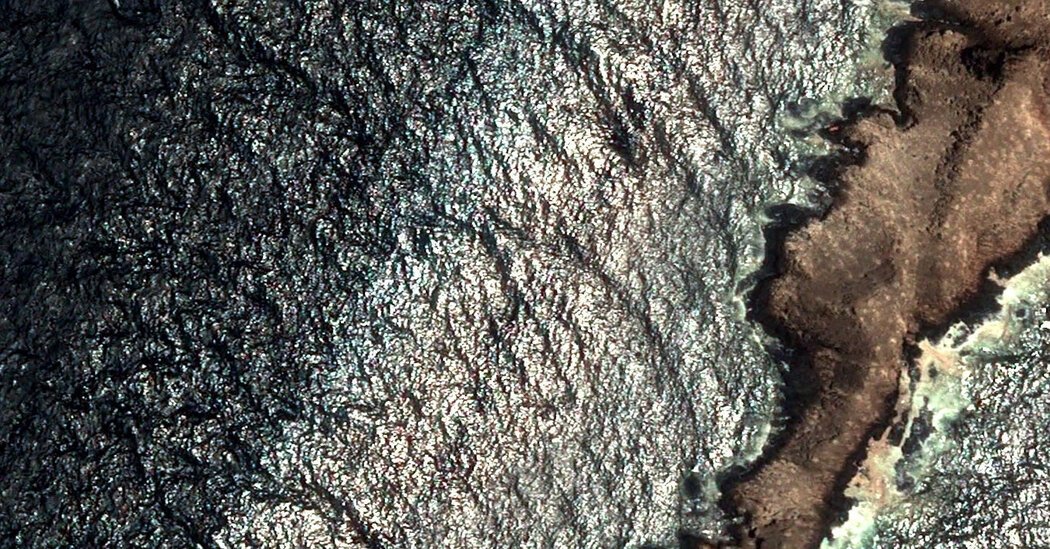
An oil spill from a Russian shadow fleet tanker that ran aground two months ago has spread its long, black tongue across a remote, ecologically sensitive swath of the Arabian Sea, according to satellite data and statements from Oman’s government.
The spill has encircled the rocky cliffs of an Omani island, Jazirat al Qibliyah, that is home to a range of endangered seabirds, and spread to a 25-mile stretch of beach on the mainland, called Ras Madrakah, Oman’s environmental agency said Wednesday in a statement carried by the state news agency.
A British maritime disaster management company, called Ambrey, has been hired to rescue the tanker and stop the spread of the spill, according to the company. “This is an extremely challenging situation, compounded by adverse weather conditions,” said Ed Wollaston, director of global response at Ambrey.
The spill compounds the environmental consequences of three widening, overlapping conflicts that have made oil and gas infrastructure targets of war in recent months. Russia and Ukraine have attacked each other’s energy facilities. In Yemen, the Houthi militia has attacked oil tankers tied to Saudi Arabia. And the United States and Iran have attacked oil installations and tankers in and around the Strait of Hormuz.
Several oil spills have been detected from satellite images in the strait, including a fairly significant one off Iran’s Kharg island, according to Brian Barnes, a geographer at the University of South Florida. None of them are anywhere as large as the massive spills of the 1991 Gulf war, when Iraqi forces set ablaze hundreds of oil wells and caused one of the world’s worst environmental catastrophes, which took years to clean up. But swift cleanups are impossible with the ongoing conflict, and even the ecological impacts of the spills are hard to gauge at the moment.
“Satellite observations are great and can tell us a lot,” Mr. Barnes said. “But we don’t have the capacity to go out and see.”
On Tuesday, Iranian state media posted images of oil contamination spreading to Qeshm Island, including an area, known as Shib Deraz, where the rare hawksbill sea turtle nests every spring. Iranian government officials have said nothing about the cause of that spill.
Part of Russia’s shadow fleet
The spill in Omani waters appears to be among the largest of several in the waterways of the Middle East. Estimates vary widely on the scale of the contamination, and what caused it in the first place remains a mystery. All that is certain is that Oman’s government has been forced to respond, because the tanker crashed into the rocky shoals of Qibliyah on a windy day in June.
It seems to have had little to do with Oman, or the conflicts in the region.
The tanker, known as the Caroline Bezengi, is about 900 feet long and capable of carrying nearly a million barrels of oil. It had been used for the last couple of years to ferry Russian crude oil to refineries in Asia, according to TankerTrackers.com, a company that monitors global oil shipping.
In the past, it was flagged under Cameroon. Its managing agent was a firm registered in Cyprus, called Lagosmarine, which was under sanctions by the United States and European Union for helping finance Russia’s war in Ukraine.
Since May, 2023, it had made 12 trips from ports in Russia to ports in India and Pakistan, and once to China, according to logs kept by TankerTrackers.com. In 2025, its crew had complained of not being paid for months, the Seafarers Union of Russia told Russian media outlets.
Its latest journey began on May 13 from the Russian port of Novorossiysk, on the Black Sea, according to TankerTrackers.com. It was headed for Sikka, a port on the western coast of India that serves the world’s largest refinery complex, near Jamnagar.
India, which has not signed on to Western sanctions imposed after Russia’s invasion of Ukraine, has instead sharply increased its purchase of Russian oil since that war began in 2022.
India’s growing economy needs a lot of oil, and its refineries, including the Jamnagar complex, have made a thriving business from exporting refined products to fuel-hungry countries.
Running aground at sea
The Caroline Bezengi did not reach India this time.
On June 6, the ship encountered “an incident” outside Oman’s territorial waters, the head of the country’s Environment Authority, Abdullah Bin Ali Al Amri, said in an interview on Oman TV.
Whether the incident was caused by malfunctioning equipment on the ship or by an attack remains unknown. No party has accepted responsibility.
By June 21, according to the Omani government, the ship ran aground on the rocks of the Qibliyah Island. “Reconnaissance measures were taken to inspect the ship’s safety, and indeed, at that time, there was no noticeable oil spill,” Mr. Al Amri said in the television interview.
By late July, there was a noticeable spill. By early August, it had spread.
Oman’s Environment Authority said this week that the slick covers around 390 square kilometers.
Greenpeace said that by Aug. 4 it had covered 600 square kilometers, a fourfold increase in just two days. “The situation surrounding the tanker Caroline Bezengi is yet another alarming example of the serious environmental risks posed by Russia’s so-called shadow fleet,” the organization said in a statement.
John Amos, head of an organization called SkyTruth, which uses satellite imagery to track oil contamination, estimated the coverage area to have grown to roughly 2,200 square kilometers. He said the Omani government’s estimate appears “far too low.”
Mr. Amos said if all of the Caroline Bezengi’s oil leaked, the spill would be comparable to the Exxon Valdez disaster, one of the worst spills in American history that killed hundreds of thousands of seabirds, otters, seals and whales.
A headache for Oman
Ambrey, the maritime response firm, said in a statement to The New York Times that it was working with the Omani air force to stabilize the ship, and that ships to help with the salvage operation were en route.
Shadow fleet tankers are often uninsured, and shipowners rarely come forward. Oman is left with the task of monitoring and stanching the damage. The Environment Authority, in its latest statement on Monday, said the slick was advancing quickly in a northeasterly direction.
It said it was trying to protect the most environmentally sensitive areas. “Efforts are being directed towards identifying zones most vulnerable to impact and correlating them with pollution drift trajectories, with particular emphasis on areas of high ecological value and sensitivity,” the ministry said.
Zane Irwin and Ismaeel Naar contributed reporting

